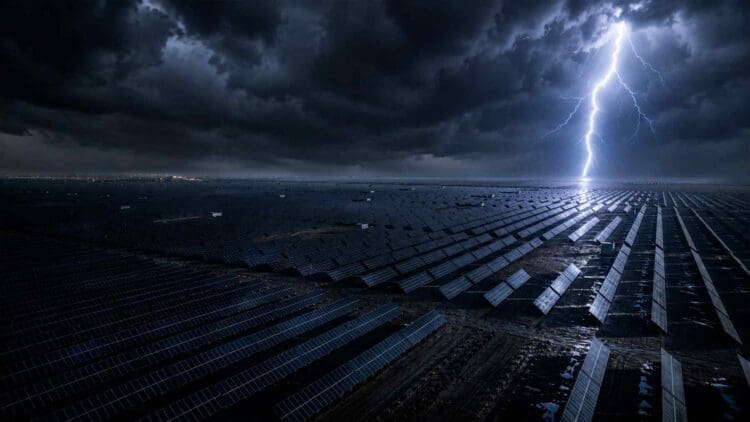

Across Rajasthan, recent storms left behind a telling scene: solar panels bent out of shape, frames torn loose, modules detached from rooftops entirely. For an industry that has made India one of the world’s fastest-growing solar markets, the images were a quiet alarm.
The damage wasn’t an isolated episode. As installations multiply — driven by rooftop subsidies, open-access policy, and surging commercial demand — a pattern is emerging that the industry can no longer ignore: capacity is scaling faster than the durability standards meant to hold it all together.
When the wind hits: storm damage exposes a structural weak point
The Rajasthan storms didn’t just damage panels — they pointed to something deeper. Industry experts have identified aluminum frames as a key structural vulnerability in solar modules, particularly under high-wind conditions. When gusts hit hard enough, those frames bend, tear, or fail to hold modules in place. The result is the kind of damage that has been appearing with uncomfortable regularity.




Rooftop solar has grown quickly, and that growth has been uneven. Government subsidies accelerated adoption faster than quality oversight could follow in some regions. Installations went up; inspection and enforcement did not always keep pace. Whether current installation standards — designed for a different scale of deployment — are adequate for the climate realities India’s solar infrastructure actually faces is now an open question.
The concern is not hypothetical. It’s visible in the wreckage left behind after each major weather event.
A procurement rethink: quality and compliance move up the priority list
The industry is responding. Engineering, procurement, and construction contractors and developers are updating how they approach projects, with durability moving higher on the checklist. Procurement decisions are shifting toward domestic manufacturers and toward compliance with India’s Approved List of Models and Manufacturers — the ALMM.
The ALMM framework exists precisely to establish baseline standards. Closer alignment with it signals that buyers are prioritizing reliability over the lowest upfront cost — a meaningful shift in a market where price pressure has historically been intense. Commercial, industrial, and open-access segments are all expanding rapidly, and each new project is a long-term asset. Getting the procurement decision right at the start matters more when that asset is expected to generate returns over two decades.
Capacity keeps climbing: major tenders signal an industry in full expansion
Even as the durability conversation intensifies, the scale of new development makes clear that India’s solar expansion is not slowing down. NTPC Renewable Energy has issued EPC tenders for two large projects in Rajasthan: a 240 MW installation near Devikot and a 550 MW project near Shimbhoo Ka Bur, both carrying bid deadlines of June 26, 2026.
Maharashtra’s electricity regulator approved a 2,500 MW round-the-clock renewable energy procurement for the state distribution company, setting a tariff of ₹5.90 per kWh. That is a significant long-term commitment. Large institutional buyers are locking in renewable supply at scale.
Inox Clean Energy signed a definitive agreement to acquire Vena Energy India’s 6 GW renewable portfolio — including 1.2 GW of operational assets, 1.8 GW nearing commissioning, and 3 GW under development. Deals of this size reflect deep confidence in the sector’s trajectory. The urgency around durability standards is inseparable from all of this: the more capacity that gets built, the more consequential the structural choices become.
Regulatory signals: grid rules, tax changes, and must-run mandates reshape the landscape
Regulators are adjusting to the new scale of deployment. Tamil Nadu’s electricity regulator mandated that renewable energy stations be treated as must-run, meaning curtailment is only permitted for grid security reasons. That protection matters — curtailment risk has long been a source of financial uncertainty for developers, and removing it changes the calculus on long-term project viability.
In Rajasthan, the electricity regulator ruled that the GST reduction on renewable energy devices — from 12% to 5%, effective September 2025 — qualifies as a change-in-law event under existing power purchase agreements. By applying regulatory symmetry, this ruling requires developers to pass the resulting capital savings directly through to distribution companies and end consumers. Clearer rules on grid dispatch and contract terms lower the risk profile for buyers and make long-term investment more predictable.
Beyond India: a global supply chain takes shape
India’s durability challenge is unfolding against a broader shift in how the global solar supply chain is being structured. Australia is evaluating a 50,000-ton-per-year solar-grade polysilicon facility at the Hunter Energy Hub in New South Wales, supported by the Australian Renewable Energy Agency. If built, the plant could supply enough ultra-pure polysilicon to support approximately 27 GW of solar module manufacturing annually.
Separately, Telecommunications Consultants India is seeking partners to install 645 solar systems across 16 regions of Ghana, totaling 31,210 kW — a project whose geographic spread illustrates how solar deployment is reaching entirely new markets.
Both developments point to a global effort to diversify manufacturing and reduce dependence on concentrated supply chains. For India, a more diversified global supply base could eventually mean more options — and more leverage — when specifying the quality standards its expanding market demands. The industry has built fast. Now it has to build better, and the regulatory, procurement, and supply chain conditions to do exactly that are beginning to fall into place.