
We thought solar plants were bad for birds until one site turned into a refuge for larks, with dozens of families now raising chicks beneath the panels
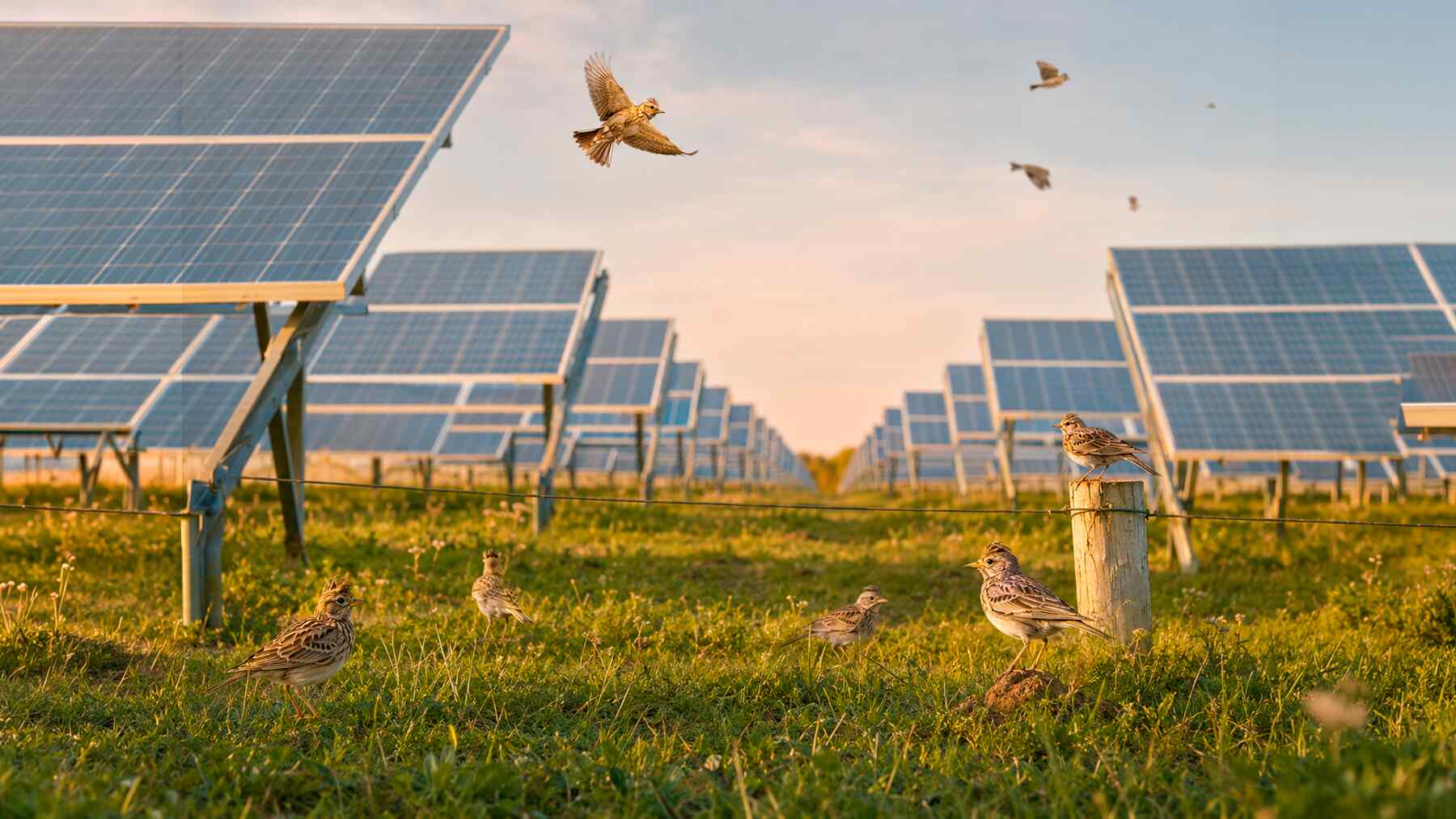 Credits: Edited, representative image
Utility-scale solar plants can be transformed into wildlife havens – if managed responsibly.
The global green energy transition requires rapid deployment to meet fast-approaching targets.
However, conservationists are concerned about this unprecedented capacity growth’s impact on local ecosystems.
Her work focuses on making complex topics accessible, informative, and relevant for readers across different areas of interest.
Yet, one solar plant proved that the opposite was true when the lark population began to increase.
Will this site serve as a blueprint for future facilities that aim to become nature sanctuaries?
How approaching deadlines drive accelerated capacity
Major international climate targets now have rapidly shortening timelines.
The most critical deadline is 2030.
Globally, climate agreements mandate that renewable energy capacity must triple to 11,000 GW.
Meeting this goal is important to prevent global warming from increasing outside safe margins.
Likewise, individual nations have enforced their own legally binding targets.
India is targeting 500 GW of carbon-free capacity by 2030. Concurrently, the European Union aims for a 45% renewable energy share.
However, to meet these fast-approaching targets, renewable infrastructure must scale significantly.
Rapid, large-scale deployment is the only viable way forward to net-zero.
Solar energy is the essential driver of the clean energy tech growth.
Utility-scale arrays are extremely fast to construct, highly cost-effective, and have predictable scalability.
The International Energy Agency predicts that solar capacity will account for 80% of new global additions.
But for this to be true, developers must first lower solar’s ecological impact.
Rising ecological concerns over solar footprint
Large-scale solar projects have a major physical footprint. This increases the concerns among environmentalists.
The more arrays that can be installed, the greater the plant’s power output will be.
But the promise of massive amounts of electricity comes at the cost of major land use.
Utility-scale projects require up to 10 acres of land per megawatt of capacity on average.
This means a 100 MW plant can displace almost 1,000 acres of natural habitat.
When massive landscapes are suddenly cleared, nature often struggles to adapt to the environmental changes.
Local wildlife is forced to face the immediate loss of critical foraging and nesting grounds.
Additionally, solar infrastructure can result in significant habitat fragmentation.
These sites usually have security fencing around their perimeters, which cuts off migration pathways.
When some species cannot access their traditional territories, it negatively impacts local biodiversity.
Fortunately, green energy expansion does not have to compromise wildlife.
An energy zone becomes a bird sanctuary
Germany’s Solarpark Weesow-Willmersdorf in Brandenburg demonstrates that solar facilities can be eco-conscious.
The German energy company EnBW developed the project, which is one of the country’s biggest large-scale solar plants.
Solarpark Weesow-Willmersdorf covers approximately 405 acres. This vast expanse of land piqued the interest of researchers in its ecological footprint.
Biological surveys unveiled an unprecedented success story.
The solar plant has become a refuge hotspot for threatened and rare bird species.
Local avian populations increased significantly. Skylarks were the primary success story of the solar plants.
Skylarks are raising their chicks at the solar plant
However, inside the solar park, between 21 and 47 breeding pairs per 25 acres were counted.
The absence of pesticides leads to an abundance of insects, turning the plant into an ideal hunting ground.
Zero human disturbance and an absence of predators increased skylark safety for nesting.
Furthermore, the panels create microclimates that diversify nesting spots and open foraging options.
The use of sheep grazing for grass maintenance is also more ideal for breeding sites.
Germany’s solar success story proves that energy production does not have to come at the expense of the environment.
By understanding the needs of local species, responsible management frameworks can be introduced.
This way, utility-scale solar plants can be transformed into sanctuaries where wildlife can thrive. Eco-conscious solar facilities prove that renewables can actively restore biodiversity while progressing climate targets.
Anke Maree is a writer with a clear and engaging editorial style. Her work focuses on making complex topics accessible, informative, and relevant for readers across different areas of interest.
