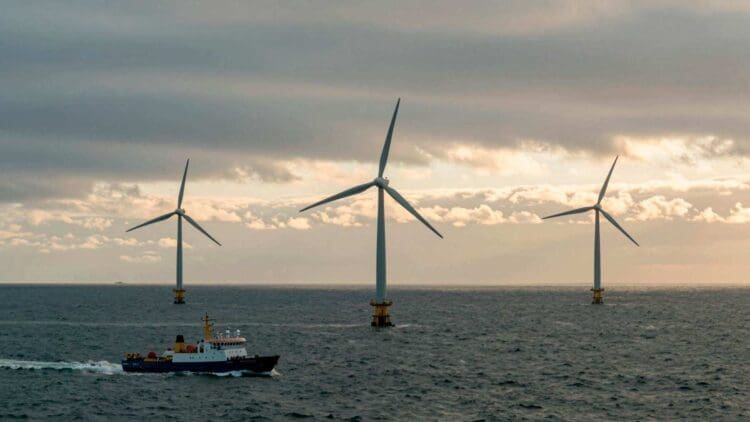

Japan and the United Kingdom have signed an Offshore Wind Compact committing Japan to facilitate up to £9 billion ($12.08 billion) in investment for 5.9 GW of floating offshore wind capacity in UK waters. The agreement was announced during Japanese Prime Minister Sanae Takaichi’s visit to Downing Street and marks one of several energy and technology partnerships the two G7 nations launched together. UK Prime Minister Keir Starmer’s office confirmed the deal over the weekend.
Compact Signed During Takaichi’s Downing Street Visit
Takaichi’s trip to Downing Street was framed around G7 partner engagements, and the Offshore Wind Compact emerged as one of the most concrete outcomes. Starmer’s office confirmed the agreement through an official statement outlining the scope of Japanese government facilitation and naming the specific projects involved.
The compact commits Japan to facilitating up to £9 billion in investment directed at floating offshore wind development in UK waters—covering 5.9 GW of capacity across three separate projects, each with Japanese corporate involvement. The deal also positions the UK as Japan’s leading clean energy partner in Europe, a designation that carries both symbolic and practical weight.



Three Floating Wind Projects Underpin the Investment
The largest share of capacity — 3.6 GW — comes from Ossian, a floating wind project planned roughly 84 kilometers off Scotland’s east coast in waters about 72 meters deep. Owned by Copenhagen Infrastructure Partners, SSE, and Japan’s Marubeni Corp., the project’s consortium estimates it could avoid up to 7.5 million metric tons per annum of carbon emissions. Ossian is currently in the study and planning stage.
Green Volt adds another 560 MW to the total. Targeted for commissioning in 2029, it is owned by Flotation Energy—a Scotland-based subsidiary of Tokyo Electric Power Co.—and Vårgrønn AS. The project already holds consent and secured a contract for difference from the UK government in September 2024. Its consortium projects it could generate 1.5 terawatt hours per year and reduce carbon dioxide emissions by around 1 million metric tons annually.
The third project, Erebus, is a 100 MW demonstration facility planned for the Celtic Sea, owned by Blue Gem Wind — a joint venture between Ireland-based Simply Blue Energy and France’s TotalEnergies. Japan’s Kansai Electric Power recently acquired a stake in Simply Blue Energy, establishing the Japanese connection. Construction is planned for 2026–27, and the project could cut carbon emissions by approximately 150,000 metric tons per year.
UK Cites Energy Security and Cost Reduction as Primary Drivers
Downing Street was direct about the policy rationale. The compact, it said, will help reduce UK reliance on volatile global fossil fuel markets—a concern that has grown more acute following energy price disruptions in recent years.
The UK government framed the deal as a long-term structural measure rather than a reaction to any single market event. Expanding homegrown clean energy is presented as a sustained policy goal, with expected outcomes that include strengthening energy security and helping lower consumer bills over time. The designation of the UK as Japan’s leading clean energy partner in Europe adds a strategic dimension, signaling an ongoing relationship rather than a one-off transaction.
Broader UK–Japan Energy and Technology Agreements
The Offshore Wind Compact was not the only significant announcement from the Downing Street meeting. Several parallel agreements extended the bilateral partnership into adjacent sectors.
Hitachi Energy committed £18 million to a purpose-built facility in Stafford, reinforcing Japanese industrial investment in UK energy infrastructure. On the nuclear side, Rolls-Royce signed a new agreement with the UK National Nuclear Laboratory to develop next-generation nuclear technologies in collaboration with Japan’s Atomic Energy Agency. Fusion energy also featured in the announcements — the UK Atomic Energy Authority and Japan’s National Institutes for Quantum Science and Technology agreed to collaborate on fusion research, building on a separate agreement between Japan’s Furukawa Electric and Britain’s Tokamak Energy to explore options for a new fusion research and development facility in the UK.
Rounding out the day’s announcements, the two countries formed a Frontier Tech Partnership spanning AI, quantum computing, civil nuclear, and defense technology. Downing Street described it as a framework to translate British research into scalable technology with Japanese investment.
5.9 GW of Capacity on the Way
The Offshore Wind Compact commits Japan to facilitating up to £9 billion in investment across Ossian, Green Volt, and Erebus—three floating wind projects totaling 5.9 GW of capacity. The UK government’s stated goals are energy security and lower consumer bills. Alongside the wind deal, the two countries announced nuclear, fusion, and frontier technology partnerships, reflecting a broad expansion of the UK–Japan bilateral relationship well beyond any single sector.
Kelly is an experienced writer with 15 years of experience exploring the big stories that shape our world, from tech breakthroughs and space exploration to climate, energy, and the fascinating quirks of science. She has a talent for turning complex ideas into sharp, memorable insights that stay with readers long after they’ve finished reading.