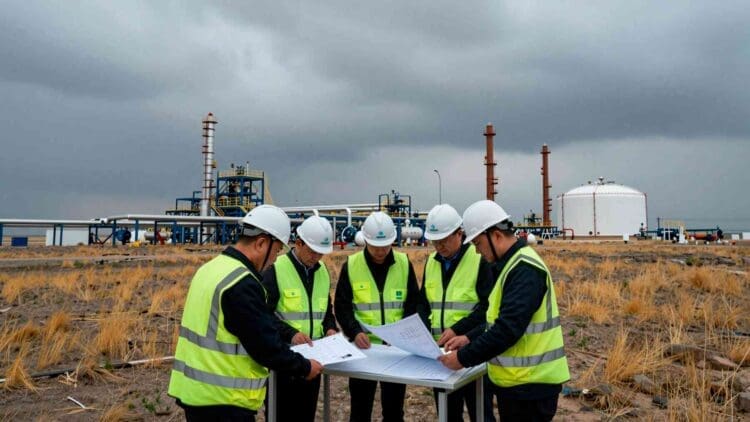

Kazakhstan has formally moved its 2.5 billion cubic meters per year gas processing plant at the Kashagan field into active implementation, with a Chinese consortium appointed as EPC contractor by governmental decree. Energy Minister Yerlan Akkenzhenov confirmed the milestone during a dedicated project meeting, signaling that one of the country’s most strategically watched energy investments has cleared the planning stage.
Kashagan gas plant moves into implementation phase
The transition was confirmed at a meeting where attendees reviewed the project’s current status, worked through coordination matters among involved parties, and discussed how to keep the facility on schedule. Minister Akkenzhenov used the occasion to underline the project’s strategic value for Kazakhstan’s gas industry.
The project carries real political weight. Akkenzhenov noted that it remains under close scrutiny from Kazakhstan’s president and government — a reflection of how seriously the country is prioritizing expanded domestic gas processing capacity. That level of oversight means the timeline will face pressure from the top.




To keep progress visible, QazaqGaz has been directed to submit monthly reports to the Ministry of Energy. Those reports are expected to detail actions taken and flag emerging challenges early enough that issues can be addressed before they compound into larger problems.
Chinese consortium named EPC contractor by government decree
The EPC contractor appointment came through a formal governmental decree. The designated consortium consists of two Chinese firms: the China National Chemical Engineering Sixth Construction Company Kazakhstan Branch and China Wuhuan Engineering Corporation Ltd. Together, they carry responsibility for the engineering, procurement, and construction of the entire facility.
The EPC model places a single contractor in charge of delivering a complete, operational plant, which can streamline accountability considerably. Rather than managing separate engineering, supply, and construction contracts in parallel, the owner deals with one primary party. Following the meeting, Akkenzhenov issued directives focused on maintaining effective coordination across the project team and meeting established timelines, cited as a clear expectation for every party involved.
Combined capacity to reach 3.5 bcm with second plant under construction
The 2.5 bcm facility is not the only gas processing project advancing at Kashagan. A separate plant with a capacity of 1 billion cubic meters per year is already under active construction at the same field, and when both come online, Kazakhstan will be able to process up to 3.5 billion cubic meters of Kashagan gas annually.
That figure represents a substantial expansion of the country’s ability to handle associated gas produced alongside oil extraction. Both projects are framed as part of a broader effort to strengthen national energy capabilities—developing domestic processing infrastructure reduces reliance on flaring or exporting raw gas and lets Kazakhstan capture more value from its hydrocarbon resources.
Kashagan field: scale and infrastructure context
Understanding the scale of these investments requires some context about Kashagan itself. According to the North Caspian Operating Company, the field holds estimated recoverable oil reserves of between 9 and 13 billion barrels, equivalent to roughly 1 to 2 billion tonnes, placing it among the largest oil discoveries made in recent decades.
The field sits offshore in the northern Caspian Sea, approximately 80 kilometers from the city of Atyrau. Despite being an offshore development, the water is unusually shallow—only about 3 to 4 meters deep—which creates its own distinct engineering challenges, quite different from those encountered in deepwater projects. The oil reservoirs themselves lie approximately 4,200 meters below the seabed, and reaching them requires substantial infrastructure spanning both offshore platforms and onshore processing complexes.
The Ministry of Energy wants monthly progress reports
Kazakhstan’s 2.5 bcm gas processing plant at Kashagan has formally moved from planning into active implementation, with a Chinese consortium—comprising the China National Chemical Engineering Sixth Construction Company Kazakhstan Branch and China Wuhuan Engineering Corporation Ltd.—appointed as EPC contractor by governmental decree.
The project operates under direct oversight from Kazakhstan’s president and government. QazaqGaz is required to submit monthly progress reports to the Ministry of Energy to keep implementation on track.
A second 1 bcm plant is already under construction in the same field. Once both facilities are complete, Kashagan’s total gas processing capacity will reach 3.5 bcm per year—a significant addition to Kazakhstan’s energy infrastructure, anchored in one of the world’s largest oil fields.
Kelly is an experienced writer with 15 years of experience exploring the big stories that shape our world, from tech breakthroughs and space exploration to climate, energy, and the fascinating quirks of science. She has a talent for turning complex ideas into sharp, memorable insights that stay with readers long after they’ve finished reading.