Globally, we have one primary goal, which focuses on our planet’s sustainability. However, it is no easy feat to rise above the occasion, as we continue to face significant challenges. Fortunately, renewable companies, such as Kitepower, prove that we may no longer need conventional wind turbines. Now, clean power can become more accessible to some of the most carbon-heavy industries and harsh, remote environments. With Kitepower, the sky is the limit when it comes to clean power.
We may no longer need wind turbines
As the world pushes for net-zero by 2050, some industries still significantly depend on fossil fuels for power production, and decarbonizing these heavy industries is no easy feat. Furthermore, some harsh, remote environments also face challenges in keeping their carbon footprints low, as access to renewable energy technologies is very limited and/or too expensive.
Take conventional wind power, for example. While wind power is an ideal power solution, as it can generate clean power day and night, conventional turbines require vast spaces of land, they contribute to noise and visual pollution, and disrupt habitats. Transport and installation also prove challenging, resulting in limited application options.

Fortunately, a Dutch company has thought outside the box and above the ground, proving that when it comes to clean power production, the sky is the limit. Find out more below.
Kitepower: It flies and produces 30kW at 1,300 feet
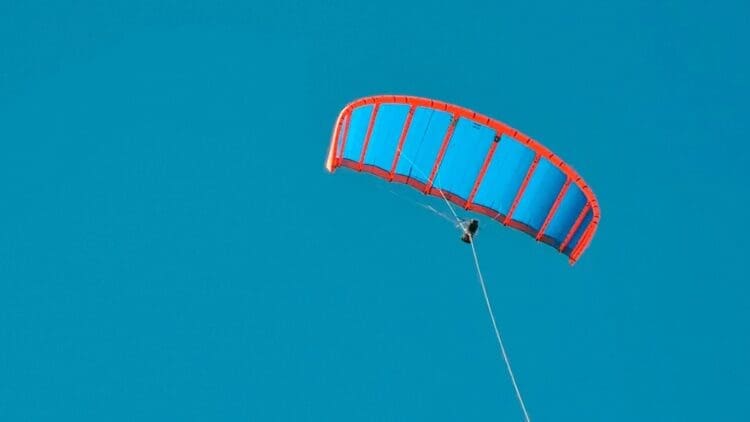
The wind power industry has been introduced to some unique designs in the past, such as the ‘green pod’ wind turbine that produces energy even during snowfall. Just as we think that we’ve seen it all, the Dutch company called Kitepower introduces the Hawk to the world. The Hawk is a pioneering and portable energy solution that proves that anyone can access clean power.
Kitepower’s Hawk kite system is a cost-effective alternative to conventional wind turbines, producing clean power at lower wind speeds compared to conventional systems. The Hawk can also operate in stronger wind speeds at significantly high altitudes. The system consists of:
- An optional battery to store excess energy
- A ground station that converts the kinetic power into electricity and reels the kite in
- A Dyneema tether that acts as a lightweight and strong connection between the kite and the ground station
- A kite control unit (2km wireless range)
Floating versatility in wind power
Kitepower’s floating power offers high versatility in application, as its benefits are useful for:
- Hybrid systems to save diesel and costs for off-the-grid applications
- Remote construction sites to decrease congestion and increase sustainable energy usage
- Agricultural applications, as farmers can produce clean power, sell excess energy as a “cash crop,” and avoid acoustic and visual pollution
Specifications of the Hawk
- 30 kW rated power output
- Operates for 10 hours per charging cycle
- 400 kWh battery (optional)
- 25 years of lifetime for the ground station
- 110 km/h average kite flight speed
Kitepower offers other benefits as well, including:
- A plug-and-play setup, with installation in less than 24 hours and ‘out-of-the-box’ operations
- Stable power production
- Easy global transportation
- Easy deployment in harsh, remote environments
- Clean power production 24/7
- Maximized power production compared to solar panels and wind turbines
- Up to 90% less material utilised
- A renewable alternative to diesel generations
- Incentive programs and tax incentives
- Decreased carbon footprint
In conclusion, Kitepower’s Hawk kite system may be the clean power solution that you have been searching for, especially if its application is needed in a very harsh, remote location. The Hawk can be rented from Kitepower for a period of 6 to 12 months. When it comes to kite power, the sky is indeed the limit. Another innovative flying wind turbine design by KiteKRAFT offers 100 kW of endless, clean wind power. Before we know it, the skies will be filled with wind kites producing power all over the world.
Disclaimer: Our coverage of events affecting companies is purely informative and descriptive. Under no circumstances does it seek to promote an opinion or create a trend, nor can it be taken as investment advice or a recommendation of any kind.