
Just millimeters above every ocean wave, a razor-thin layer of air controls how heat, momentum, and greenhouse gases move between the sea and the sky. Scientists have long known this invisible frontier exists — and long struggled to study it. No instrument had ever mapped it directly, at scale, over open water.
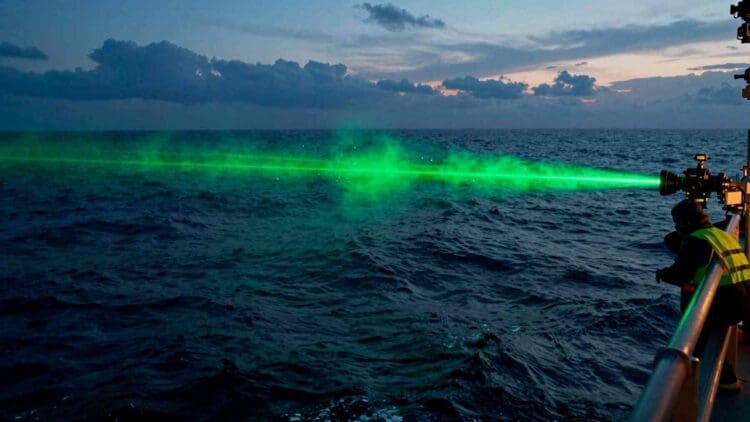
That changed aboard FLIP, a research platform that drifted in the Pacific, where a green laser beam cut through artificial mist hovering just above the waves. What it captured had never been seen before — and turned out to be more complicated than the prevailing models assumed.
A laser beam where no instrument has gone before
The team behind this work was led by Dr. Marc Buckley of the Helmholtz-Zentrum Hereon Institute of Coastal Ocean Dynamics. Operating from FLIP — the currently retired Floating Instrument Platform — they deployed a custom laser measurement system over open Pacific waters. Their method was Particle Image Velocimetry, or PIV, a technique well established in laboratory fluid dynamics but never before applied over the open ocean.




The setup followed a straightforward logic. A green laser beam passed through water droplets introduced into the air just above the waves — mist caught in a shaft of light. Those droplets tracked the airflow precisely, scattering laser light and rendering even the smallest movements visible. The laser also penetrated the water surface itself, where refraction exposed the wave structure below.
What emerged was a simultaneous, high-resolution picture of both air and water — from a few millimeters above the surface to roughly one meter up. No instrument had mapped this zone directly, at this scale, over real open water before.
Two mechanisms, one wave field
The imagery revealed something the researchers did not fully anticipate. Two distinct energy-transfer mechanisms were operating at the same time — but in opposite directions, depending on wave size.
Short waves, roughly 3.2 feet in length, travel more slowly than the wind above them. Their crests act as obstacles, disrupting airflow and generating pressure differences that push energy from wind into wave. The concept was established in theory; seeing it directly, at this resolution, was new.
Long waves tell a different story. Stretching up to 100 meters, they move faster than the wind. Rather than being driven by it, they reshape the airflow through their own motion, producing distinct flow patterns that work in the opposite direction.
The key finding is not that each mechanism exists — it is that both operate simultaneously within the same wave field. Different parts of the ocean surface were doing different things at the same time, a level of complexity that had never been directly observed. That has real consequences for how scientists construct their models.
Why this thin layer of air matters so much
The air-sea interface is one of the most consequential boundaries on Earth. It governs the exchange of heat, momentum, and greenhouse gases — including CO₂ — between ocean and atmosphere, shaping sea state, influencing weather systems, and feeding into the long-term behavior of the global climate.
Despite that significance, the precise mechanisms controlling these exchanges have remained largely unmeasured. Scientists have relied on theoretical frameworks and indirect data for decades. As Dr. Buckley noted: “Until now, no one has measured the airflow this close to the ocean surface, let alone mapped the mechanisms of energy exchange at such a fine scale.”
Marine biochemistry connects to these dynamics as well. How gases cross the ocean surface depends on turbulence and flow patterns within this millimeter-thin layer. More precise data here could sharpen estimates of how much CO₂ the ocean absorbs — a figure central to climate projections.
From observation to better climate models
These findings do more than describe what happens above the waves. They supply empirical data to anchor the theoretical framework for air-sea exchange — one that, until now, has rested on incomplete foundations.
The research was published in Nature Communications and involved collaboration across multiple international institutions. That breadth matters: incorporating these mechanisms into operational climate and weather models will require wide scientific engagement and sustained refinement over time. It is not a problem any single team solves alone.
The team is already planning a next phase, intending to extend the PIV system to capture subsurface water movements with greater precision. Pairing what happens just above the surface with what happens just below it could close one of the remaining significant gaps in air-sea interaction science — two complementary views of the same boundary, finally seen together.
Reducing uncertainty in climate projections is incremental work, built on measurements like these. But with a laser and a drifting platform, this team may have given modelers the direct observations they have long needed.