
Study finds mesoscale wind models underestimate internal wake power losses at US East Coast offshore wind farms
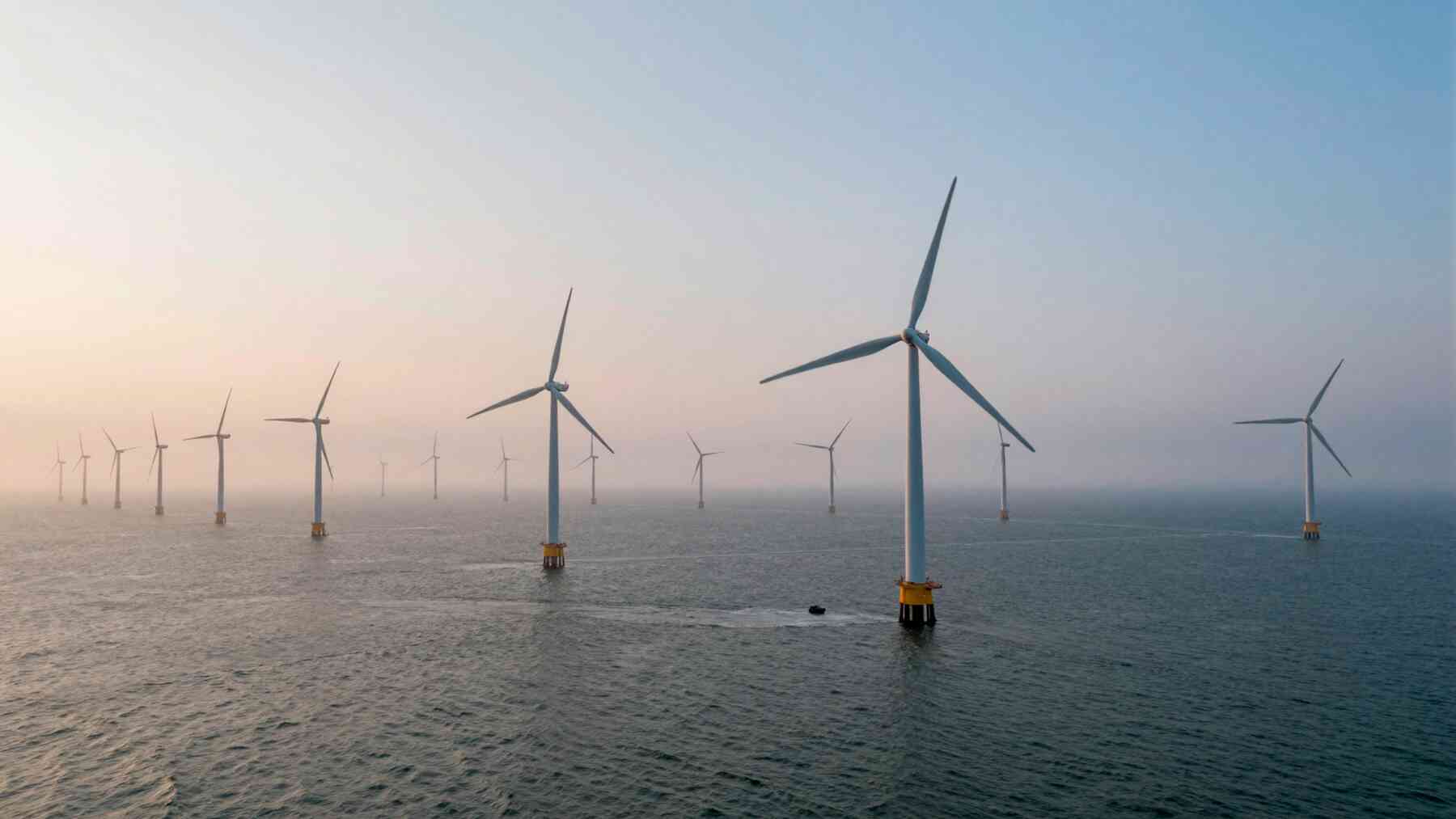 AI-made
Mesoscale weather models are widely used to estimate energy losses from wind farm wakes — but a new peer-reviewed study suggests they may be missing a critical piece of the picture.
Published in Wind Energy Science, the study compared mesoscale Weather Research and Forecasting (WRF) simulations against large-eddy simulations for three planned offshore wind farms off Rhode Island and Massachusetts: South Fork, Sunrise Wind, and Revolution Wind. While the mesoscale model reliably captured broad wake velocity deficits between farms, it systematically underestimated power losses occurring within them — a gap with direct implications for how developers and planners assess offshore wind energy output.
Study Compares Two Modeling Approaches for Offshore Wind Wakes
Researchers at the National Renewable Energy Laboratory and collaborating institutions ran both mesoscale WRF simulations and large-domain large-eddy simulations (LES) for the three planned farms. Together, South Fork, Sunrise Wind, and Revolution Wind represent a combined nameplate capacity of 1.76 GW, using 11 MW turbines. South Fork and Revolution Wind sit roughly 10 km downstream of Sunrise Wind along the predominant southwesterly wind direction — making the cluster a natural test bed for studying both internal and inter-farm wake effects.
One complicating factor: numerical discretization caused the mesoscale model to incorrectly wake non-aligned neighboring turbines in certain wind direction sectors.
To reflect realistic operating conditions, the team selected five simulation cases spanning a range of atmospheric stability, from weakly unstable to weakly stable, drawn from 20-year climatological data for the region. Funding came in part from the US Department of Energy and the Bureau of Ocean Energy Management.
Mesoscale Grid Resolution Limits Ability to Resolve Individual Turbine Wakes
Grid spacing is a core limitation of mesoscale models. The WRF simulations here operated at approximately 1 km resolution — far coarser than the 206-meter rotor diameter of the simulated turbines — meaning the model simply cannot resolve the wake trail left by a single machine.
That coarse grid also introduces a positional problem: turbine locations in the mesoscale simulation were displaced an average of 400 meters, roughly two rotor diameters, from their actual positions. The shift alters effective turbine alignment and spacing, adding further uncertainty to internal wake estimates. Under stable atmospheric conditions, individual turbine wakes persist over long distances and directly affect downstream turbines in ways the mesoscale model cannot capture.
Instead of resolving discrete wake structures, the model relies on the Fitch wind farm parameterization, which treats turbines as a distributed momentum sink and a source of turbulence kinetic energy across a grid cell — smoothing out exactly what LES resolves explicitly.
Internal Wake Losses Underestimated; Cluster Wake Velocity Captured Reasonably Well
The performance gap becomes stark at the turbine level. For the most aligned wind direction sector, internally waked turbines in the LES generated 37% less power than front-row turbines on average. The mesoscale simulation showed only a 16% reduction — less than half the loss captured by the higher-fidelity model.
Cluster wakes told a different story. When turbine arrays were spaced more than 50 rotor diameters apart, mean normalized power differences between the two approaches stayed within 2 percentage points. Velocity deficit downstream of the farms was also well captured, with a mean root-mean-square error of approximately 5%. The mesoscale model correctly reproduced stability-driven differences too: narrower, faster-recovering wakes under unstable conditions and broader, longer-lasting wakes under stable ones.
One complicating factor: numerical discretization caused the mesoscale model to incorrectly wake non-aligned neighboring turbines in certain wind direction sectors. This introduced spurious power losses that partially offset underestimates elsewhere — sometimes producing accurate combined wake loss figures, but for the wrong reasons.
Implications for Offshore Wind Energy Planning and Model Use
The findings raise questions about mesoscale-only modeling frameworks currently used to estimate energy yields for large-scale US offshore wind deployment. Internal wakes typically account for the largest share of power losses within a wind farm, and the study indicates mesoscale models may substantially undercount them.
The authors note that mesoscale simulations may still yield accurate combined wake loss estimates across some wind direction sectors, if underestimates and overestimates happen to cancel out. That outcome, however, depends heavily on wind rose characteristics and farm layout — an unreliable foundation for planning decisions. The study calls for hybrid approaches pairing mesoscale simulations, which handle long-range cluster wake propagation efficiently, with LES or other high-fidelity methods capable of resolving turbine-level internal wake dynamics.
These limitations are not specific to offshore environments. They are intrinsic to the mesoscale modeling framework itself, which means they apply equally to onshore wind farm energy assessments using similar tools.
A 16% Modeled Loss Against a 37% LES-estimated Loss
WRF simulations reliably capture broad wake velocity deficits downstream of single and multiple offshore wind farms, with mean errors near 5%, and correctly represent how atmospheric stability shapes wake recovery. The internal wake problem is where they fall short — particularly when turbines align with the prevailing wind direction under stable stratification. The gap is substantial: a 16% modeled loss versus a 37% LES-estimated loss in the most aligned conditions. Cluster wake effects are better represented when inter-farm spacing exceeds 50 rotor diameters. Underlying all of this is the model’s 1 km grid spacing, which cannot resolve individual turbine wakes and introduces position errors of roughly two rotor diameters. These are structural constraints, not regional ones — onshore assessments face the same problem.
Kelly is an experienced writer with 15 years of experience exploring the big stories that shape our world, from tech breakthroughs and space exploration to climate, energy, and the fascinating quirks of science. She has a talent for turning complex ideas into sharp, memorable insights that stay with readers long after they’ve finished reading.
