
Australian engineers borrowed a speargun to solve one of offshore wind’s most expensive unsolved problems
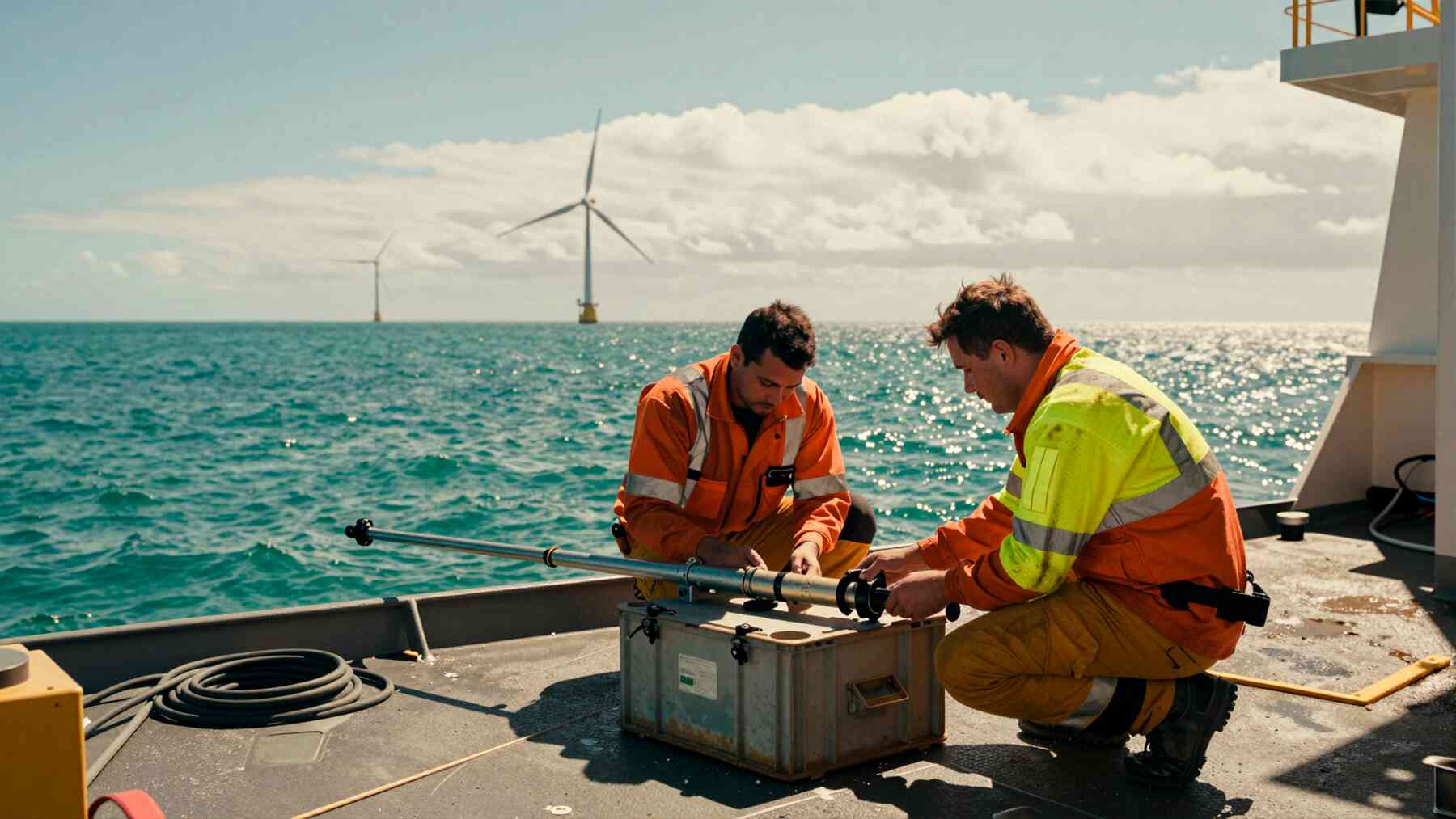 AI-made
Somewhere between a beach sport and a billion-dollar engineering problem, a team of Australian researchers found an unlikely answer. Their tool of choice: a modified speargun.
Offshore wind turbines need to be anchored into the seabed — and before that can happen, engineers must understand exactly what lies beneath the seafloor. In the shallow coastal waters where many wind farms are planned, that’s proven surprisingly difficult and expensive to do well. Existing lightweight probes often can’t penetrate the sandy bottom effectively, while the heavy-duty alternatives can run up to AU$200,000 a day.
Researchers at RMIT University think they may have found a better way.
It slows site investigations, limits how many tests engineers can actually run, and adds uncertainty to the foundations of structures designed to stand for decades.
A seabed problem that’s costing the wind industry millions
Offshore wind turbines don’t simply sit on the ocean floor — they’re anchored into it. Getting that right requires detailed knowledge of the soil below, and in the shallow coastal waters where many planned wind farms will be built, that knowledge doesn’t come cheaply.
Standard lightweight penetrometers, dropped or winched from a vessel’s deck, frequently fail to push far enough into dense, sandy seabeds. They depend on gravity, and gravity isn’t always sufficient. The heavier, more capable probes carry a steep price: up to AU$200,000 per day in vessel and equipment costs alone.
That expense does more than strain project budgets. It slows site investigations, limits how many tests engineers can actually run, and adds uncertainty to the foundations of structures designed to stand for decades.
The speargun concept: where the idea came from
The RMIT team zeroed in on the core problem — insufficient force to drive a probe into dense sand — and borrowed a solution from an unexpected place. A speargun stores energy and releases it suddenly to propel an object forward. Applied to seabed testing, that same principle can launch a penetrometer tip into the seafloor with considerably more force than a free-fall drop generates.
Practicality shaped the design from the outset. The launching device can be adapted to existing probe equipment rather than requiring entirely new hardware, allowing engineers to retrofit current tools at minimal cost. That lowers the barrier to adoption considerably. The probes can also be retrieved and reused after each test — a “probe and go” approach that limits seabed disturbance and supports environmental compliance requirements.
What the lab results revealed
Testing took place at RMIT’s Heavy Structures Laboratory, in collaboration with researchers from the University of Melbourne. The team ran the device through multiple probe tip types across varying sand densities inside a water tank, with high-speed cameras and a full sensor array capturing penetration data throughout.
The results were notable. In high-density sandy material — the type that routinely defeats standard free-fall probes — the speargun device reached twice the penetration depth of previously reported values for freely falling probes. That’s not a marginal gain; it represents a meaningful shift in what lightweight testing equipment can realistically achieve. Those findings have since been published in the Canadian Geotechnical Journal, giving the work peer-reviewed standing in the field.
Cost savings and practical implications for offshore wind
Deeper, more reliable penetration has a direct financial consequence. When a single tool gathers better data per deployment, fewer costly alternatives are needed. Lead author Junlin Rong pointed to “significant time and cost savings” compared to existing dynamic penetrometers, and noted that the device outperforms them on embedment depth.
Traditional cone penetration testing isn’t going anywhere — it remains the industry standard for detailed site investigation, and the RMIT team isn’t suggesting otherwise. What the speargun device could realistically do is reduce how often those expensive tests are necessary, slotting into the existing toolkit rather than displacing it. The “probe and go” design also carries weight beyond cost, since minimizing seabed disturbance has become increasingly important as offshore wind projects face tighter environmental scrutiny during permitting.
What comes next: field trials and industry partnerships
Laboratory results are one thing. Performance in open water — with real currents, variable seabed conditions, and the logistical demands of offshore work — is another matter entirely. RMIT Professor Majid Nazem confirmed the device is ready to make that transition.
“We are keen to conduct field trials and collaborate with our potential industrial partners to further test its performance for offshore geotechnical engineering applications,” Nazem said.
The research was supported by the Australian Research Council and carried out with colleagues at the University of Melbourne. With peer-reviewed results in hand and that institutional backing secured, the team is now actively seeking industry partners to take the next step.
The offshore wind sector is expanding steadily across Australia, Europe, and Asia. If field trials confirm what the laboratory has shown, a modified speargun could become a standard piece of equipment for engineers working to anchor wind infrastructure into the seafloor.

Carlos is an engineer with strong expertise in technical and industrial topics. He previously worked at international companies such as Siemens and is multilingual.
