
Deep in the Mongolian steppe, China quietly switched on a 12.8 GWh battery cluster so vast that only an AI can run it
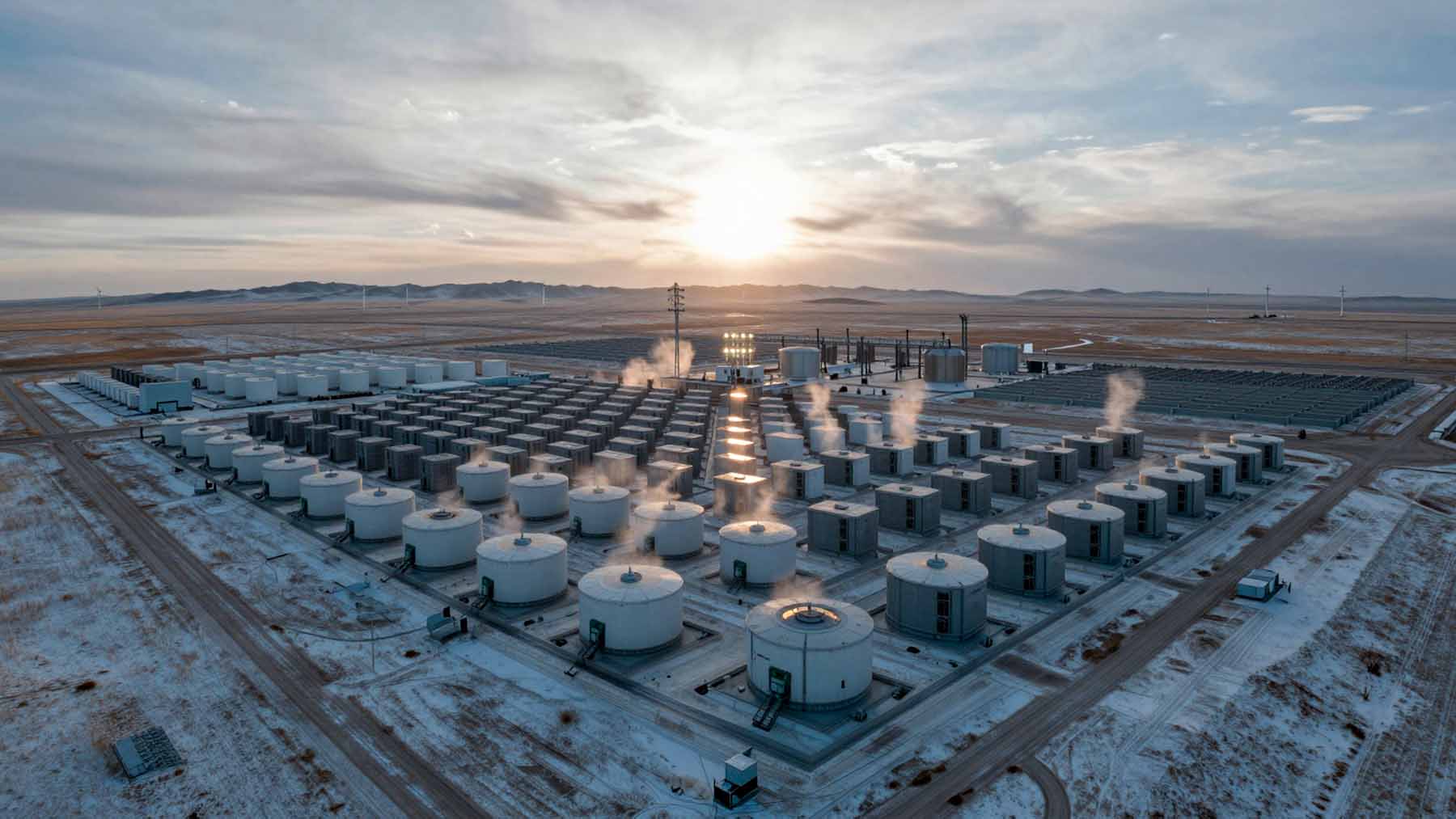 Image generated with artificial intelligence
Across the windswept grasslands of Inner Mongolia, a staggering industrial transformation just crossed a quiet threshold.
High-tech energy corridors spanning China’s remote northern frontier endured a grueling winter to bring a massive power project to full commercial operation.
Beyond the sheer physical footprint of Envision Group’s energy storage cluster lies an engineering feat built to survive subzero temperatures below 0°F.
An AI-managed battery cluster was created to guarantee continuous, zero-carbon power for the world’s most concentrated AI supercomputing infrastructure.
Yet behind the steel containers and high-voltage transmission lines sits a mystery. Why would a nation build a 12.8 gigawatt-hour (GWh) energy reservoir in the middle of nowhere—and what is it truly destined to power?
A record-setting facility comes fully online
The anchor of this massive effort, the Envision Jingyi Chagan Hada Energy Storage Power Station, recently cleared every grid verification hurdle required by regional operators. It completed three consecutive charge and discharge cycles at max rated capacity before passing a mandatory 72-hour continuous trial run in freezing winter conditions.
Holding roughly 4 GWh of capacity at a single site, Chagan Hada stands as the world’s largest single-site electrochemical energy storage facility.
To put that in an American context, this single installation packs roughly four times the capacity of California’s largest battery storage plants, such as the Moss Landing Energy Storage Facility.
Yet Chagan Hada is only one piece of the puzzle. The broader network extends across six regional hubs—Bayannur, Ordos, Hohhot, Ulanqab, Xilingol, and Alxa.
This pushes Envision’s total regional storage footprint past 14 GWh across the territory.
How AI took the wheel on grid dispatch
Managing a 12.8 GWh storage network is far beyond human capacity in a conventional control room. To manage the vast energy flows, Envision embedded self-learning artificial intelligence algorithms directly into the core battery management system.
This hands over autonomous operational authority to software without waiting for manual human sign-offs.
Machine learning models continuously track individual cell thermal performance and coordinate charge cycles based on real-time grid fluctuations. Adjustments that once took human operators minutes to process now occur within milliseconds.
Furthermore, the AI connects directly to local electricity spot markets, analyzing price trends to buy low and sell high.
Envision engineers project this predictive architecture will boost lifetime revenue by approximately 20 percent over fixed-dispatch schedules. This economic model is backed by live trading data across the regional power grid.
Why Inner Mongolia became China’s battery proving ground
Inner Mongolia was selected for strategic reasons.
The region serves as a primary clean energy powerhouse, generating wind and solar power on a scale that regularly overwhelms local power grids. Without adequate storage, thousands of megawatt-hours of clean generation are curtailed and wasted.
These utility-scale battery clusters solve the problem by capturing excess daytime solar and wind power, then discharging it during peak evening demand.
The infrastructure also stabilizes long-distance ultra-high-voltage (UHV) lines transporting power thousands of miles eastward to major urban centers.
As state-owned energy companies ramp up major lithium iron phosphate battery procurement in 2026, this northern proving ground offers a glimpse into the future of global grid management.
From grid buffer to powering AI data centers
The true strategic masterstroke—the core hook behind this colossal build—is only now becoming clear.
Envision didn’t build this mega-cluster merely to balance the regional grid. The entire 12.8 GWh system was built to plug directly into the newly commissioned Galaxy Campus in Ulanqab. This massive site is a 2-gigawatt green energy AI computing park engineered to power over one million AI hardware accelerators.
Here lies the ultimate technological loop.
An AI-managed battery cluster was created to guarantee continuous, zero-carbon power for the world’s most concentrated AI supercomputing infrastructure. When local wind power drops, the battery array steps in seamlessly.
By co-locating world-class compute with massive renewable storage, China has unveiled the ultimate blueprint for the future of artificial intelligence.
Kelly is an experienced writer with 15 years of experience exploring the big stories that shape our world, from tech breakthroughs and space exploration to climate, energy, and the fascinating quirks of science. She has a talent for turning complex ideas into sharp, memorable insights that stay with readers long after they’ve finished reading.
