
The United States lost unobligated, domestic-technology enrichment capability for national security and defense purposes in 2013, when the last gaseous diffusion plant closed. Now, more than a decade later, the federal government is moving to restore it. In August 2025, the National Nuclear Security Administration awarded a sole-source contract to a subsidiary of BWXT Technologies to advance the Domestic Uranium Enrichment Centrifuge Experiment — known as DUECE — into a full pilot plant phase, partnering with Oak Ridge National Laboratory to bring that capability back online by the 2040s.
NNSA Awards BWXT Contract for DUECE Pilot Plant
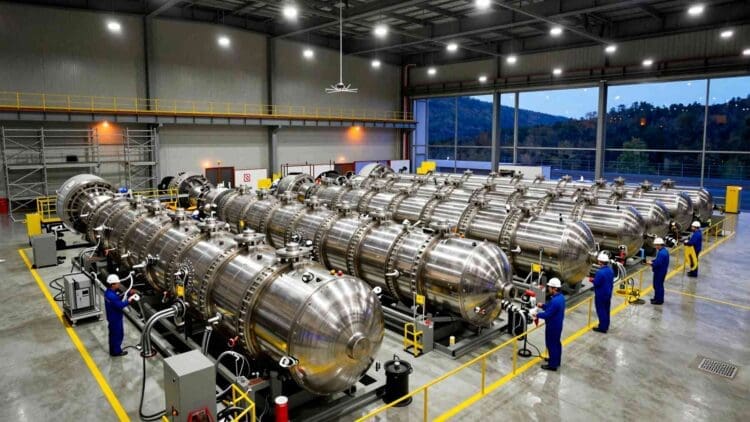
The August 2025 contract is a sole-source award, meaning NNSA selected BWXT Technologies without a competitive bidding process. That reflects both the sensitivity of the work and the specific qualifications BWXT brings to classified manufacturing and defense fuels programs. The contract tasks a BWXT subsidiary with demonstrating DUECE manufacturing and technology at the pilot plant scale.
Earlier in 2025, BWXT had already acquired 97 acres at Horizon Center Industrial Park, located near ORNL, to house its Centrifuge Manufacturing Development Facility. ORNL will serve as the long-term design authority for the Generation 1 DUECE technology — and the lab and BWXT will operate as both partners and neighbors.


Why Domestic Enrichment Capability Is Needed
The core issue is a legal one. Under international treaty obligations, uranium supplied by foreign sources cannot be used for defense-related purposes — including naval nuclear propulsion or tritium production for the nuclear stockpile. Only uranium enriched domestically, using fully domestic technology, qualifies as “unobligated” and “unencumbered,” making it eligible for those missions.
The U.S. government identified this gap in 2014, recognizing that within two decades the country would need more enriched uranium to meet nuclear mission requirements. That finding directly prompted the launch of the DUECE project in 2016. Without a domestic enrichment path, the U.S. defense nuclear enterprise faces a long-term supply problem that cannot be solved by purchasing material from allies.
DUECE Development Milestones at ORNL Since 2016
Progress since 2016 has been steady. Within four years of launch, ORNL had built a laboratory-scale cascade, successfully demonstrated the technology using uranium hexafluoride gas, and delivered a long-range R&D plan. NNSA accepted that plan by the end of 2020 and has funded ORNL annually against it ever since.
By the end of 2021, the team had a working centrifuge meeting NNSA requirements for both complexity and performance. Construction began the following year on a facility to house an engineering-scale cascade, and in 2023 ORNL settled on a final configuration for the Generation 1 design. The first formal design release followed in 2024.
The pace accelerated in 2025. Single-machine gas testing was completed, and on June 1 the Generation 1 laboratory cascade began operations — a meaningful demonstration that the technology is ready for the next phase.
Timeline to Full Deployment and What Comes Next
The path from laboratory cascade to full capability spans roughly two more decades, broken into distinct phases. Through the early 2030s, ORNL plans additional deployments of the Generation 1 machine to continue maturing the design’s Technology Readiness Level — work intended to prepare the technology for handoff to the pilot plant environment.
By the mid-2030s, BWXT plans to deploy the centrifuge into a pilot plant cascade. Full domestic uranium enrichment capability for defense needs is targeted for the 2040s, roughly consistent with the timeline the government identified as necessary back in 2014. ORNL’s role does not end there; the lab plans to apply advances in computing and materials science to develop next-generation centrifuge designs, building on what the current program establishes.
Historical Context: U.S. Uranium Enrichment from the Manhattan Project to Today
Oak Ridge’s connection to uranium enrichment goes back to 1943. Two enrichment technologies operated there during the Manhattan Project: the K-25 gaseous diffusion plant and the calutron technology deployed at what is now Y-12 National Security Complex. Gaseous diffusion proved more efficient at scale and became the dominant U.S. approach for decades.
Three large gaseous diffusion plants operated over the following half-century — at Oak Ridge, Portsmouth (Ohio), and Paducah (Kentucky). Oak Ridge ran about 40 years; Portsmouth ran just under 50. Paducah, the last to close, shut down in 2013.
Centrifuge technology was already being developed near the K-25 site during the Cold War as a potential replacement for the energy-intensive diffusion process. That work stopped in the 1980s, following the Three Mile Island disaster, the end of the Cold War, and falling global demand for enriched uranium. The market no longer justified the investment. The DUECE site at Horizon Center Industrial Park now sits on the same land as the original K-25 plant — a detail that gives the current program an unmistakable historical resonance.
From Research to Deployment
The NNSA-BWXT contract marks a concrete transition from laboratory research to industrial deployment. ORNL has spent nearly a decade developing and validating the DUECE centrifuge technology; BWXT now takes on the manufacturing and pilot plant role, with ORNL remaining the design authority for Generation 1.
The underlying driver is straightforward: treaty obligations prevent the U.S. from using foreign uranium for defense missions, and the country has had no domestic enrichment capability since 2013. DUECE is the government’s answer to that gap. If the current schedule holds, the U.S. will restore that capability by the 2040s — roughly three decades after losing it.