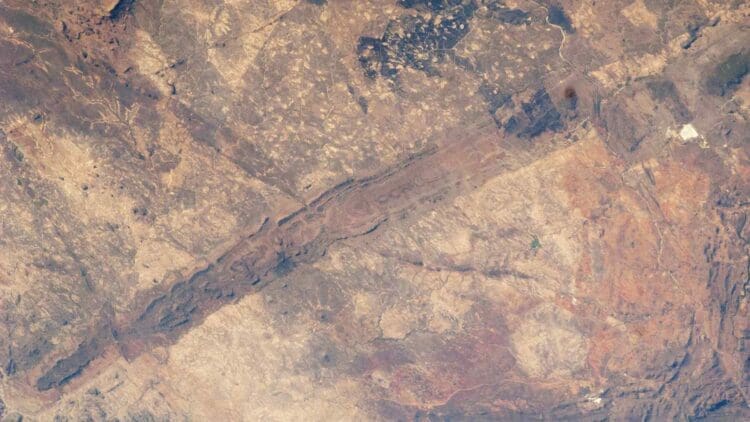

An ancient marvel that sustains several sectors and a local economy. In the past, we faced challenges to pinpoint unique structures on maps, as there were limited ways to capture complete images. Now, thanks to NASA’s space-based imaging, highly detailed images can be captured, even of ancient structures that are 342 miles long. This not only reforms perspectives about known structures, but also helps unveil hidden or long-forgotten ones. Modern technology is a wonder, isn’t it?
Reimagining landscapes and ancient formations
Before the wonders of modern technology, various methods were used to pinpoint locations and structures, making navigation a specialized skill required for travel and research. Maps were the first visual representation of geological formations and regions, with the oldest (known) map dating back over 2,500 years. The map, a Babylonian clay disk, shows the planet as a flat disk surrounded by the “bitter river,” or ocean.
The Babylonians were advanced for their time, but their early mapping techniques were mainly symbolic and limited to the region. The techniques were thus very basic, plotting measured distances of towns, geological structures, and agricultural land by using:



- Basic angles
- Ropes
- Chains
Greek insights were used to advance mapping and perceive Earth as a sphere, and thanks to the wanderlust of travelers and sailors, logs and notes were used to expand mapping details. Eventually, math, geometry, and astronomical calculations were used to plot thousands of locations and formations. Now, thanks to NASA and advanced space-based imaging, we can reimagine Earth and all its geological structures.
A 342-mile African structure older than the Americas
NASA has played a pivotal role in our modern society by increasing insights ranging from the vast energy reservoir beneath Mars’ surface to detailed scientific research of Earth and its climate. In one of NASA’s space-based images, a geological structure in an African country can be seen, and it is even older than the Americas. To put this into perspective, North and South America formed approximately 200 million and 135 million years ago, respectively.
However, this ancient structure started forming nearly 2.5 billion years ago in Zimbabwe, and is known as the Great Dyke. It is one of the longest igneous rocks on the planet, stretching over 342 miles from Zimbabwe’s northeast to the southwest, and its width ranges between 2 and 8 miles.
Geological structures such as the Great Dyke form when magma gradually protrudes from Earth’s mantle through tectonic plate faults. Zimbabwe’s Great Dyke is thus representative of Earth’s continuous and gradual evolution. However, it is also so much more.
Picturesque and of economic significance
Ancient geological structures hint at how the Earth differed geologically billions of years ago, even unveiling the events that help shape the planet as we know it today. Yet, some of these structures present other significant value to the countries they are based in, and the Great Dyke is no exception. The area is abundant in valuable minerals, such as:
- Nickel
- Copper
- Gold
- Iron
- Cobalt
- Platinum
- Chromium
The Great Dyke is exceptionally rich in the latter two, and plays an active role in the mining industry and the local economy. These minerals are also vital to the global clean energy transition, and thus attract significant international interest and investment. The U.S. has a particular strategic reliance on the Great Dyke’s minerals, especially after ranking second-to-last in critical mineral production.
NASA’s contribution to pinpointing geological structures, whether ancient or not, thus helps to advance detailed mapping for scientific research and much more. This way, structural changes resulting from environmental and human impacts can be more easily tracked, and the advanced mapping of mineral deposits will also contribute to both the mining and renewable energy industries. The U.S. is racing against time with its “doomsday vault,” which makes the latter role exceptionally pivotal.