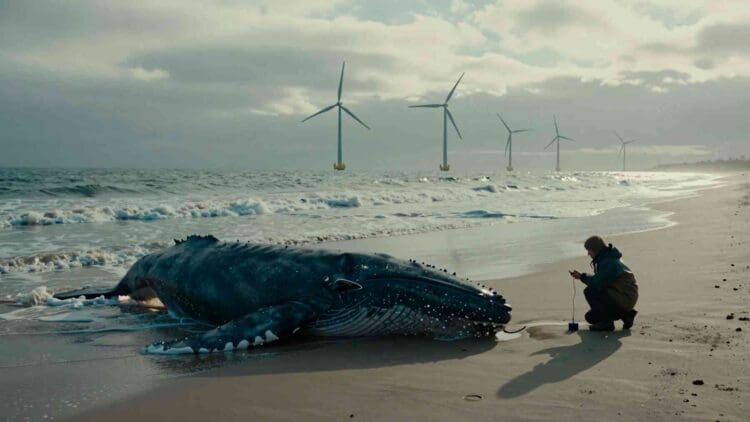

Nearly a dozen whales washed ashore along the New Jersey coast in the winter of 2022–23, just as offshore wind developers were ramping up survey work in the same waters. The timing alarmed coastal communities and sparked an immediate question: were the wind farms to blame?
Federal investigators said no. The Marine Mammal Commission reviewed the deaths and found no evidence linking them to wind energy development—most whales, necropsies showed, had died from ship strikes. But at least one researcher who studies underwater acoustics is not convinced the full story has been told.
A deadly winter on the Jersey Shore
Between December 2022 and March 2023, nearly a dozen whales died off the New Jersey coast—waters that overlap directly with several proposed offshore wind farm sites. The deaths drew swift attention from coastal residents, conservation groups, and politicians who suspected a connection to the surge in wind development nearby.



Federal investigators moved quickly to assess the situation. Necropsies on recovered whales pointed consistently to ship strikes as the primary cause of death. The Marine Mammal Commission, the federal oversight agency responsible for marine mammal protection, reviewed the evidence and concluded there was no link between the deaths and wind energy development. That finding quieted some of the alarm—but it did not settle every question.
Why ship strikes are rising — with or without wind farms
The Marine Mammal Commission noted that the number of whale deaths that winter was not statistically higher than average. Ship strikes have been climbing steadily for a decade, and the explanation is not complicated.
Commercial whaling ended decades ago, and whale populations along the East Coast have been recovering ever since. Shipping traffic and fishing activity have grown in parallel. More whales in the water plus more vessels at sea produce more collisions—a predictable, if grim, outcome. Researcher Michael Stocker of Ocean Conservation Research frames the problem in broader terms: “Population recoveries since the cessation of commercial whaling are coincident with increasing shipping traffic and increasing fishing efforts.” Wind development, he argues, is adding new layers to an already complicated picture.
The noise problem no one has fully measured
Before any wind turbine goes into the water, developers send survey ships to map the seafloor. Those ships rely on underwater acoustic devices — sonar systems and sub-bottom profilers — that emit sounds capable of stressing marine mammals.
A single survey ship operating in isolation probably poses limited risk. The concern Stocker raises is different. During the critical winter months of 2022–23, eleven separate survey operations were running simultaneously in the New Jersey region. That level of acoustic activity has never been formally evaluated for its cumulative effect on whales. His question cuts to the point: “Were the ship strikes just a coincidence? Or were they a product of compromised whale vigilance due to aggregated stress factors?” No regulatory framework currently requires that kind of cumulative assessment—individual surveys are reviewed in isolation, not as a system.
Clean energy goals meet marine conservation realities
Offshore wind is not a marginal industry. Several wind farms are already operating off the U.S. East Coast, with several more planned or actively under construction—projects that are central to coastal states’ strategies for meeting carbon reduction targets and generating clean electricity at scale.
Expanding offshore wind inevitably means more survey ships, more construction noise, and more marine traffic in waters that whales and dolphins already share with a growing commercial fleet. Cetaceans are considered especially sensitive to underwater noise disturbance. How they coexist with an industrializing ocean — one that now includes both traditional shipping and a new generation of energy infrastructure — is a question that keeps getting deferred.
What researchers want to happen next
Stocker presented his findings at the 187th Meeting of the Acoustical Society of America in November 2024. His goal was not to assign blame or relitigate the federal conclusions. He wanted to open a structured conversation about what current oversight may be missing.
The central ask from researchers is relatively focused: cumulative impact assessments that account for overlapping survey activities, rather than individual projects evaluated one at a time. The gap between what federal agencies have concluded and what acoustic researchers are observing needs better data to bridge it. As offshore wind development continues expanding along the East Coast, that pressure will only intensify. Whether regulators, developers, and marine scientists can build a shared framework before the next cluster of whale deaths will determine whether clean energy and ocean conservation can genuinely advance together.
Kelly is an experienced writer with 15 years of experience exploring the big stories that shape our world, from tech breakthroughs and space exploration to climate, energy, and the fascinating quirks of science. She has a talent for turning complex ideas into sharp, memorable insights that stay with readers long after they’ve finished reading.