
For decades, iridium has been the irreplaceable — and painfully scarce — metal at the heart of clean hydrogen production. More valuable than gold, historically peaking near $5,000 per ounce, and there simply is not enough of it to meet the world’s growing energy needs.
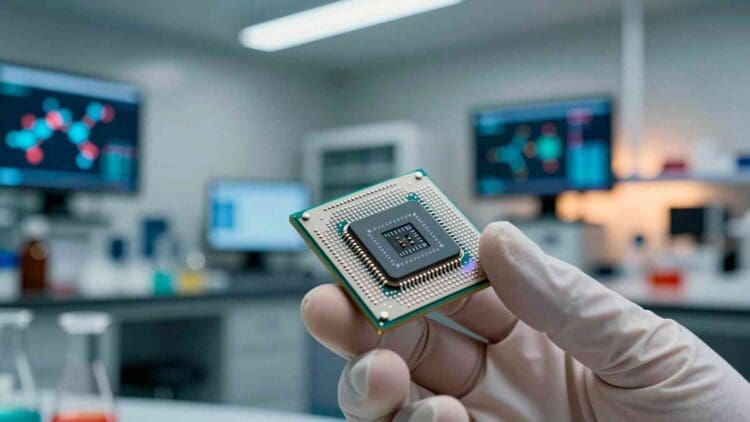
The search for an alternative has stretched across laboratories worldwide for years. Then, on a chip no larger than a fingernail, Northwestern University scientists screened 156 million nanoparticles — and found their answer in a single afternoon.
Why iridium became green hydrogen’s biggest bottleneck
Clean hydrogen starts with water. Apply electricity, and you can split water molecules into hydrogen and oxygen — a process called water splitting. The hydrogen side is relatively straightforward. The oxygen side, known as the oxygen evolution reaction (OER), is where things get difficult.

OER is sluggish and energy-hungry without the right catalyst. Iridium fills that role perfectly, driving the reaction with unmatched efficiency while holding up in the harsh acidic environments that modern electrolyzers require. Until now, nothing else came close.
The problem is that iridium is extraordinarily rare. It surfaces mainly as a byproduct of platinum mining, and global supply is limited. As Ted Sargent, study co-author and Northwestern professor, put it: “There’s not enough iridium in the world to meet all of our projected needs.” That supply ceiling makes scaling green hydrogen nearly impossible.
A ‘full army of researchers’ on a single chip
The tool that changed the search is called a megalibrary. Chad Mirkin at Northwestern University introduced the platform in 2016, describing it as the world’s first nanomaterial “data factory.” The concept is deceptively simple: pack millions of unique nanoparticles onto a single chip, then test them all at once.
Each megalibrary is built using arrays of hundreds of thousands of tiny pyramid-shaped tips, with each tip printing an individual dot containing a precisely designed mixture of metal salts. When heated, those salts reduce into single nanoparticles — each one a distinct composition and size. No two dots are identical.
Mirkin describes the scale with a useful analogy. “You can think of each tip as a tiny person in a tiny lab,” he said. “Instead of having one tiny person make one structure at a time, you have millions of people. So, you basically have a full army of researchers deployed on a chip.” For this project, Mirkin and Sargent partnered with the Toyota Research Institute (TRI) to find an iridium replacement.
How 156 million nanoparticles led to one winning formula
The chip held 156 million individual particles — each a different combination of four metals: ruthenium, cobalt, manganese, and chromium. All four are relatively abundant and inexpensive compared to iridium, and all carry known catalytic properties. A robotic scanner worked through the chip, assessing OER performance across the most promising particles, with the best performers advancing to further laboratory testing.
One composition emerged as the clear winner: Ru52Co33Mn9Cr6 oxide. Multi-metal catalysts can produce synergistic effects that push performance beyond what any single metal delivers alone. This one did exactly that.
“Our catalyst actually has a little higher activity than iridium and excellent stability,” Mirkin said. Ruthenium-based materials often degrade quickly under operating conditions — but here, the other three metals appear to stabilize it. That outcome was not something the team could have predicted without screening millions of combinations first.
From lab chip to real-world device — and the cost advantage
The Northwestern team took the critical next step: they scaled up the winning composition and demonstrated it inside an actual electrolyzer device. In long-term testing, the new catalyst ran for more than 1,000 hours with high efficiency and strong stability in a harsh acidic environment. That durability, outside controlled lab conditions, is what separates a promising material from a practical one.
The cost advantage is substantial — roughly one-sixteenth the cost of iridium. That gap alone could reshape the economics of green hydrogen at scale. Still, researchers urge caution. “There’s lots of work to do to make this commercially viable,” said Joseph Montoya, a senior staff research scientist at TRI.
A platform that could reshape how science finds new materials
The hydrogen catalyst is the headline, but the megalibrary platform may be the larger story. Generating millions of high-quality data points in a single run produces exactly the kind of rich dataset that machine learning models need to identify patterns and predict new materials. Northwestern, TRI, and Mattiq — a Northwestern spinout — have already built machine learning algorithms designed to work with megalibrary data.
Mirkin sees applications well beyond catalysis: batteries, biomedical devices, fusion energy, advanced optics. The study, published August 19, 2024, in the Journal of the American Chemical Society, offers one concrete demonstration of what that approach can deliver.
“The world does not use the best materials for its needs,” Mirkin said. “People found the best materials at a certain point in time, given the tools available to them… We want to turn that upside down.”
Kelly is an experienced writer with 15 years of experience exploring the big stories that shape our world, from tech breakthroughs and space exploration to climate, energy, and the fascinating quirks of science. She has a talent for turning complex ideas into sharp, memorable insights that stay with readers long after they’ve finished reading.