
Ohio farmland is quietly becoming ground zero for America’s AI power crisis, and one developer began preparing for it more than a decade ago
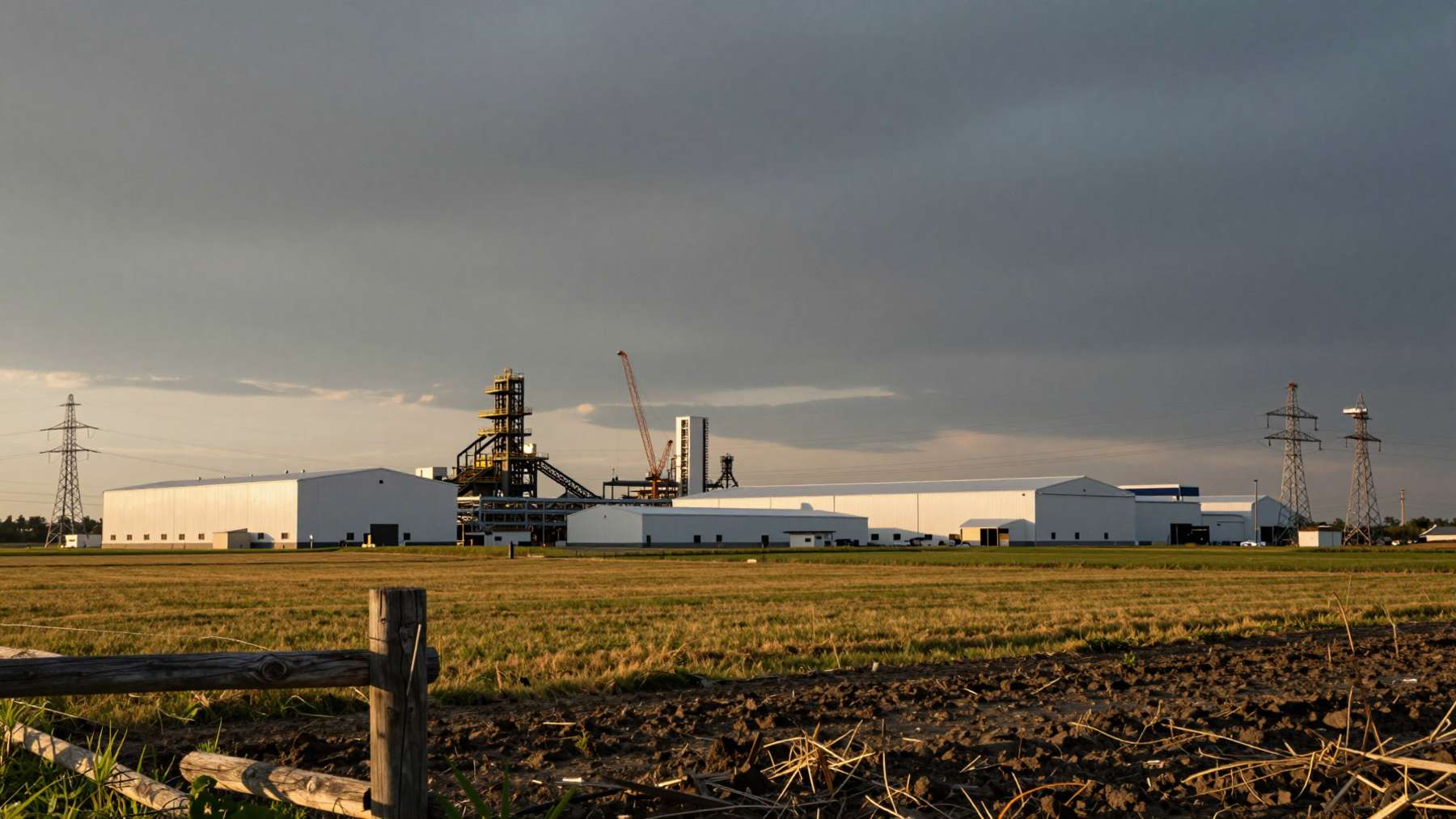 Image generated with artificial intelligence
Ohio farmland is quietly becoming ground zero for America’s AI power crisis, and one developer began preparing for it more than a decade ago.
Northeast of Columbus, Ohio, the idyllic Main Street of New Albany yields to pastoral fields—until the countryside gives way to endless rows of monolithic white data centers emitting a steady industrial hum.
This agricultural corner has transformed into one of the nation’s densest AI computing clusters, joined by a $28 billion Intel chip factory rising nearby. The immense computational capacity housed here demands vast amounts of electrical energy from a regional grid struggling with surging demand.
New York state even enacted a year-long data center construction moratorium to craft protective ratepayer regulations, as other states consider similar moves.
In response, construction has begun on a groundbreaking battery installation designed to stabilize the eastern grid.
A grid under pressure from the AI boom
PJM Interconnection manages the electrical grid across 13 states and the District of Columbia, struggling to match soaring artificial intelligence workloads. As processing power demands skyrocket, regional power generation fails to keep pace.
The resulting price spikes have triggered bipartisan anger, with governors demanding tech giants pay for infrastructure upgrades rather than burdening residential utility customers.
The White House similarly pushed AI developers to build, bring, or buy dedicated power supplies. New York state even enacted a year-long data center construction moratorium to craft protective ratepayer regulations, as other states consider similar moves.
The battery that broke ground in New Albany
Addressing this grid strain, developer Eolian broke ground on its Flint Grid project inside the New Albany data center cluster.
Phase one delivers 200 megawatts of dispatchable capacity with 1 gigawatt-hour of storage over a five-hour duration, making it the largest battery project east of the Mississippi River.
The facility charges during off-peak hours when power is abundant and low-cost, then discharges during peak demand to mitigate price spikes. While proven in California and Texas, zero installations of this scale previously existed in PJM territory. Phase one targets operational readiness by June 2027.
How one developer spotted Ohio’s potential years early
Flint Grid’s origin traces to the early 2010s in northern Virginia. Eolian CEO Aaron Zubaty sought solar sites near Data Center Alley outside Dulles Airport, but suburban sprawl and the Appalachian Mountains restricted growth.
Observing that topography flattened east of Columbus, Zubaty identified central Ohio as a strategic hub with open land and technical talent from The Ohio State University.
During early site scouting, Eolian researchers tracked anonymous corporate entities purchasing land near substations—entities that turned out to be Amazon Web Services. AWS opened its first New Albany data center in 2016, igniting a land rush.
A decade of calculated risk
Acquiring site control was only the initial step. Eolian spent years navigating local permits, grid interconnection queues, and Ohio Power Siting Board approvals while PJM power prices remained low.
By 2025, Eolian proactively ordered long-lead-time transformers without a power purchase agreement, taking on substantial financial risk.
In December, Zubaty bid the project into PJM’s regional capacity auction for delivery starting June 1, 2027. The auction cleared at maximum price caps, signaling critical power deficits. Winning that bid established a binding construction timeline where missing the mid-2027 deadline carries severe financial penalties.
Could this be a model for the rest of the East?
While battery deployments break national records, growth remains concentrated in the West, leaving Eastern grids vulnerable to AI power demands.
Hyperscalers in New Albany could contract directly for Flint Grid’s capacity credits, insulating themselves from market spikes while satisfying political demands to cover energy costs.
Yet replicating this model remains difficult: legacy PJM rules lag behind Western markets, and developers cannot retroactively buy land near AI hubs they failed to anticipate a decade ago.
This highlights the single secret advantage Eolian secured years early. When tech giants bought up sprawling acreage, one small parcel with an old house, a pond, and dense foliage was left behind.
Eolian quietly bought that overlooked tract. Today, fully surrounded by server farms, that forgotten plot is the high-value asset unlocking grid power for the nation’s premier AI cluster—the ultimate hidden weapon powering America’s digital future.
Kelly is an experienced writer with 15 years of experience exploring the big stories that shape our world, from tech breakthroughs and space exploration to climate, energy, and the fascinating quirks of science. She has a talent for turning complex ideas into sharp, memorable insights that stay with readers long after they’ve finished reading.
