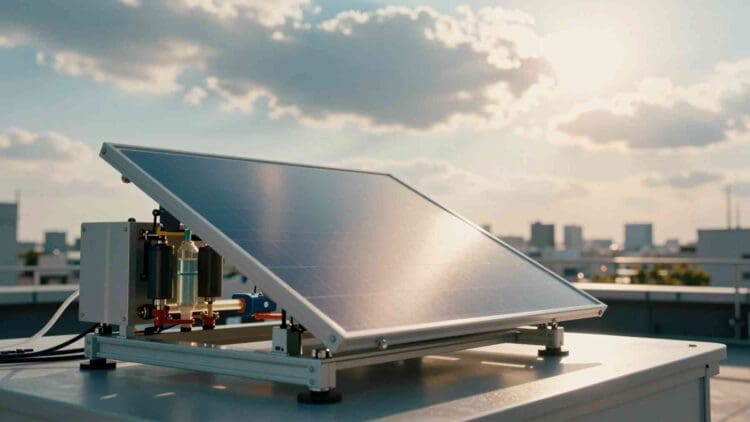

Researchers at Osaka Metropolitan University have unveiled a battery-free artificial photosynthesis system that produces formic acid from water and CO₂—and keeps running steadily as sunlight shifts throughout the day.
The work was led by Associate Professor Yasuo Matsubara and Professor Yutaka Amao. In outdoor testing, the device continued generating formic acid even as light conditions changed, without relying on the batteries or added electronics that conventional solar fuel systems typically require.
Osaka team unveils self-regulating solar fuel device
The device is built around a straightforward idea: engineer the regulation directly into the hardware, rather than layering electronics on top. The Osaka team designed an electrolyzer that responds to shifting sunlight on its own, and outdoor testing confirmed the system kept producing formic acid from water and CO2 even as light conditions changed across the day. That stability, achieved without batteries, is what makes the result significant.


Formic acid is the system’s chosen output. It can function as both a fuel and an energy storage medium—the compound itself holds the energy captured from sunlight until it’s needed.
Why conventional systems rely on batteries and added electronics
Fluctuating sunlight is one of the central engineering challenges for artificial photosynthesis. When light levels rise and fall, solar cells drift away from their most efficient operating point. To correct this, most systems use Maximum Power Point Tracking—MPPT—which continuously adjusts voltage and current to keep the solar cell near peak output. Conventional MPPT setups depend on batteries and extra electronics to do that work, adding cost, mechanical complexity, and more parts that can fail.
The Osaka team took a different path: instead of managing fluctuation through external hardware, they redesigned the electrolyzer to handle regulation from within.
A custom solid electrolyte enables built-in self-regulation
The key is a custom solid electrolyte integrated directly into the electrolyzer. This material gives the device its self-regulating behavior. As sunlight intensifies, the electrolyzer heats up, and that warming causes electrical resistance inside the device to drop. Lower resistance means electricity flows more freely—a natural balancing effect where more solar energy arriving prompts the device to adjust its internal conditions to accommodate it.
No battery, no converter, no separate control circuit required. Professor Amao described it directly: “This self-regulating behavior helps keep fuel production more stable throughout the day and automates the system while reducing dependence on batteries and costly external components. ” Associate Professor Matsubara expressed confidence in the outcome—the behavior is not a workaround but something engineered into the material itself.
Potential impact on clean energy costs and infrastructure
Removing batteries and converter electronics from a solar fuel system has real practical consequences. Upfront costs drop when fewer components are involved, and simpler systems are easier to maintain and less likely to fail in the field. For cities, companies, or households investing in cleaner energy infrastructure, that simplicity carries genuine weight.
Variable sunlight—long treated as a problem to be managed—becomes easier to convert into storable fuel when less added equipment is involved. Less overhead for dealing with changing light levels throughout the day means the whole system becomes more viable at scale.
A more practical artificial photosynthesis system could also reduce dependence on fossil fuels. Cleaner energy production is associated with lower air pollution, which has been linked to respiratory and cardiovascular health problems in communities worldwide. A more resilient energy system, one less exposed to fuel price volatility, could lower long-term operating costs for the people who rely on it.
Research stage and next steps
The technology has not yet been commercialized. It remains in the research stage, and the path from laboratory demonstration to deployed infrastructure involves many additional steps—context that matters when weighing the significance of the result.
Artificial photosynthesis as a field is built on a compelling premise: mimic what plants do naturally, using sunlight, water, and CO2 as inputs to produce energy-rich compounds. The Osaka system produces formic acid, which can store energy and serve as a fuel, making it a practical target for this kind of research.
The work was described via Science Daily. The Osaka Metropolitan University team has demonstrated a battery-free artificial photosynthesis device that self-regulates fuel output as sunlight fluctuates, centered on a custom solid electrolyte that adjusts internal resistance with temperature. The result is a simpler, potentially lower-cost design for converting sunlight into storable solar fuel—without the batteries and electronics that conventional systems require.
Kelly is an experienced writer with 15 years of experience exploring the big stories that shape our world, from tech breakthroughs and space exploration to climate, energy, and the fascinating quirks of science. She has a talent for turning complex ideas into sharp, memorable insights that stay with readers long after they’ve finished reading.