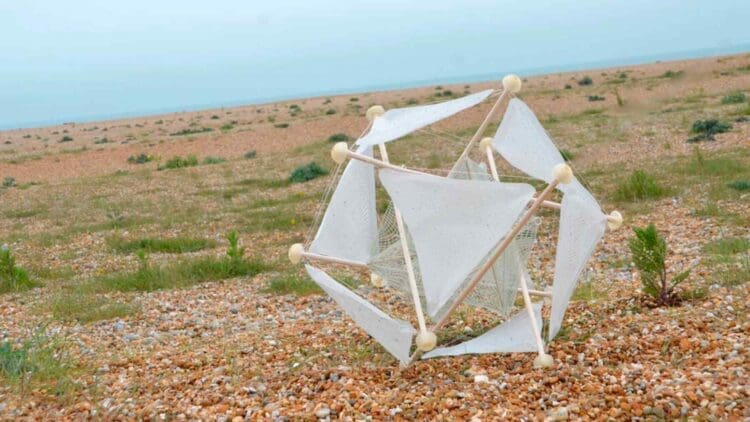

A nature-inspired wind device proves the best way to restore the environment is to work with it, and not against it.
The planet is rapidly undergoing devastating changes that worsen each day, which is why human intervention is desperately needed.
Should decreased resilience eventually lead to complete ecosystem collapses, the cascading effects will be severe.



However, instead of trying to control nature, would it not be best to simply roll with it?
How the planet is nearing a tipping point
Earth is currently caught in the middle of a “tragic love rectangle.”
At one end, climate change is changing weather patterns and predictability. On the other end, humanity is building a mountain of pollution stretching from sea to sky.
At the fourth end, the loss of biodiversity becomes the tip of the iceberg that will eventually sink this loveboat.
The latest data from 2026 indicate that approximately 40% of Earth’s land is degraded.
With the fundamental biological systems breaking down as a result, sustaining life becomes nearly impossible.
The loss of vital soil structure inhibits its ability to be a “living” filter. This essentially leaves behind a trail of dust and ecological dangers.
More than 3.2 billion people are already affected by this degradation.
As it escalates, the search for a feasible and sustainable solution is extremely urgent. But what will truly help to break this tragic cycle?
A cascading effect that will be felt globally
This ongoing dispute is leading to consequences that are being felt around the entire world.
During an ecosystem collapse, the failures begin to unravel across all borders.
NOAA has already sounded the alarm for 82 countries. The ocean’s color is changing at a significant rate due to dying coral reefs.
The rising unfavorable ocean conditions are affecting nearly all living organisms.
On land, droughts are worsening the rising global freshwater bankruptcy crisis, as well as the health of the soil.
Without vegetation, more heat penetrates the soil, causing higher ground carbon dioxide emissions. This worsens the greenhouse gas effect and stresses remaining greenery.
The degraded land also struggles to manage water adequately.
Extended dry spells pose the risk of severe dust storms. In rare moments of rain, flash floods wash remaining nutrients away.
This calls for unique interventions, and the University of the Arts London may have found the answer.
Rolling with the wind to break free from degradation and disaster
With so many regions trying to prepare for heavy rain and extreme drought conditions, soil well-being is often overlooked. Fortunately, the designer Yizhuo Guo led a team to explore solutions for soil health and restoration as the primary goal.
The project was a collaboration between the University of the Arts London (UAL) and Imperial College London.
This project resulted in a small, nomadic traveler called the “Wasteland Nomad,” which addresses desertification.
The natural cycle of a design that lives, functions, and decays
The Wasteland Nomad’s design was inspired by a tumbleweed rolling in the wind.
The lightweight, spherical structure is easily moved by desert winds from all directions. As it rolls, it slowly releases seeds across a larger space, increasing survival chances.
The physical rolling impact slightly “disturbs” the land surface to improve soil aeration and help seeds stick in the crust.
The structure is made from biodegradable materials that self-decay over time.
This highly innovative man-made intervention ensures that life, instead of litter, is left behind.
It proves that the environment we want to restore can be saved with these green wind-powered balls. It certainly beats using plastic irrigation pipes or carbon-heavy machinery to plant trees.
So, instead of only controlling nature, why not roll with increased heat-blocking solar energy installations and land-based biomimetic systems instead?