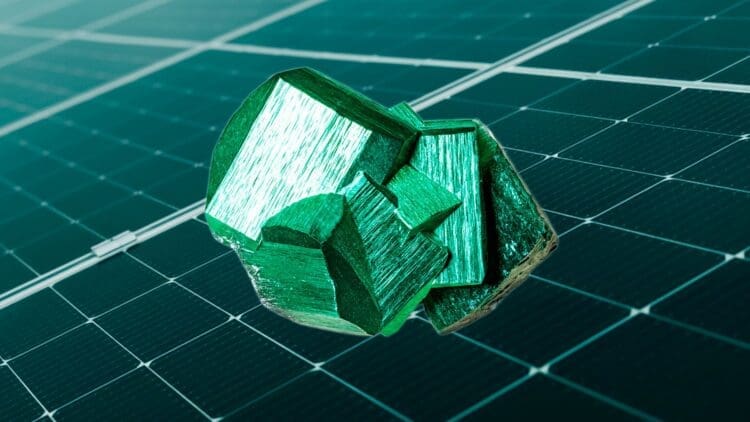
2025 has been the year of solar, as the global solar capacity underwent an explosive growth. In the first six months of 2025, the global solar capacity grew by 380 GW, and experts believe this trend will continue. How much of this capacity includes the solar game-changer material cannot be pinpointed, but it does seem as if perovskite may have met its match, as the Aussies have unveiled a new contender for solar material. Find out more about this latest solar contender below.
Perovskite was once seen as the solar game-changer material
As the global solar energy capacity increased, so did the number of researchers working on a series of photovoltaic cells to achieve the highest efficiencies possible. Once upon a time, perovskite was seen as the solar game-changer material. Perovskite solar cells (PSCs) are a pioneering solar technology made from an ultra-thin film of metal halide perovskite composite.
PSCs have significant advantages compared to silicon solar cells, like affordable production, versatility, adjustable properties, and high efficiency. Unfortunately, perovskite has a much lower stability and therefore does not last very long. Its scalability for commercial use is also challenging. But, there may be a new kid on the block from down under, as the Aussies have unveiled a new contender.

Aussies have unveiled a new contender
Australia has embraced solar energy production and plans to provide three states with free daily solar power. Now, the Aussies plan to break new ground in solar technology with the pioneering solar material, kesterite. After a decade of stagnated results in efficiency, kesterite and researchers’ luck finally turned. However, it is thanks to the researchers from UNSW Sydney that a new world record for efficiency was achieved.
UNSW’s School of Photovoltaic and Renewable Energy Engineering team, led by Scientia Professor Xiaojing Hao, achieved a record solar efficiency of 13.2% with kesterite solar cells after enhancing them with hydrogen. Other team members, Dr Jialiang Huang and Dr Kaiwen Sun, stated that heat-treating (annealing) synthesized kesterite solar cells in an atmosphere filled with hydrogen led to their success.
Kesterite can be synthesized from the abundant and non-toxic elements copper, zinc, tin, and sulfur. This is why the synthesized kesterite solar cells are also referred to as CZTS solar cells. According to Prof. Hao:
“hydrogen is modulating the defects within CZTS, that’s what helps increase its efficiency in terms of converting sunlight into electricity.”
From record efficiency to other advantages
Beyond the breakthrough in solar efficiency, CZTS solar cells have proven to be advantageous in other terms as well, including being:
- Highly affordable in production
- Able to maintain PV performance long-term
- Extremely eco-friendly
- Available in abundance
- Good optoelectronically
“The big picture here is that we ultimately want to make electricity cheaper and greener to generate.” Prof. Hao
Presently, CZTS will function best when integrated with tandem solar cells, which is a combination of two or more cells, to promote increased absorption and conversion of the solar spectrum into electricity, resulting in higher efficiency. Prof. Hao added that they will continue to decrease the defects of CZTS during and post-fabrication treatments.
Prof. Hao explained that they will also research all material types for the top layer of the tandem cells, as it will be the best way to maximize their chances of success. This way, they will achieve highly efficient tandems the quickest for long-term use. The UNSW team’s research and findings are published in the scientific journal Nature Energy. If kesterite research continues and the material in tandem cells becomes commercial, we could be looking at a solar revolution. Whether they will replace the world’s largest energy-producing concentrator, we cannot say for sure.