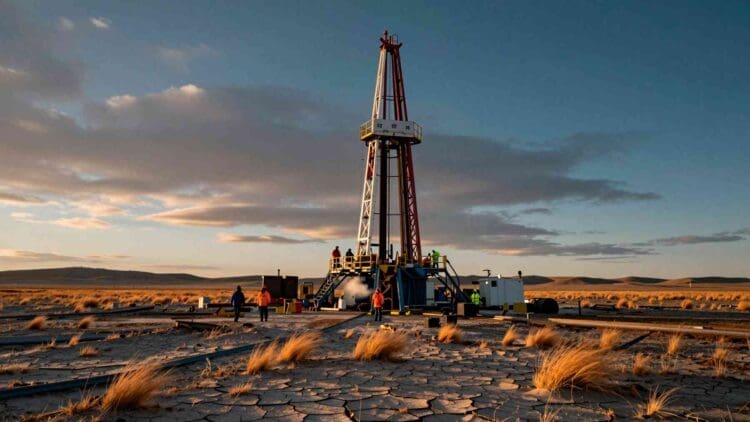

Petro Matad, the AIM-listed Mongolian oil company, has published audited full-year results for 2025, reporting a net loss after tax of $4.23 million—down from $10.92 million the prior year. Oil revenues reached approximately $2 million, as the company generated its first meaningful production income from Block XX.
The narrowed loss reflects a year in which Petro Matad added a second producing well to its Mongolian operations, with the Gazelle-1 well coming onstream in the fourth quarter of 2025.
2025 financial results at a glance
The headline number tells a clear story. Petro Matad’s net loss after tax fell to $4.23 million for the year ended December 31, 2025, compared with $10.92 million the year before—a reduction of more than 60%. That improvement wasn’t driven by cost-cutting alone. It came from the company generating real revenue for the first time at meaningful scale.



Oil sales produced net revenue of approximately $2 million, with barrels sold at an average price of $61.8 per barrel across the year. Cash also strengthened, rising to $3.67 million at year-end from $2.96 million at the close of 2024. To support production-growth activities, the company completed an equity raise in mid-July 2025.
Production performance drove the improved financial position
At the center of the financial improvement was Block XX’s operational record. The Heron-1 well maintained production uptime above 99% throughout 2025, delivering approximately 54,000 barrels in total oil sales to PetroChina’s neighboring TA-1 facility by year-end. For an early-stage production operation, that level of reliability is worth noting.
The bigger development came in October. A well test at Gazelle-1 achieved a maximum natural flow rate of over 400 barrels of oil per day, giving the company confidence to bring the well onstream before the end of that same month. Gazelle-1 contributed over 7,000 barrels in oil sales before year-end — a meaningful addition given how short its producing window actually was.
Together, the two wells pushed Block XX’s average production for 2025 to 168 barrels per day. With Gazelle-1 only contributing for part of the year, that full-year average understates what the field can now deliver on a sustained basis.
Oil sales agreement with PetroChina resolved after tax dispute
Generating production is one thing. Getting paid for it is another. Petro Matad navigated a significant commercial hurdle in 2025 when PetroChina withheld 30% of revenue related to Mongolian tax treatment — a dispute that created uncertainty around the company’s cash position for much of the year.
The Oil Sales Agreement with PetroChina was signed in April 2025, establishing the formal framework for selling Block XX crude. By year-end the withholding issue had been fully resolved, with all 2025 payments made in full. That resolution directly supported the improvement in cash on hand at year-end. The company also noted that detailed analysis conducted during those negotiations may help streamline approval of a similar agreement for 2027.
Early 2026 production exceeds expectations and farm-out talks continue
The momentum from late 2025 has carried into 2026. Average production year-to-date has reached 233 barrels per day, with Gazelle-1 performing above post-period expectations. In April 2026, the company reached 100,000 cumulative barrels produced from Block XX — a marker of operational progress for a company that only recently began generating revenue.
Farm-out discussions on the Mongolian portfolio are ongoing, and rising oil prices during 2026 have increased interest from potential partners. Mongolian fiscal terms are structured so that the contractor’s return rises in proportion to the oil price—a feature that makes the asset more attractive in the current environment. Petro Matad has described the farm-out initiative as a major focus for the year.
On the commercial side, PetroChina approved the 2026 Oil Sales Agreement following slow negotiations, repeating a pattern from 2025. With the agreement in place, Petro Matad has submitted an invoice for over 40,000 barrels of 2026 production to date. The company is also considering acquiring 3D seismic on Block XX during the summer of 2026.
Renewable energy subsidiary pursues large-scale projects in Mongolia
Petro Matad holds a 50% interest in Sunsteppe Renewable Energy (SRE), which is pursuing utility-scale renewable energy projects in Mongolia. The nearest-term development is a 200MW hybrid project in Tuv Province, which SRE considers the most likely of its existing projects to reach ready-to-build status in the near term.
SRE is active across several other fronts simultaneously. Discussions are ongoing to secure a 100MW solar and 100MW battery fast-track project, and an expression of interest has been submitted for a 100MW wind project managed by the International Finance Corporation. SRE is also part of a consortium selected as the preferred bidder to negotiate terms on a 90 MW solar and battery project with the Ulaanbaatar municipality. The company chose not to participate in five government solar auctions ranging from 20MW to 50MW, citing tight delivery deadlines and penalty clauses for missed targets.
The company is moving away from exploration-stage uncertainty
Petro Matad enters 2026 in a materially stronger position than it held a year ago. Its net loss has narrowed sharply, cash has grown, and it now operates two producing wells rather than one. The resolution of the PetroChina tax dispute, the Gazelle-1 addition, and the 100,000 cumulative barrel milestone all point to a company moving from exploration-stage uncertainty toward a more established production footing. Farm-out progress and the trajectory of oil prices will be the key variables to watch as 2026 develops.
Kelly is an experienced writer with 15 years of experience exploring the big stories that shape our world, from tech breakthroughs and space exploration to climate, energy, and the fascinating quirks of science. She has a talent for turning complex ideas into sharp, memorable insights that stay with readers long after they’ve finished reading.