
Petrobras contracts Halliburton to drill wells for Latin America’s first saline-reservoir carbon capture and storage pilot project in Rio de Janeiro
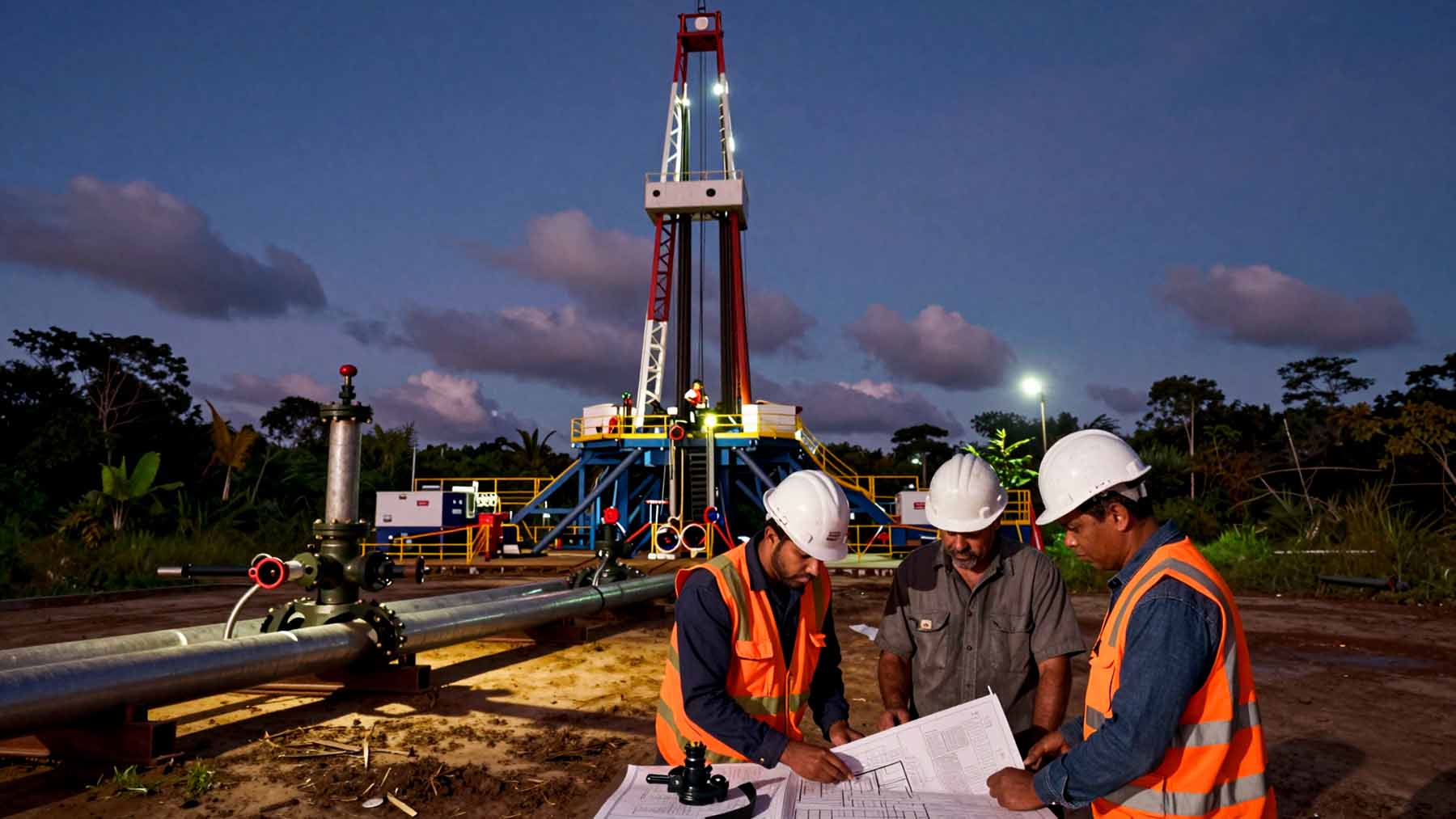 Image generated with artificial intelligence
Petrobras has contracted Halliburton to drill four onshore wells at the Barra do Furado Station in Quissamã, Rio de Janeiro—a milestone that marks Latin America’s first attempt to capture, transport, and store industrial CO2 in a saline reservoir. The wells are the physical foundation of the São Tomé CCS Pilot Project, a venture that puts Brazil at the frontier of geological carbon storage in the region.
Petrobras signs drilling contract for São Tomé CCS pilot project
The contract with Halliburton Produtos Ltda covers drilling and completion of four onshore wells at the Barra do Furado Station (EBAF) in Quissamã, Rio de Janeiro. The well setup includes one vertical injector well and three directional monitoring wells, each with a distinct role in the capture and storage process.
Together, these wells form the physical backbone of the São Tomé CCS Pilot Project—the first initiative in Latin America designed to capture CO2 from industrial sources, move it via pipeline, and inject it into a saline reservoir for long-term geological storage.
Special CO2-resistant materials are used throughout the well construction—a necessary precaution given how corrosive pressurized carbon dioxide can be underground.
For Petrobras, this contract isn’t just a procurement call. It’s a concrete step in the company’s broader push toward carbon neutrality by 2050, a goal that now has actual infrastructure behind it.
Why Petrobras is pursuing carbon capture and storage
Petrobras is classifying São Tomé as a Research, Development and Innovation (R&D&I) project. That label matters—it signals the initiative isn’t only about cutting near-term emissions, but about building the knowledge base for larger-scale CCS deployment across Brazil down the road.
Saline reservoirs are considered a promising medium for storing industrial CO2. They’re geologically widespread and can hold large volumes of carbon over long timeframes, which is precisely why testing this approach in a real-world environment, rather than a lab, is the whole point.
The data and operational procedures this pilot generates are meant to inform how Brazil handles CCS at commercial scale. São Tomé is as much about learning as it is about storing carbon.
Project targets up to 110,231 U.S. tons of CO2 per year with a 2029 operational start
The numbers give you a sense of the project’s ambition. São Tomé aims to capture and store up to 110,231 U.S. tons of CO2 annually over a three-year operational period—a significant volume for a pilot, and one that reflects how seriously Petrobras is treating this.
The timeline breaks into clear phases: drilling, well completion, and all supporting infrastructure are scheduled to wrap up by 2028. In 2029, Petrobras launches the injection phase, pumping CO2 underground for three years, followed by three more years of reservoir monitoring.
Beyond the Latin America angle, São Tomé is also the first project in Brazil to transport CO2 via pipeline and store it in a saline reservoir. That combination—pipeline transport plus saline storage—hasn’t been done in the country before.
Regulatory implications and role of national agencies
One of the less-discussed but genuinely important dimensions here is the project’s regulatory function. São Tomé will serve as a real-world testing ground for Brazil’s two key oversight bodies: the National Agency of Petroleum, Natural Gas and Biofuels (ANP) and the State Environmental Institute (INEA). Both agencies will monitor and validate the procedures and standards generated throughout the project.
That’s a deliberate design choice. By bringing regulators into the process from the start, Petrobras is helping build the institutional knowledge needed to govern CCS at scale. Brazil doesn’t yet have a mature regulatory framework for geological carbon storage, and this pilot offers a controlled, observable environment where agencies can assess what works, what needs adjustment, and what standards should apply before any commercial CCS projects move forward.
Key technologies deployed in the São Tomé project
São Tomé isn’t just notable for what it’s storing—it’s also notable for how it’s doing it. Several technologies being deployed here are either new to Brazil or represent meaningful advances in CCS monitoring capability.
Fiber optic coating on the wells enables real-time tracking of the CO2 plume as it moves through the subsurface. That kind of continuous visibility is critical for safety and for understanding how the reservoir behaves under injection conditions. Separately, a reservoir sampling system has been designed to eliminate the need for well intervention during monitoring, reducing both operational risk and cost across the project’s multi-year monitoring phase.
Special CO2-resistant materials are used throughout the well construction—a necessary precaution given how corrosive pressurized carbon dioxide can be underground. Fiberglass coating on the monitoring well also enables the use of nuclear magnetic resonance (NMR) for subsurface data recording, providing detailed information about fluid distribution and rock properties and adding another layer of precision to the overall monitoring process.
Brazil’s first real-world CCS testing ground for regulators
The São Tomé CCS Pilot Project represents several firsts at once: Latin America’s first saline-reservoir CO2 storage initiative, Brazil’s first pipeline-based CO2 transport and storage project, and the country’s first real-world CCS testing ground for regulators. Petrobras has contracted Halliburton to drill four wells—one injector, three monitoring—at EBAF in Quissamã. Infrastructure is due by 2028, with injection operations starting in 2029. The project runs for up to six years total, combining three years of injection with three years of post-injection monitoring.
Kelly is an experienced writer with 15 years of experience exploring the big stories that shape our world, from tech breakthroughs and space exploration to climate, energy, and the fascinating quirks of science. She has a talent for turning complex ideas into sharp, memorable insights that stay with readers long after they’ve finished reading.
