
Philippines plans Green Energy Auction to shift 20 off-grid islands from diesel to solar power with battery storage
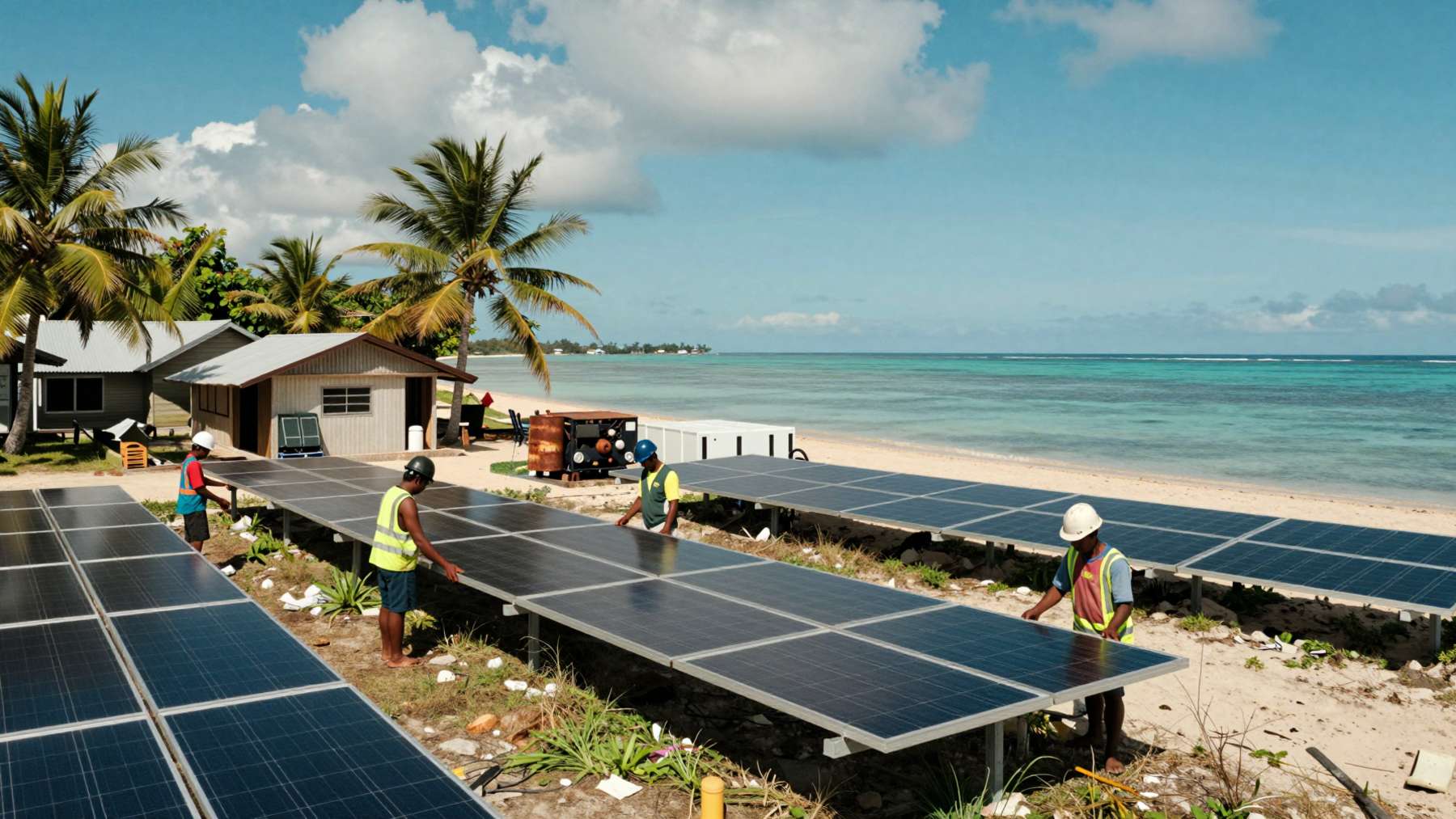 Image generated with artificial intelligence
Twenty off-grid islands in the Philippines still run almost entirely on diesel—expensive to ship, vulnerable to price swings, and increasingly costly to subsidize. The Philippine Department of Energy plans to change that. The agency expects to launch a Green Energy Auction next year targeting those 20 NAPOCOR-served islands, with the goal of replacing diesel generators with solar photovoltaic systems paired with battery energy storage.
DOE announces off-grid green energy auction for 2027
The DOE is moving fast. All 20 targeted islands are currently served by the National Power Corporation (NAPOCOR)—and these aren’t tiny, hard-to-reach outposts. They’re described as the country’s larger NAPOCOR-served islands, which makes them the logical starting point for a structured competitive procurement process.
To get the design right, the DOE recently held focus group discussions with renewable energy developers, local government units, and other stakeholders. The goal: figuring out what a workable auction framework actually looks like for island settings, and what safeguards need to be in place for it to succeed.
Most off-grid islands depend entirely on diesel—a fuel that has to be shipped in, often to difficult locations, and whose price swings with global markets.
One of those safeguards involves NAPOCOR itself. The state-owned utility will keep its diesel systems running throughout the transition, so the lights stay on while winning developers build and commission their new solar and battery facilities. No planned gap in service.
High diesel costs and fuel subsidies drive the policy shift
The economic case here isn’t subtle. Most off-grid islands depend entirely on diesel—a fuel that has to be shipped in, often to difficult locations, and whose price swings with global markets. That combination makes power both expensive and unpredictable.
The numbers are stark. The DOE says the average true cost of generation in off-grid areas is around PHP 18 (roughly $0.30) per kilowatt-hour—roughly $0.30 — but on some of the more remote islands, that figure climbs as high as PHP 62 per kWh, roughly $1.01. A serious cost burden by any measure.
Island residents don’t pay those full costs directly. The Energy Regulatory Commission sets regulated consumer rates, and the gap between those rates and actual generation costs gets covered by the Universal Charge for Missionary Electrification, or UCME—a charge collected from electricity consumers across the entire country. Every Filipino with a power bill is effectively subsidizing diesel generation on remote islands.
The off-grid GEA is specifically designed to address conditions that conventional renewable energy auctions don’t account for. Island grids are small, isolated, and operationally different from the main grid, so the auction framework has to reflect that reality.
Expected Effects: Lower generation costs and reduced nationwide subsidy
If the transition works as planned, the benefits won’t be limited to those 20 islands. Replacing diesel with solar PV and battery storage is expected to reduce the true cost of electricity generation in these areas—and lower generation costs mean a smaller gap to cover, which translates to a smaller UCME subsidy requirement.
That matters for the rest of the country. A reduced UCME charge would lower electricity bills for consumers nationwide. The DOE has framed this explicitly as a nationwide benefit, not just a local infrastructure upgrade.
Island communities themselves stand to gain something different: more reliable power. Diesel generation is vulnerable to supply disruptions, fuel delivery delays, and equipment wear. Solar paired with battery storage can offer more consistent output, far less dependent on external supply chains.
The DOE projects long-term savings for electricity consumers once the renewable facilities are operational. Those savings depend on the auction attracting competitive bids and developers actually delivering—but the directional logic is straightforward.
Context: Philippines’ broader renewable energy expansion program
The off-grid auction doesn’t exist in isolation. It’s part of a much larger push by the Philippines to expand renewable energy capacity across the archipelago.
The DOE plans to hold the sixth through ninth rounds of its Green Energy Auction Program for project delivery within the next two years. Earlier in 2026, the agency announced more than 3,200 MW of non-floating solar capacity targeted for construction between 2027 and 2028. Four auction rounds also aim to bring in 5,565 MW of renewable capacity from other technologies between 2028 and 2035.
The Philippines installed more than 1 GW of generation capacity in 2025, with most of it coming from renewable sources. That momentum feeds into the country’s national target of adding at least 25 GW of renewable power by 2035—a goal requiring sustained investment and a steady pipeline of projects.
The off-grid island auction adds a new dimension to that program. It’s not just about hitting capacity targets on the main grid—it’s about reaching communities the main grid doesn’t serve and replacing a costly, polluting fuel source with something more sustainable and, eventually, cheaper.
Lower electricity bills for consumers
To sum up: the Philippine DOE plans to launch a Green Energy Auction next year targeting 20 NAPOCOR-served islands. The auction aims to replace diesel generation with solar PV and battery storage. Generation costs in off-grid areas currently average PHP 18 (roughly $0.30) per kWh, with some islands reaching PHP 62 (roughly $1.01)—costs partially subsidized through a nationwide charge. Replacing diesel with renewables is expected to reduce that subsidy, lower electricity bills for consumers across the country, and deliver more reliable power to island communities. The auction is part of a broader renewable energy expansion program targeting 25 GW of new capacity by 2035.

Kelly is an experienced writer with 15 years of experience exploring the big stories that shape our world, from tech breakthroughs and space exploration to climate, energy, and the fascinating quirks of science. She has a talent for turning complex ideas into sharp, memorable insights that stay with readers long after they’ve finished reading.
