
France’s redesigned Poutès Dam opens seasonally for migrating salmon while aiming to preserve 85% of its former hydropower output
 EDF
Each year during spring and fall, wild Atlantic salmon migrate up the gorges of the Allier River in Southern France, compelled by one of the longest freshwater migratory corridors in Western Europe. Some migrate for as much as 560 miles from the Atlantic Coast to their breeding grounds in the highlands.
However, for close to eight decades, the Atlantic salmon migration was stymied by a single concrete barrier. The unapproved construction of the Poutès Dam during World War II was a major contributor in cutting off 60 percent of the breeding sites of the river. Researchers claim that this single barrier was the cause of the extinction of the Loire-Allier Salmon population. It is the last long-distance salmon run on the continent, and it is disappearing in silence.
A dam erected during the war, a species going extinct in silence
Poutès Dam was constructed in 1941 in the narrow gorge of the river Allier in the Haute-Loire area, apparently without any governmental approval. It was wartime, and the electricity was desperately needed. The ecological balance would be struck later on, and it would not be kind.
Citizens had taken over the Monistrol d’Allier power plant, and a national campaign, initiated by WWF and Patagonia, was advocating for demolition.
Salmon catchment had already dropped to one-fifth of its value by 1950. Scientists calculated that Poutès Dam accounted for about 90% of the decline of the great salmon of the Loire-Allier system. Only 8% of the 2,200 hectares of the spawning areas, utilized at the beginning of the 19th century, were still reachable, while the remaining 92% were unreachable due to the construction. Now, France owned something rare and precious: the only population of migrating Atlantic salmon in Western Europe. And it was disappearing.
Two decades of conflict, one fragile solution
The campaign started in earnest in 1991. Environmental groups and anglers were demanding complete demolition. Citizens had taken over the Monistrol d’Allier power plant, and a national campaign, initiated by WWF and Patagonia, was advocating for demolition. The pressure was there, but so was the opposition.
There were three distinct parties that blocked the project for two decades. Conservation NGOs were pushing for the full demolition of the dam. EDF, which was the owner of the dam, was trying to secure its investment. Local politicians were afraid of the loss of taxes from the structure. They couldn’t come to an agreement.
The deadlock was eventually broken in October 2011, when French Environment Minister Nathalie Kosciusko-Morizet officially declared the compromise: the Poutès would not be demolished but completely redesigned. The dam would remain; all else would change. However, even this decision wasn’t easy. In May 2016, the CEO of EDF decided to halt the construction of the new Poutès due to the financial problems of the company and low prices on the hydroelectric power market. The optimized version of the “New Poutès” was finally approved by the French government in September 2018.
Rebuilding the dam from the inside out
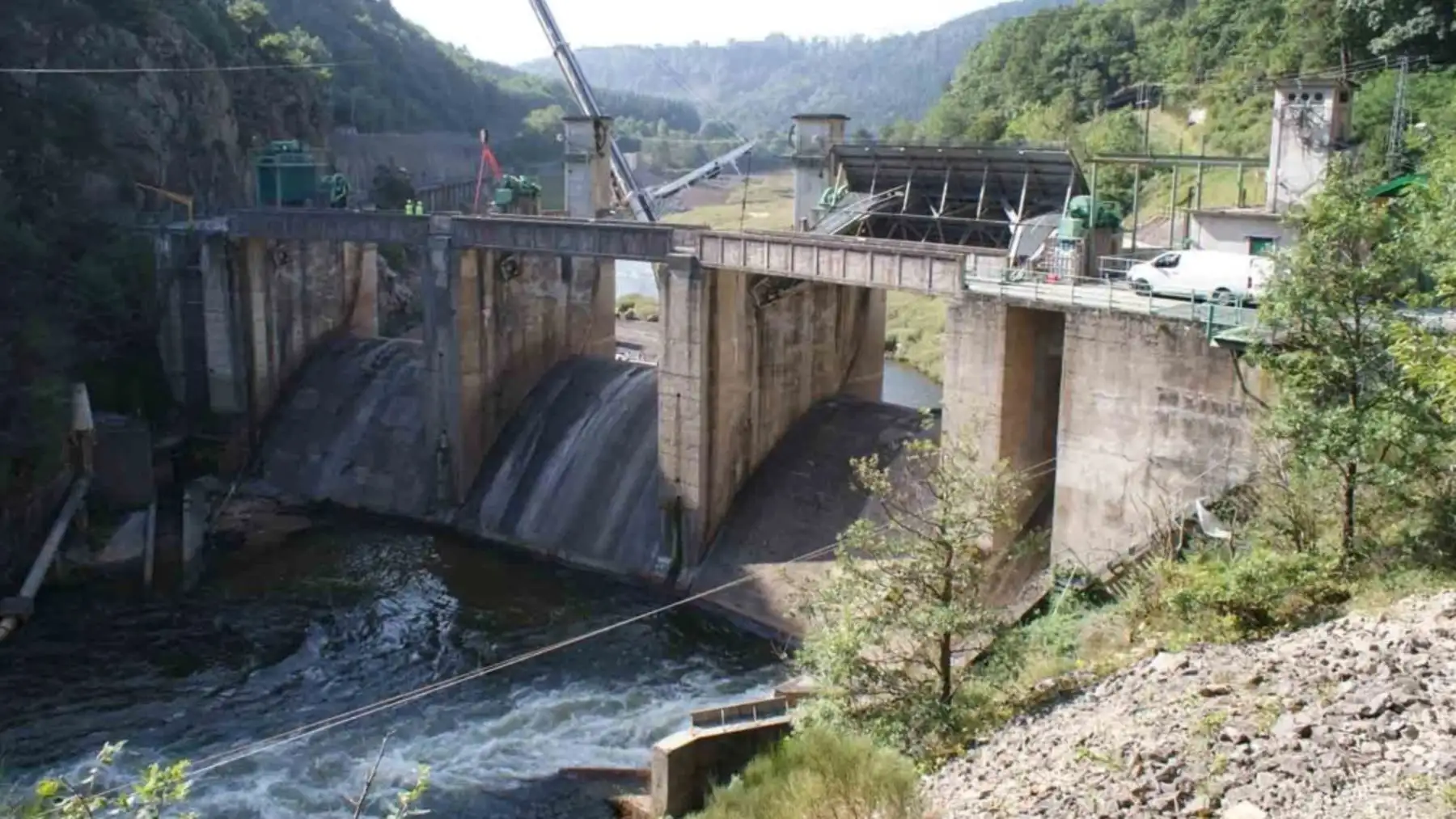
Construction took place between 2019 and 2022. During that first year of construction, the reservoir was completely drained, and three large gates, each weighing 20 metric tons, were taken apart. The dam has been entirely transformed on the inside.
Some statistics speak volumes. Now, the modified dam is 23 feet tall instead of 58 feet, and its reservoir has been shortened from 2.2 miles to only 1,312 feet (one quarter mile). Something that was a significant barrier became a mere weir. Central flap gates provide complete sediment transport during high flows and open all the way during spring and autumn migration periods when the gates stay open for 91 days, allowing fish free movement. Finer intake screens were installed too: 0.47 inch-mesh in place of the previous 0.79-inch (approximately one half-inch instead of 4/5-inch). This change helps the young salmon, known as smolts, move downstream through the dam to the ocean.
Salmon tracking: Where science meets the river
The design of the new project did not result from a sketch on the drawing board alone. Before construction of the new project started, the Wild Salmon Conservatory and EDF organized trial migration periods in 2017, 2018, and 2020. For the three years, the reservoir was drained by 19.7 feet, reducing its size from 2.2 miles to just half a mile, and an additional downstream bypass was created through the left-bank valve.
Smolts were captured using upstream using drum-net traps, outfitted with acoustic transmitters, and set free in the water. Receivers positioned above and below the dam recorded migration time and behavior through the structure. The data was directly used to design Optimized New Poutès, engineering choices were directly influencing the ecological monitoring. The turbine flow was maintained at 988.8 cubic feet per second, as originally, while hydroelectric power generation was halted for the period that the gates were open to the fish.

What 85% looks like—and what it means for the river’s future
Through generation only during the three opening months of each season, the modified dam is designed to maintain roughly 85 percent of its previous yearly hydropower production capacity. The Monistrol d’Allier facility, powered by Poutès and two small dams on the Ance du Sud, generates about 82 million kWh annually, serving as the main source of renewable energy in this part of Haute-Loire.
The new Poutès was opened in October 2022. For the first time in 80+ years, the Allier Gorge gave Atlantic salmon an unimpeded passage to their ancestral spawning grounds. What will happen after that is up to the fish and the monitoring committees established within the 50-year concession agreement for the project, who have the right to change the seasonally transparent period depending on the population status. A review of the upstream migration process is scheduled for eight years later; should the salmon not come back in sufficient numbers, the conditions of the concession can be amended accordingly.
The engineering compromise is in place. Whether the salmon will reclaim what was taken from them over eight decades is the question the Allier River will now begin to answer.
Kelly is an experienced writer with 15 years of experience exploring the big stories that shape our world, from tech breakthroughs and space exploration to climate, energy, and the fascinating quirks of science. She has a talent for turning complex ideas into sharp, memorable insights that stay with readers long after they’ve finished reading.
