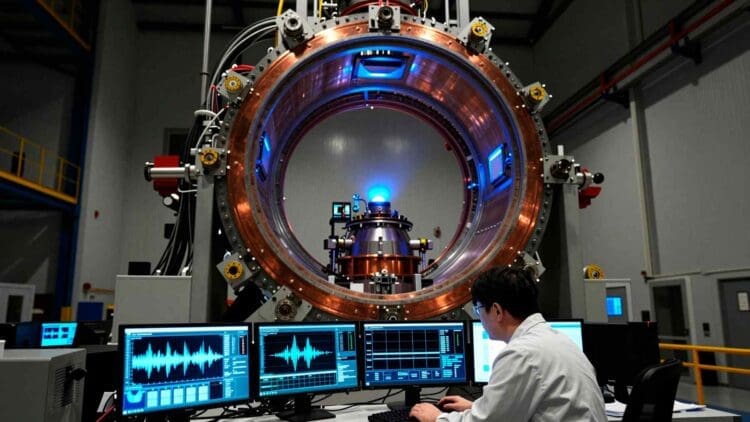

Researchers at the U.S. Department of Energy’s Princeton Plasma Physics Laboratory have accomplished something the fusion field has long pursued: running a single machine learning system on two separate tokamaks — DIII-D in the United States and KSTAR in South Korea — and successfully preventing plasma instabilities in both. Lead author SangKyeun Kim and colleagues published the result in a May 2024 paper in Nature Communications. Both devices were operating in high-confinement mode, the plasma state required for commercial power generation, making this the first demonstration of its kind at commercially relevant conditions.
What the Study Found
The same machine learning code ran on two physically distinct devices — DIII-D in the United States and KSTAR in South Korea — and achieved stable high-confinement mode in both without triggering instabilities. That result, reported in Nature Communications in May 2024, is the first of its kind under conditions directly relevant to commercial-scale fusion power.
Lead author SangKyeun Kim highlighted what makes the outcome significant. Fusion devices differ in design, scale, and operating conditions, and a single transferable codebase functioning across both represents meaningful progress toward general-purpose plasma control — something the field has long needed but not yet demonstrated.

Why Plasma Instabilities Are a Central Engineering Problem
Inside a tokamak, plasma conditions shift every millisecond. Human operators cannot respond at that speed. When control breaks down, the result can be a disruption — a sudden magnetic perturbation that destabilizes the plasma entirely. These are not simply inefficiencies; they can cause serious physical damage to the fusion vessel, making them unacceptable in any commercial reactor designed to run reliably for years.
The problem is sharpest in high-confinement mode. H-mode is the plasma state required for commercial power generation, but it is also the hardest to stabilize. At the plasma’s edge, explosive instabilities called edge-localized modes — ELMs — can erupt without warning, drawing impurities from the vessel walls into the plasma and degrading fusion efficiency. Suppressing ELMs while sustaining H-mode remains one of the central unsolved problems in fusion engineering.
How the Machine Learning Control System Operates
Traditional control code follows fixed instructions. The PPPL system, developed by Egemen Kolemen — associate professor and head of the Plasma Control Group at Princeton/PPPL — works differently. It analyzes incoming data, identifies relationships between variables, and adapts its responses in real time. Rather than waiting for a problem to manifest, it anticipates and intervenes before the instability develops — all within milliseconds.
PPPL has been building toward this capability for years. In 2019, Principal Research Physicist William Tang and his team published a paper in Nature demonstrating the first transfer of disruption-control models between two tokamaks. That work laid the conceptual foundation for what Kim’s team has now achieved at commercially relevant conditions.
Broader Machine Learning Program at PPPL
The plasma stability result sits within a wider institutional effort at PPPL to apply machine learning across multiple areas of fusion research, each targeting a different computational bottleneck.
Michael Churchill, PPPL’s Head of Digital Engineering, is using machine learning to accelerate stellarator design optimization. Stellarators are geometrically more complex than tokamaks and require running multiple simulation codes during design — some demanding advanced supercomputers and still running slowly. Machine learning helps close that gap.
Researcher Doménica Corona Rivera has applied machine learning to the HEAT code, which models heat flux in tokamak divertors. Her work has cut computation time significantly while maintaining roughly 90% consistency with the original code — close enough to inform real-time parameter adjustments between plasma shots.
Associate research physicist Álvaro Sánchez Villar and his team use machine learning to optimize ion cyclotron radio frequency heating. Their models produce results in microseconds rather than minutes, making real-time control applications feasible rather than theoretical. Principal Research Physicist Fatima Ebrahimi leads a separate four-year DOE-funded project combining experimental data, validated simulations, and machine learning to study plasma edge behavior in commercial-scale tokamaks.
Context and Significance for Fusion Development
Closing the gap between laboratory demonstration and commercially relevant performance is a key milestone on the path to viable fusion power, and the 2024 result moves that boundary in a meaningful way.
The transferability of a single codebase across different tokamak designs matters because fusion devices vary considerably. A control system that works on only one machine has limited practical value. One that functions across architecturally distinct devices is a different proposition entirely. Commercial tokamaks will operate at larger sizes and higher temperatures than today’s experimental machines, making robust plasma control methods essential rather than optional.
The PPPL findings, considered alongside the broader AI program underway at the laboratory, represent one part of a sustained, multi-year effort to make fusion reactors controllable and durable at scale. The 2024 Nature Communications paper marks a milestone in that effort — not the conclusion of it.
Kelly is an experienced writer with 15 years of experience exploring the big stories that shape our world, from tech breakthroughs and space exploration to climate, energy, and the fascinating quirks of science. She has a talent for turning complex ideas into sharp, memorable insights that stay with readers long after they’ve finished reading.