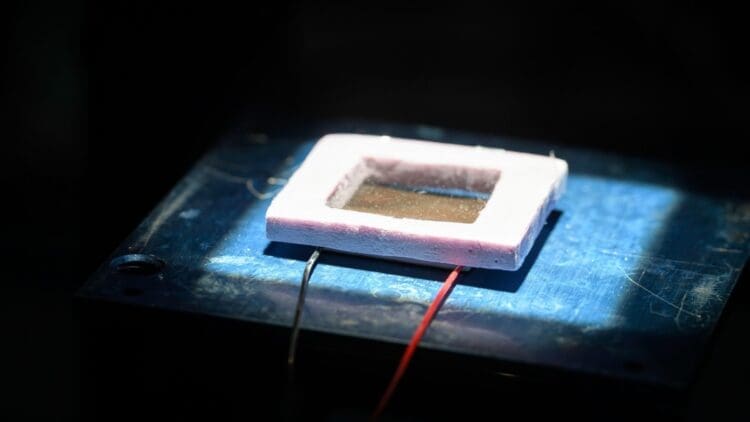

Solar thermoelectric generators have been a quiet frustration for decades. They can pull electricity from virtually any heat source — not just sunlight — yet standard, unoptimized designs operating in normal air have stubbornly converted less than 1% of solar energy into usable power. Meanwhile, ordinary rooftop panels hit around 20%. While complex lab setups pushed those numbers slightly higher using expensive vacuum systems, everyday devices remained stuck. Researchers kept returning to the same fix: better semiconductor materials, modest gains, repeat.
A team at the University of Rochester decided to ask a different question entirely. Instead of improving what everyone else had been improving, they left the semiconductors completely alone—and looked somewhere else.
A promising technology stuck in neutral
Solar thermoelectric generators work on a beautifully simple principle. Heat one side of the device, keep the other side cool, and the temperature difference drives electricity through the semiconductor materials sandwiched between them. This is the Seebeck effect — no moving parts, no complex chemistry, just a thermal gradient doing quiet work.



Their theoretical appeal is genuine. Unlike photovoltaic panels, which respond only to light, STEGs can draw on industrial waste heat, body warmth, or diffuse solar radiation. That flexibility makes them attractive across an unusually wide range of applications.
Yet practical, open-air efficiency numbers have remained discouraging. Standard STEGs convert less than 1% of sunlight into electricity, while residential solar panels manage around 20%. That gap is not a rounding error—it is an enormous practical barrier, and it has resisted nearly every materials-science advance the field could offer.
A different question: what if you ignored the semiconductors?
Professor Chunlei Guo and his colleagues at the University of Rochester’s Institute of Optics decided to reframe the problem entirely. Their core insight was that the semiconductors were not necessarily the limiting factor — the real opportunity lay in how the device managed heat on its two outer sides.
The logic is straightforward. Make the hot side absorb and retain more heat. Make the cold side shed heat more aggressively. The temperature difference across the device grows, and a larger temperature difference means more electricity — without touching a single semiconductor. This two-pronged thermal management philosophy guided the entire study, published in Light: Science and Applications, and it represents a conceptual shift as much as a technical one.
Black metal, mini greenhouses, and laser-sculpted aluminum
The first strategy targeted the hot side. Using powerful femtosecond laser pulses, the team etched nanoscale structures onto tungsten, transforming it into what Guo’s lab calls “black metal.” The treated surface selectively absorbs light at solar wavelengths while reducing heat loss at other wavelengths—capturing more energy and holding onto it longer.
The second strategy was almost agricultural in its simplicity: a transparent plastic sheet placed over the black metal surface, creating a miniature greenhouse effect. It reduces convection and conduction losses, trapping heat and pushing the hot-side temperature higher.
On the cold side, femtosecond lasers returned—this time applied to ordinary aluminum. The process sculpts tiny structures into the metal’s surface, producing a heat sink that dissipates heat through both enhanced radiation and convection. The researchers report this approach doubles the cooling performance of a standard aluminum heat dissipator. None of these interventions involved the semiconductor materials inside the device.
15 times more power—and a lit-up LED to prove it
The results were striking. The engineered STEG generates 15 times more power than a conventional baseline device—a figure the team demonstrated in practical terms by using their device to power LEDs far more effectively than standard open-air STEGs could manage.
Fifteen times is a large number, though worth keeping in perspective. Even with this dramatic relative improvement, STEGs have not fully closed the gap with commercial photovoltaics in raw power conversion, and significant ground remains. Still, by demonstrating that un-vacuumed, atmospheric devices can take such a massive leap, the jump is large enough to reopen serious conversations about where STEGs might fit in the broader energy landscape. The research received funding from the National Science Foundation, FuzeHub, and the Goergen Institute for Data Science and Artificial Intelligence.
From rural villages to wearable tech: what this could power next
Guo has pointed to several concrete application areas: wireless sensors for the Internet of Things, wearable devices that harvest body heat, and off-grid energy systems for rural communities without reliable grid access. STEGs are particularly well-suited to these scenarios because direct sunlight is not required—any thermal gradient will do.
Before widespread deployment becomes realistic, further efficiency gains will likely be needed. The 15-fold improvement is a proof of concept, not yet a commercial product.
What may matter most is the research direction this work opens. By demonstrating that thermal management — rather than semiconductor chemistry — can deliver dramatic gains, the Rochester team has handed the broader field a new set of questions to pursue. Other researchers now have reason to examine those same overlooked sides of the device and ask what more might be possible.
Kelly is an experienced writer with 15 years of experience exploring the big stories that shape our world, from tech breakthroughs and space exploration to climate, energy, and the fascinating quirks of science. She has a talent for turning complex ideas into sharp, memorable insights that stay with readers long after they’ve finished reading.