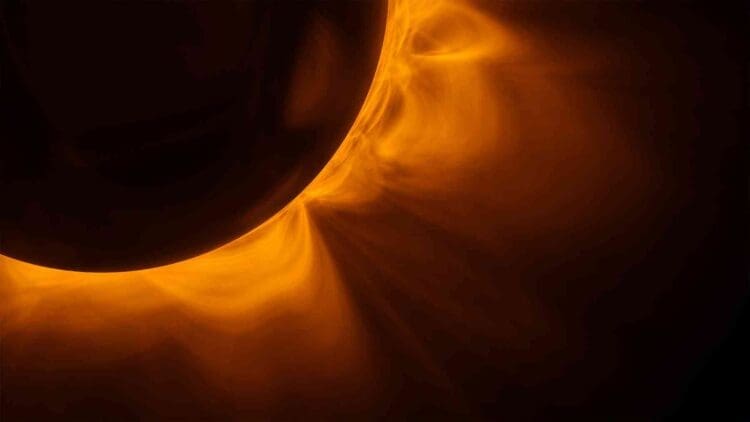

Solar flares are among the most violent events in our solar system—sudden eruptions in the Sun’s outer atmosphere that flood Earth with X-rays, threaten satellites, and disrupt the upper atmosphere within minutes. Scientists have studied them for decades. But a core assumption embedded in that research may have been wrong the entire time.
New findings led by Northumbria University suggest that ions inside solar flare plasma reach temperatures exceeding 60 million degrees—roughly 6.5 times hotter than previously believed. For decades, solar physics assumed ions and electrons in flare plasma shared the same temperature. That assumption, it turns out, may have obscured something fundamental about how flares actually work.
A 50-year puzzle hiding in plain sight
Since the 1970s, scientists have noticed something odd about solar flares. The spectral lines — bright signatures in extreme-ultraviolet and X-ray light — appeared broader than theory predicted. The leading explanation was turbulent plasma motions inside the flare, but researchers struggled for decades to pin down exactly what kind of turbulence could account for the effect.




The mystery persisted partly because of a foundational assumption that went largely unchallenged: ions and electrons in flare plasma share the same temperature. Few researchers seriously questioned whether that premise held up. Dr. Alexander Russell, an associate professor in solar physics at Northumbria University, decided to question it—and he looked outside solar physics entirely to do so.
What solar flares actually are—and why they matter
Solar flares are sudden, massive releases of energy in the Sun’s outer atmosphere, heating local plasma to above 10 million degrees in minutes while sharply increasing X-ray and radiation levels reaching Earth. That radiation poses real hazards to satellites, spacecraft, and astronauts, and it affects the upper atmosphere in ways that can disrupt communications and GPS systems.
Flare plasma consists of two particle types: ions, which carry a positive charge, and electrons. Together they form the superheated material scientists study through spectral light signatures. Understanding flare temperatures more precisely is not a purely academic exercise—better temperature models feed directly into space weather forecasting, the science that helps protect satellites, power grids, and other infrastructure from solar events.
The clue that came from somewhere else entirely
The breakthrough came when Russell’s team looked beyond solar physics. Researchers studying near-Earth space, the solar wind, and computer simulations had already established something significant: a process called magnetic reconnection heats ions roughly 6.5 times more than electrons. Russell noted this ratio appears to function as a near-universal law, confirmed across multiple research contexts. Nobody had applied that cross-disciplinary insight to solar flares.
“Nobody had previously connected work in those fields to solar flares,” Russell said. The gap was not a failure of data — it was a failure of connection between research communities working on related problems in parallel. When the team redid calculations using modern data, they found that ion-electron temperature differences can persist for as long as tens of minutes in key regions of a flare, long enough to meaningfully affect how the plasma behaves and what observers detect.
Ions at 60 million degrees — and what that explains
With the new framework in place, the numbers shift considerably. Flare ions can reach temperatures exceeding 60 million degrees Celsius — 6.5 times higher than the previously accepted figure. At those temperatures, the thermal motion of ions alone generates enough energy to account for the anomalous broadening of spectral lines that puzzled researchers for half a century.
That is the core of what Russell’s team is proposing. The unexplained line widths may not require turbulence as an explanation at all; ion temperature, previously dismissed as a variable, could do the work instead. The findings were published in the Astrophysical Journal Letters in September 2025, with Russell leading an international team that included researchers from the University of St. Andrews, the Harvard-Smithsonian Center for Astrophysics, and Lockheed Martin.
What comes next for solar physics
The research challenges decades of modeling assumptions and opens the door to revisiting prior solar flare studies with revised temperature parameters. Many existing models may need to be reexamined with ion-electron temperature differences factored in from the start. It is a significant recalibration—not just of one variable, but of how the field has framed flare physics.
Future observations will be critical. Instruments capable of resolving ion and electron signatures separately could confirm whether the new temperature ratios hold across different flare types and solar conditions. More accurate solar flare ion temperatures could also sharpen space weather prediction models that protect satellites and power grids—forecasts carrying growing importance as reliance on space-based infrastructure expands.
This work illustrates what becomes possible when researchers look across disciplinary boundaries. A 50-year mystery in solar physics may have gone unsolved not because the answer was out of reach, but because it was sitting in a neighboring field, waiting for someone to make the connection.
Kelly is an experienced writer with 15 years of experience exploring the big stories that shape our world, from tech breakthroughs and space exploration to climate, energy, and the fascinating quirks of science. She has a talent for turning complex ideas into sharp, memorable insights that stay with readers long after they’ve finished reading.