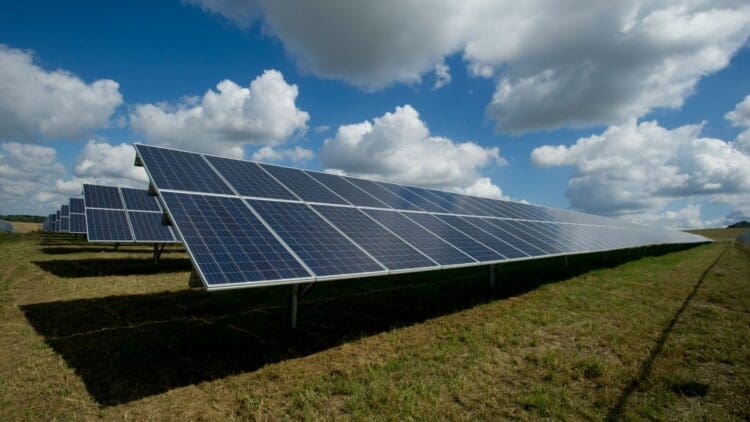

In the dry farming country around Griffith, New South Wales, rows of almond trees now share the land with more than 10,000 solar panels. The Kerarbury farm has quietly become something different from the properties around it — a place where the energy infrastructure is as deliberate as the irrigation lines.
The shift didn’t happen overnight. But the agricultural and clean energy sectors are now watching closely to see whether what’s been built here can be replicated across regional Australia.
A farm caught between rising costs and a clean energy opportunity
Agriculture is one of Australia’s most significant economic sectors, but it’s also among the most energy-intensive. Farms face pressure from volatile electricity prices, tightening emissions expectations, and the sheer operational cost of keeping large properties running. For almond growers specifically, that pressure is acute — irrigation systems, processing equipment, and cold storage all require consistent, affordable power. A disruption in supply isn’t just inconvenient; it can damage an entire season’s crop.



Griffith, in the Riverina region of New South Wales, sits at the center of Australia’s almond industry. The area’s flat terrain, high solar irradiance, and established agricultural infrastructure made it a logical candidate for testing whether clean energy and farming could genuinely coexist at scale. That question led AGL Energy and Sungrow to partner on the Kerarbury project — moving one working almond farm away from fossil fuel dependence without compromising the reliability that intensive agriculture demands.
How the system actually works: solar, storage, and 10,000 panels
The installation at Kerarbury covers a total capacity of 5.99 MW, built around more than 10,000 solar panels distributed across the property. At its core sit two complementary technologies from Sungrow: the SG4950HV-MV power conversion system and the PowerTitan Liquid-cooled battery storage system, using ST2293UX battery units. Together, they generate approximately 14,000 MWh of clean electricity each year — enough to cover the farm’s substantial energy demands across its busiest operational periods.
The battery storage component is what separates this from a standard solar installation. Solar generation is inherently variable; output drops on cloudy days and stops entirely at night. PowerTitan units absorb excess generation during peak sunlight hours and release it when the panels aren’t producing — smoothing out the gaps that would otherwise force the farm to draw from the grid or fossil fuel backup. For cold storage operations, where continuity is non-negotiable, that kind of stability matters considerably.
The numbers: emissions cut, costs lowered, renewables at 83%
The headline figure is an estimated 83% renewable energy penetration rate, meaning the farm now sources the vast majority of its electricity from its own clean generation rather than the conventional grid. Not long ago, this property would have been almost entirely dependent on fossil-fueled power. The projected annual CO₂ reduction sits at 7,500 metric tons — roughly equivalent to taking around 1,600 average passenger vehicles off the road each year.
The economics are equally relevant. Lower reliance on grid electricity reduces operational costs, and with energy prices stabilized through on-site generation and storage, the farm is far less exposed to the price volatility that has strained agricultural budgets across the country. That stability, sustained over time, translates into improved profitability.
Agrivoltaics as a model: what this project signals for regional Australia
The Kerarbury project sits within a growing practice known as agrivoltaics — the deliberate co-location of solar energy infrastructure and active food production on the same land. Rather than treating energy generation and agriculture as competing uses of space, agrivoltaics positions them as complementary. It’s a reframing that’s gaining traction, and Kerarbury is one of the more concrete examples of it working at scale.
Brendan Weinert, Head of Sustainable Business Energy Solutions at AGL Energy, framed the project’s significance directly: “Partnering with Sungrow to integrate storage solutions is a powerful example of how the energy and farming sectors can work together to drive meaningful emissions reductions, improve energy reliability, lower costs, and build a more sustainable future for regional communities.”
Joe Zhou, Country Director of Sungrow Australia, shared a similar view: “This project demonstrates how renewable energy can transform agriculture. By working with AGL, we are enabling farmers to harness clean energy reliably and cost-effectively while contributing to a more sustainable future.”
Australia’s broader clean energy transition has largely centered on urban grids and large-scale renewable projects. What Kerarbury suggests is that regional agriculture — with its land availability, high energy demand, and real exposure to climate risk — could become an active participant in that transition rather than a bystander. Whether other farms follow will depend on financing, infrastructure access, and policy support. But the benchmark has been set.