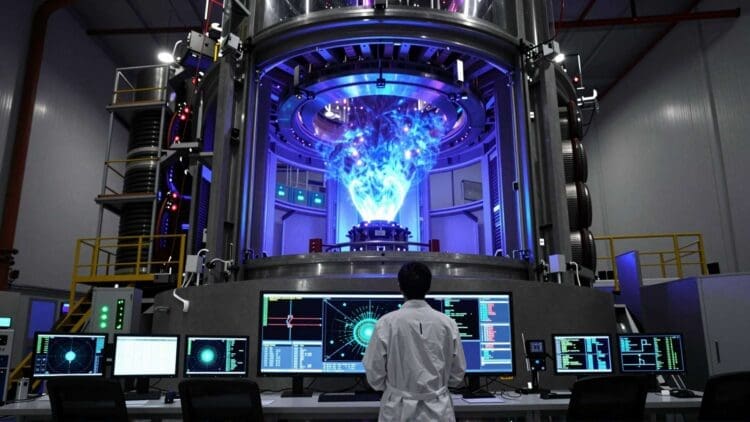

Researchers at the U.S. Department of Energy’s Princeton Plasma Physics Laboratory have cleared a significant hurdle in the pursuit of commercial fusion energy. In a paper published in Nature Communications in May 2024, lead author SangKyeun Kim and colleagues report that machine learning software successfully prevented plasma instabilities in two separate tokamaks — DIII-D and KSTAR — both operating in high-confinement mode. It marks the first time this has been achieved under conditions directly relevant to commercial-scale fusion power.
Machine learning controls plasma instabilities across two tokamaks
The May 2024 Nature Communications paper details how PPPL researchers deployed the same machine learning code on two different tokamaks — the DIII-D device in the United States and KSTAR in South Korea — achieving stable high-confinement mode in both without triggering instabilities.
“The results are particularly impressive because we were able to achieve them on two different tokamaks using the same code,” said lead author SangKyeun Kim. That point carries real weight. Fusion devices differ in design, scale, and operating conditions, so a single transferable codebase represents meaningful progress toward general-purpose plasma control — something the field has needed for a long time.


This is the first time researchers have achieved this result under conditions directly relevant to commercial fusion power. The gap between laboratory demonstration and commercially relevant performance is substantial, and narrowing it moves the technology closer to practical deployment.
Why plasma instabilities pose a critical challenge for fusion
Fusion plasma offers little margin for error. Inside a tokamak, conditions shift every millisecond and require continuous management. Human operators simply cannot respond at that speed.
When control fails, the result can be a disruption — a sudden magnetic perturbation that destabilizes the plasma entirely. These are not merely inefficiencies. Disruptions can cause severe physical damage to the fusion vessel, making them unacceptable in a commercial reactor designed to run reliably for years.
The challenge is most acute in H-mode. High-confinement mode is the plasma state required for commercial power generation, but it is also the hardest to stabilize. At the plasma’s edge, explosive instabilities called edge-localized modes, or ELMs, can erupt without warning — pulling impurities from the vessel walls into the plasma and reducing fusion efficiency. Suppressing ELMs while maintaining H-mode is one of the central problems in fusion engineering.
How the machine learning system works
Traditional control code follows fixed instructions. Machine learning works differently: it analyzes data, identifies relationships between variables, and adjusts its responses based on what it learns. That adaptability is what makes it useful for real-time plasma control.
The system developed at PPPL — built by Egemen Kolemen, associate professor and PPPL researcher — can predict when a disruption is forming, determine which parameters need adjustment, and execute those changes before the instability develops, all within milliseconds. It does not wait for a problem to emerge. It anticipates and corrects ahead of the event.
PPPL has been building toward this capability for years. Back in 2019, Principal Research Physicist William Tang and his team became the first to demonstrate transferring disruption-control models from one tokamak to another. That work, published in Nature, established the conceptual foundation for what Kim’s team has now achieved at commercially relevant scale.
Broader AI applications in fusion research at PPPL
The plasma stability work is part of a wider effort at PPPL to apply machine learning across multiple areas of fusion research, each targeting a different computational bottleneck.
Michael Churchill, PPPL’s Head of Digital Engineering, is using machine learning to accelerate stellarator design optimization. Stellarators are geometrically more complex than tokamaks and require running multiple simulation codes during design validation — some of which, including the widely used XGC, demand advanced supercomputers and still do not run quickly. Machine learning helps close that gap by enabling faster, higher-fidelity calculations.
A separate team is applying AI to the HEAT code, which models heat flux in tokamak divertors. Researcher Doménica Corona Rivera has already reduced computation time dramatically while keeping results roughly 90% consistent with the original code. The goal is to run the code between plasma shots and use those results to adjust parameters for the next discharge.
Associate research physicist Álvaro Sánchez Villar and his team are using machine learning to optimize ion cyclotron radio frequency heating. Their accelerated models produce results in microseconds rather than minutes, with minimal accuracy loss — a difference that makes real-time control applications feasible rather than theoretical.
Rounding out the effort, Principal Research Physicist Fatima Ebrahimi leads a four-year DOE-funded project studying plasma edge behavior through a combination of experimental data, validated simulations, and machine learning. The aim is to identify strategies for confining plasma in commercial-scale tokamaks, which will operate at larger sizes and higher temperatures than today’s experimental devices.
Key takeaways
The PPPL findings represent several firsts taken together. The same machine learning code worked across two different tokamaks, both operating in H-mode — the commercially required plasma state — and both avoided the instabilities that have historically made that state so difficult to sustain.
The broader AI program at PPPL suggests this is not an isolated result. Machine learning is being applied to stellarator design, heat flux modeling, plasma heating, and edge confinement, with each effort targeting a specific obstacle on the path to commercial fusion. The 2024 Nature Communications paper is one data point in a larger, ongoing effort to make fusion reactors controllable, durable, and eventually viable at scale.

Carlos is an engineer with strong expertise in technical and industrial topics. He previously worked at international companies such as Siemens and speaks Spanish, German, English, and Italian.