
Solar panels are eating America’s farmland, but experts say urban sprawl causes far more permanent damage while solar actually offers struggling farmers a rare financial lifeline through agrivoltaics, local tax revenue, and land that can farm again in 40 years
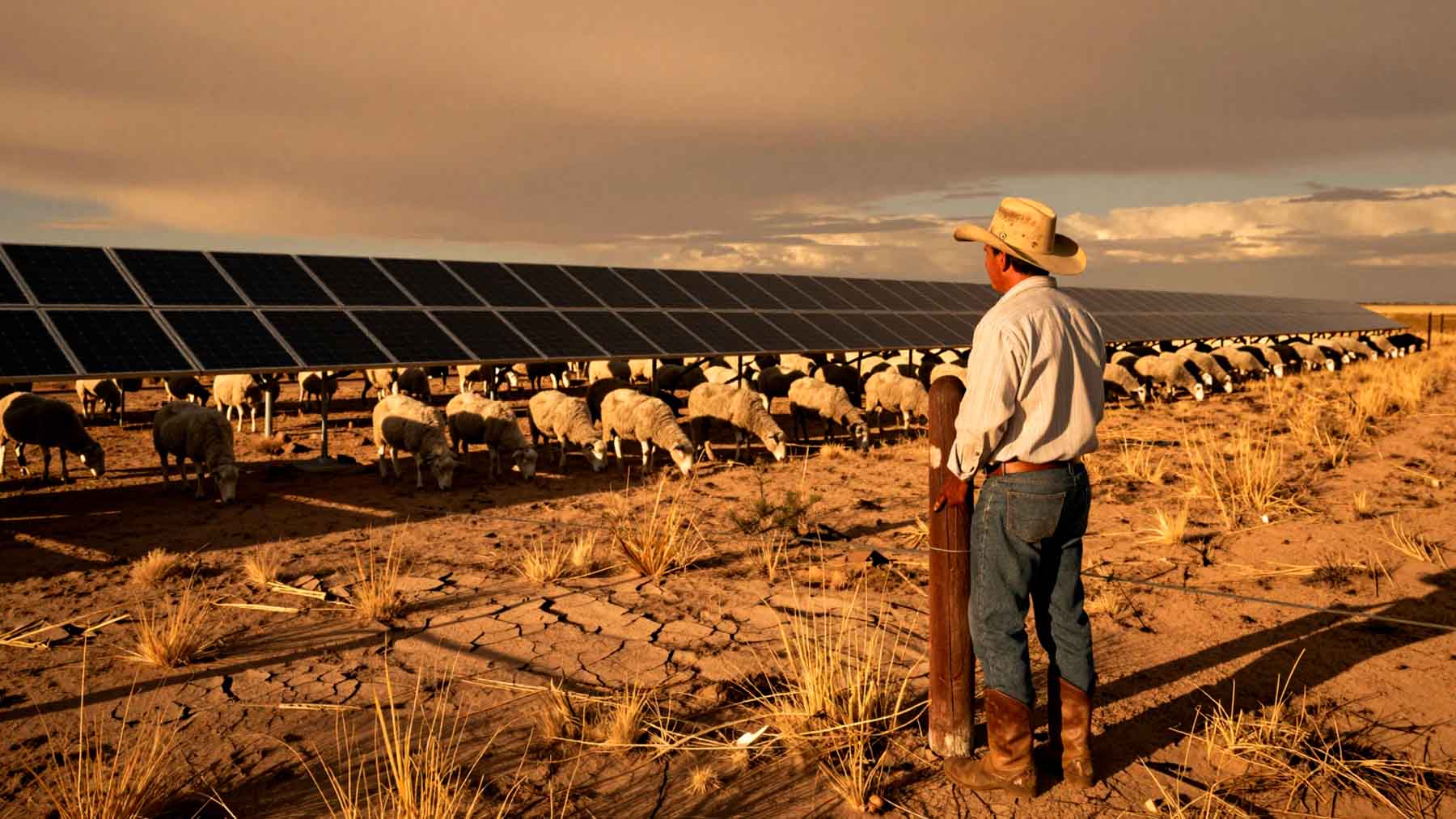 Image generated with artificial intelligence
Somewhere in West Texas, 3,000 sheep are grazing beneath rows of solar panels across 8,000 acres—and their keeper, Chad Raines, calls it the thing that finally saved his farm after more than a decade of losses.
It’s a scene that looks nothing like the farmland crisis Washington says it’s trying to prevent. The federal government recently cut funding for solar projects on agricultural land, arguing that panels are pricing farmers out and consuming America’s best soil. But a growing number of farmers say solar may be the only thing keeping them in business at all.
A Texas farmer’s unlikely lifeline
Chad Raines inherited his family’s cotton farm in West Texas in 2008. The first year looked promising. Then came 11 straight years of losses.
Widespread solar and wind development could generate local tax revenue, create rural jobs, and give farmers income that doesn’t move with commodity prices.
“We just kept digging our hole deeper,” Raines said. He faced a stark choice: quit farming or keep losing money. Then a third option appeared—agrivoltaics, a practice that combines solar energy with livestock grazing.
Today, Raines is contracted by solar companies to graze his sheep beneath their panels, keeping vegetation trimmed while feeding his flock. It’s a dual-use model that costs him little and earns him a stable income. After more than a decade of red ink, it’s what kept him on the land.
His story isn’t unique. Across the country, farmers are leasing land to renewable energy developers or grazing livestock on active solar sites. For many, it’s less a philosophical choice than a financial one—a way to survive in an industry where competing against large agribusiness has become nearly impossible for small and midsize producers.
Washington draws a line in the soil
In August 2025, the USDA pulled funding from loan programs that had supported solar projects on farmland. Agriculture Secretary Brooke Rollins framed the move bluntly: “Our prime farmland should not be wasted and replaced with green new deal subsidized solar panels.”
The administration’s argument is that subsidized solar drives up land prices and pushes working farmers out—positioning solar development and food production as fundamentally incompatible, a zero-sum contest for the same acres.
The Rural Energy for America Program (REAP), which funds small-scale solar installations for farmers and rural businesses, has also stalled. No new grant cycle has been announced as of early 2026. Critics point out that most REAP projects are small and built on marginal land, not prime agricultural soil. The federal position, however, treats all solar on farmland as the same problem.
The real threat experts point to
Land use experts push back on that framing—and they push back hard.
Jeff Risley, executive director of the Renewable Energy Farmers of America, points to urban sprawl as the primary driver of permanent farmland loss. “Thousands of acres are going to [urban development], and that’s completely taking it out of commission,” he said.
The distinction matters enormously. When farmland becomes a parking lot or a housing development, it’s effectively gone. Solar is different. “It’s a 30- to 40-year commitment, but it can also go back to agricultural land at the end of that time,” Risley said.
An estimated 83% of new solar projects are expected to be built on farmland, according to the American Farmland Trust—but that figure represents only a small fraction of total U.S. farmland. Urban development, by contrast, expands continuously and irreversibly. That comparison rarely surfaces in policy debates, even though the data suggests it should.
When solar feels like an invasion
Numbers don’t always capture what people actually see out their windows.
In upstate New York, Alex Fasulo moved to the town of Fort Edward in 2023 looking for a rural lifestyle. She expected farms and open land. What she didn’t expect was a proposed 530-acre solar project by Canadian firm Boralex—and she built a 650,000-follower Instagram audience opposing it.
“I didn’t sign up for this,” she said.
Her reaction reflects something real about how solar development lands differently depending on geography. In Texas, vast open land buffers solar arrays from small communities. In densely settled rural states like New York, panels can appear right next to a town, making the change feel sudden and total.
Risley acknowledges the tension. He advocates for community benefit agreements—contracts between developers and towns that can guarantee tangible local goods alongside tax revenue, things like a new grocery store or community center. The idea is to reframe solar not as something happening to a community, but for it. Scott Laeser of the Rural Climate Partnership takes a longer view: “Our farmland has always been used differently than it’s used today.” Pastures gave way to monocultures. Now solar enters the mix. The landscape has never been fixed.
Rural emissions, rural solutions
The stakes of this debate extend well beyond individual farms or towns.
A 2025 Rural Climate Partnership report found that rural America—home to less than 20% of the U.S. population—accounts for 38% of national carbon emissions. Agriculture alone contributes 10.5% of total U.S. emissions. Rural renewable energy isn’t just an economic question. It’s a decarbonization imperative.
Widespread solar and wind development could generate local tax revenue, create rural jobs, and give farmers income that doesn’t move with commodity prices. Texas is projected to overtake California in solar production by 2030, driven largely by farmland development—and that trajectory continues regardless of federal headwinds.
Raines puts it plainly: if policymakers want farmers to keep land in agriculture, they need to make farming profitable enough to stay in. Solar isn’t the enemy of the American farm. For many farmers, it may be the only reason one still exists.
The real question buried in this debate isn’t whether solar panels belong on farmland. It’s what we actually want rural America to look like—and who gets to decide. Parking lots don’t graze sheep. Solar panels, it turns out, sometimes do.
Kelly is an experienced writer with 15 years of experience exploring the big stories that shape our world, from tech breakthroughs and space exploration to climate, energy, and the fascinating quirks of science. She has a talent for turning complex ideas into sharp, memorable insights that stay with readers long after they’ve finished reading.
