
Planting new trees is good for cities, but an 11-year look at Chicago’s deadliest neighborhoods reveals what actually keeps people alive
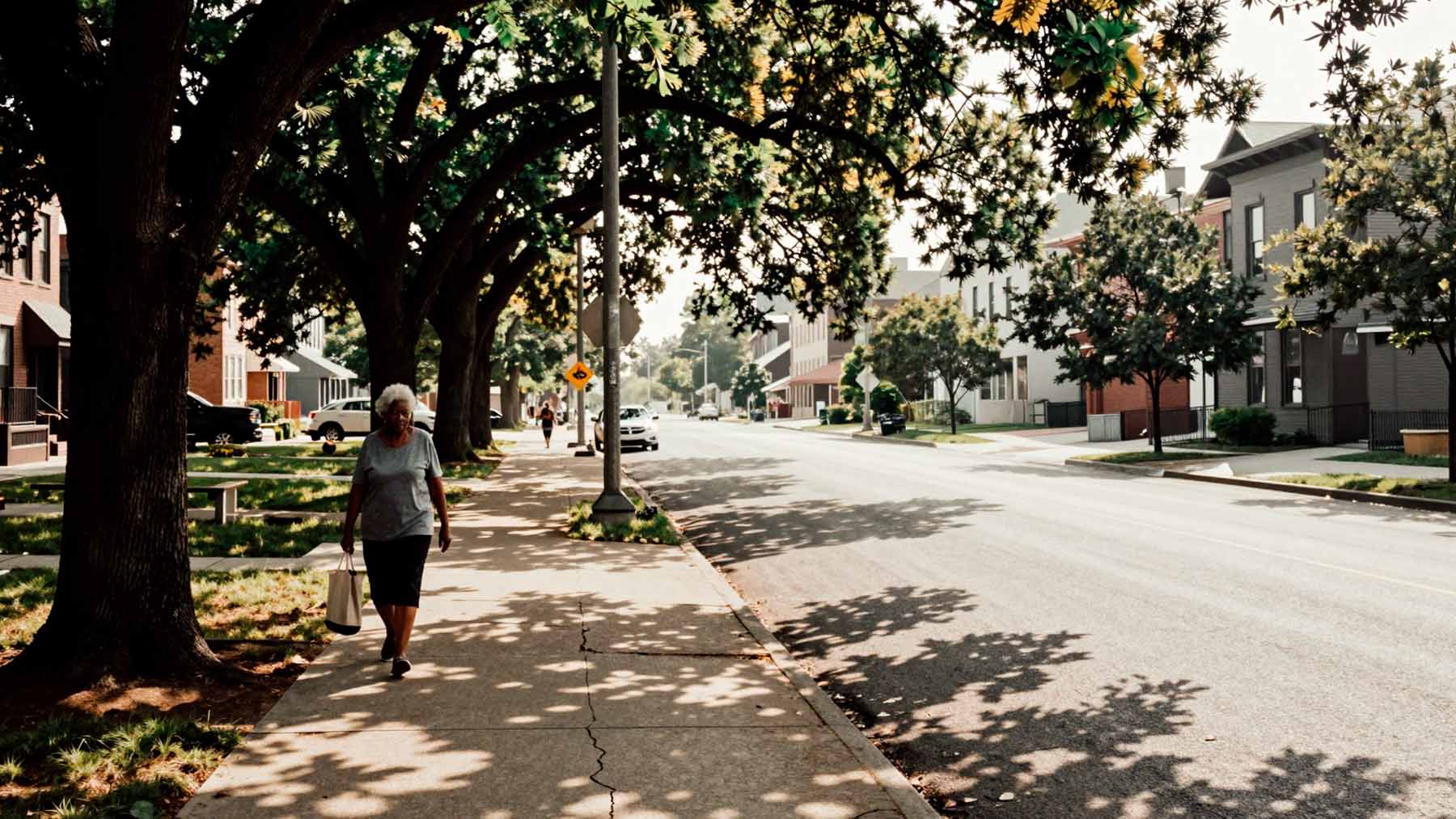 Image generated with artificial intelligence
Walk one block through Chicago’s South Side under a canopy of towering oaks, and the air feels forgiving. Walk the next block, bare and sun-baked, and the heat becomes oppressive. That contrast sits at the center of an urgent urban health debate. For years, American cities have treated tree-planting initiatives as their main defense against rising summer temperatures and heat risks. Yet a landmark 11-year analysis of Chicago neighborhoods reveals that the connection between trees and human survival is far more complex than simply counting saplings on a sidewalk.
The assumption behind urban tree-planting programs
Municipalities across the United States have funneled millions into high-profile tree-planting campaigns. The logic seems intuitive: plant more trees, expand the canopy, and save lives. Mayors announce ambitious targets while nonprofits organize weekend volunteer events, generating goodwill and positive headlines. However, the scientific foundation behind these policies carries a hidden flaw. Most past studies linking tree canopy to lower mortality relied on single-point-in-time snapshots—a single photograph of a neighborhood’s greenery rather than a long-term film. Consequently, researchers had never tracked how annual canopy changes directly relate to death rates over time.
Eleven years of data across Chicago’s neighborhoods
A study published in GeoHealth addressed this gap by tracking environmental and health data over an extended timeline. Researchers gathered annual satellite imagery measuring tree canopy across every Chicago census tract from 2011 through 2021, pairing it with over 220,000 official death records. Statistical models controlled for key mortality drivers, including summer temperatures, air pollution, median household income, and historical residential segregation. The crucial methodological breakthrough was tracking year-over-year canopy changes rather than measuring total greenery at an isolated moment. That shift in focus radically altered the study’s conclusions.
Conversely, neighborhoods experiencing canopy loss saw death rates climb, with the sharpest increases occurring in the city’s hottest, most vulnerable areas.
What the data actually showed
The findings disrupted standard urban forestry assumptions. The raw volume of trees standing in a neighborhood was not what most strongly tracked with survival rates. Instead, the critical factor was directional change: whether canopy was growing or shrinking. Each single percentage-point increase in canopy year-over-year was linked to roughly a 10% drop in overall mortality. The largest survival gains occurred in cardiovascular, respiratory, and mental health-related deaths. Conversely, neighborhoods experiencing canopy loss saw death rates climb, with the sharpest increases occurring in the city’s hottest, most vulnerable areas.
A map of inequality written in tree loss
The spatial patterns of canopy loss directly reflected Chicago’s history of urban disinvestment. The city’s South and West Sides experienced the steepest canopy declines, the hottest summer temperatures, and the highest mortality rates. Crucially, several of these neighborhood tracts initially had above-average tree cover, making their subsequent loss of mature trees catastrophic. Meanwhile, affluent lakefront communities maintained cooler temperatures and lower death rates. Tree loss, like so many health burdens, concentrates where communities can least afford it.
Why a newly planted sapling is not a substitute for an old oak
This reality challenges core policy assumptions: planting new saplings cannot immediately replace losing mature trees. Researchers modeled a hypothetical 0.03% annual canopy growth—matching Chicago’s pace of planting 14,000 trees yearly—and estimated it could prevent roughly 105 deaths per year. However, those gains require newly planted saplings to reach maturity, which takes decades. A young sapling lacks the dense leaf structure required to provide immediate cooling or pollution filtration. Evidence from Portland, Oregon, confirms that human mortality reductions scale significantly as trees age, making young saplings a slow solution to an immediate crisis.
What cities should do differently
These findings demand a fundamental shift in urban forestry strategy. Across 33 U.S. cities, research shows nearly three-quarters are actively losing greenery, with the hottest neighborhoods losing the most. A planting-first mindset treats the symptom while ignoring the underlying wound. While expanding urban forests remains valuable, an 11-year look at Chicago’s deadliest neighborhoods reveals what actually keeps people alive: protecting existing mature tree canopy from being lost in the first place. Preserving towering, established trees saves lives today—long before newly planted saplings ever grow enough shade to make a difference.
Read the complete study: Garcia, H. C., Graffy, P. M., Barrett, B. W., Visa, M. A., Jia, J., Mallen, E., … & Horton, D. E. (2026). Increasing urban tree canopy associated with reduced mortality: A longitudinal analysis of Chicago neighborhoods. GeoHealth, 10(8), e2025GH001651.
Kelly is an experienced writer with 15 years of experience exploring the big stories that shape our world, from tech breakthroughs and space exploration to climate, energy, and the fascinating quirks of science. She has a talent for turning complex ideas into sharp, memorable insights that stay with readers long after they’ve finished reading.
