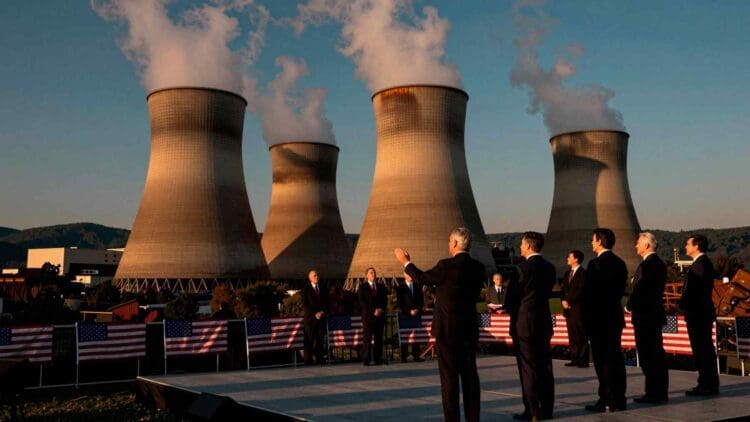

President Trump is preparing to direct roughly $700 million in federal funds toward coal infrastructure — including $425 million under the Defense Production Act for 13 existing power plants, $185 million in Energy Department grants for two new plants and one restart, and $75 million for a proposed coal export terminal in Oakland, California.
The announcement, expected at a White House event Thursday with lawmakers and governors from coal-producing states, marks one of the most direct federal financial commitments to coal in recent memory.
Trump Announces $700 Million Federal Coal Funding Package
Thursday’s Oval Office event drew lawmakers and governors from Wyoming, West Virginia, and other coal-producing states. The gathering underscored how politically central coal remains for the Trump administration, even as the fuel’s share of the national grid has declined substantially.


The $425 million in Defense Production Act funds will flow to 13 existing coal plants across 10 states — West Virginia, Kentucky, North Carolina, Indiana, Tennessee, Arkansas, Arizona, Oklahoma, North Dakota, and Wisconsin. A White House official indicated the money could support operational upgrades at those facilities, though full project-level details were not immediately released.
Separately, $185 million in Energy Department grants will help build two new plants pursued by Terra Energy Center Corp. in Alaska and TerraPurus Inc. in West Virginia, and restart the AES Warrior Run generating station near Cumberland, Maryland. The remaining $75 million in DPA funds is earmarked for the Oakland export terminal.
Why the Administration Is Invoking the Defense Production Act
The Defense Production Act dates to 1950, when President Harry Truman used it to accelerate steel production during the Korean War. Over the decades since, the law has been applied to manufacture face masks during COVID-19, support solar deployment, and address a national baby formula shortage — a wide-ranging tool that different administrations have stretched in different directions.
Trump has invoked it more aggressively than his predecessors to advance domestic energy priorities, previously using the act to restart offshore oil production near California’s coast. The latest application extends that pattern into coal.
Administration officials frame the move around grid reliability and the energy demands of artificial intelligence. Interior Secretary Doug Burgum has argued that winning the AI race is a national security imperative — and that coal-fired power is essential to meeting the surge in electricity demand that AI data centers require.
Who Receives the Funding and What It Covers
Named utility beneficiaries include Duke Energy, Hallador Energy, Oklahoma Gas & Electric, and at least one subsidiary of American Electric Power. Funds directed to existing plants may be used for upgrades, though complete project details had not been released at the time of the announcement.
The two new plant projects carry additional financial commitments. Under the Energy Department grant structure, Terra Energy Center Corp. and TerraPurus Inc. must provide matching funds, bringing total planned spending on those two projects alone to $386 million.
The Oakland Bulk and Oversized Terminal would receive $75 million in DPA funds. If built, it could enable exports of up to 12 million tons of coal annually, sourced from Wyoming, Montana, and other western states.
Criticism From Environmental and Conservation Groups
Environmental groups have pushed back sharply. Their central argument is that directing federal money toward coal prolongs dependence on a fossil fuel driving climate change — at a moment when emission-free alternatives are increasingly available and cost-competitive.
Critics also contend that renewables and natural gas are already cheaper than coal for electricity generation, making the subsidies an economic misstep as well as an environmental one.
The Oakland terminal faces its own entrenched opposition. Conservationists have fought development at that site for nearly two decades, with a persistent concern over air quality: coal dust from uncovered rail cars supplying the terminal could harm surrounding communities.
Context: Coal’s Declining Share and Broader Trump Energy Policy
Coal once supplied more than half of all US electricity. By 2024, that share had fallen to roughly 17% as utilities shifted toward cheaper natural gas and renewables — a trajectory driven primarily by market forces, which makes the scale of this federal investment particularly notable.
Trump has taken several parallel steps to slow that decline. The Energy Department has issued emergency orders requiring certain coal plants to keep operating past planned shutdown dates, citing grid reliability. The Interior Department has moved to expand federal land available for coal leasing in North Dakota, Montana, and Wyoming. Trump has also directed Defense Secretary Pete Hegseth to enter agreements purchasing electricity from coal plants to power military operations.
Taken together, the $700 million package and these related orders represent the most concentrated federal effort to sustain coal infrastructure in years. The funds would support existing plants, enable potentially the first new US coal plants built since 2013, and open a new western export route — all framed under the banner of energy dominance and national security.