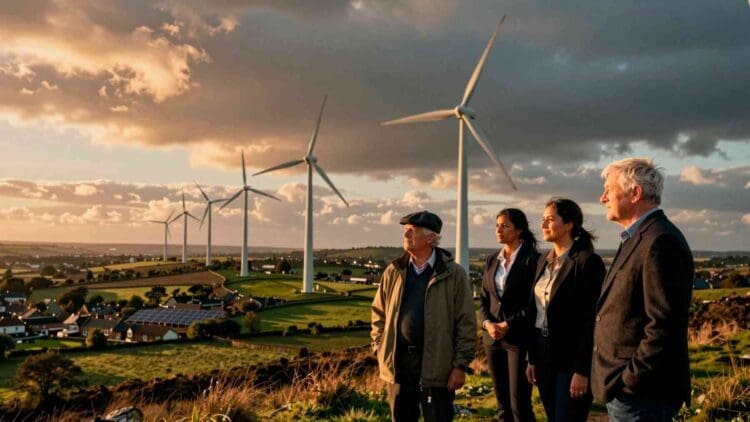

A new report published by eleven UK energy trade bodies shows that nearly two-thirds of British adults believe clean power strengthens the country’s energy security — a view held across every major political affiliation. The findings come from Watt Communities Want, which surveyed 996 UK adults between March 23 and April 20, 2026, on their attitudes toward the energy transition, infrastructure investment, and future priorities.
Poll finds majority link clean energy to national security
The 63% figure is notable not just for its size, but for its consistency. The survey found no meaningful divide by age, gender, or party affiliation — a rare alignment on a topic that often fractures along political lines. Whether respondents identified as Conservative, Labour, Liberal Democrat, or otherwise, the view that clean power supports energy security held firm across every group.
Commissioned by eleven energy trade bodies — including RenewableUK, Energy UK, and Solar Energy UK — the report is titled Watt Communities Want: Six Insights into UK Public Opinion on Energy. It covers six key themes: energy bills, infrastructure investment, climate priorities, and public misconceptions about how the energy system currently works, among others.




Methodology: social circle surveying and triple tense technique
Early Studies, the polling firm behind the research, used two methods designed to reduce the distortion common in surveys on politically sensitive topics.
The first is social circle surveying, which asks respondents what their friends, family, and colleagues think rather than what the respondents themselves believe. It surfaces genuine opinions that individuals might hesitate to express directly. Alfred Malmros, co-founder of Early Studies, described climate polling as “uniquely vulnerable to people telling us what they think they should say,” adding that the social circle method “strips out that performance.”
The second method — the triple tense technique — asked respondents to consider three time points: what people think now, what they thought in 2020, and what they expect to think in 2030. Rather than capturing opinion at a single moment, it maps the direction of public sentiment over time. Together, these approaches aim to produce a more accurate picture of what the British public genuinely believes about energy, rather than what respondents feel they ought to say.
Bills remain top concern, but public supports spreading investment costs
Cost is still the dominant issue. Lowering energy bills ranked as the highest priority for 72% of respondents, reflecting sustained pressure on household finances in recent years. The survey also found broad recognition that international events — including the ongoing crisis in the Middle East — have contributed to rising energy costs.
Yet despite that bill anxiety, the public does not appear to favor short-term fixes at the expense of longer-term stability. Fifty percent of respondents said they prefer infrastructure costs spread fairly over many years; only 28% said they would rather pay less now, even if that means higher costs later. Support for energy storage reached 57%, with 46% backing grid upgrades — both seen as essential to a more flexible energy system.
Climate change and air quality rank high in future priorities
Beyond bills and security, the survey tracked how other priorities may shift over time. Fighting climate change currently ranks third among six options in 2026, cited by 39% of respondents. That figure is projected to rise to 49% by 2030, at which point it would rank above energy security.
Reducing air pollution ranked second in the 2026 results at 37%. The data suggests it could become the single top concern by 2030, cited by 42% of respondents — a notable climb. These projections vary somewhat by political affiliation, though the overall direction appears consistent across groups.
Clean energy is also increasingly framed in economic terms. The report identifies growing public awareness of the sector as an industrial and employment opportunity, a shift that several of the commissioning trade bodies highlighted in their responses to the findings.
Significant public misconceptions about the energy system persist
Despite the broadly positive findings, the report identifies areas of persistent misunderstanding. Respondents significantly overestimated the profit margins that energy suppliers take from bills and underestimated how much of the UK’s electricity already comes from clean sources.
Most respondents also believed the government’s Clean Power 2030 target means achieving 100% renewable electricity — which is not its actual definition. The report’s authors and commissioning trade bodies called for clearer, more consistent communication from both the energy sector and government to close these gaps.
Taken together, the findings suggest that public support for the clean energy transition is broader and more durable than political debate might imply. Majorities back long-term infrastructure investment, recognize the link between homegrown clean power and energy security, and expect climate and air quality concerns to grow in importance. Public backing exists — but it rests on a foundation that includes meaningful gaps in factual understanding of the energy system as it stands today.