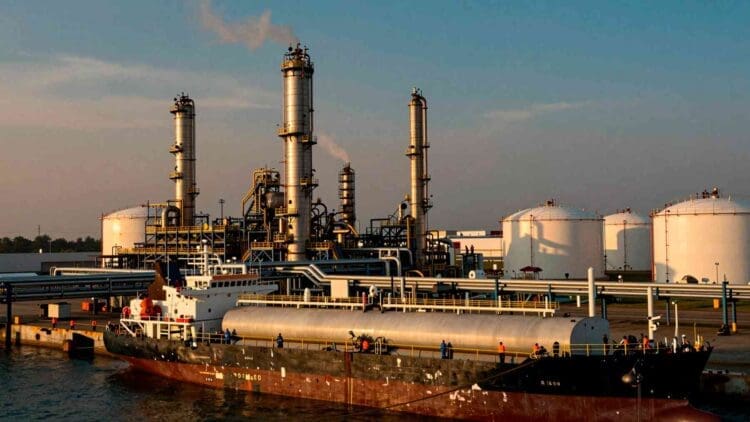

Venezuelan crude is already flowing into U.S. ports at close to 600,000 barrels per day — roughly half of the country’s total exports — and American refiners could soon be taking in even more. Speaking Friday at Port Houston, Energy Secretary Chris Wright said domestic refining capacity is positioned to absorb additional volumes from Venezuela and that the country’s share of exports heading to the U.S. may grow in the coming months.
Wright’s Statement at Port Houston
Wright delivered the remarks at Port Houston, one of the country’s busiest energy trade hubs. His comments were brief but direct: Venezuela is currently sending approximately 600,000 barrels per day to the United States, about half of its total export volume of 1.2 million barrels per day.
That share is not fixed. Wright indicated the percentage of Venezuelan exports heading to the U.S. could increase over the coming months—a signal that Washington sees room for further growth in those flows. He did not specify what conditions or agreements might drive that increase, but his framing left little room for interpretation: American refining infrastructure is ready to handle more.




Iran’s Oil Exports Halted Amid Middle East Conflict
Wright also addressed a significant disruption on the other side of the global supply picture. Iran, he said, is not currently exporting any oil or petroleum products — a halt he linked directly to the ongoing Middle East conflict, though he offered no timeline for when Iranian exports might resume.
The absence of Iranian supply represents a meaningful gap in global markets. Wright framed U.S. supply as a stabilizing force during this period of uncertainty, though he did not elaborate on the specific mechanisms or volumes involved.
Effect on U.S. Oil Supply and Refining Operations
The practical implications of Wright’s remarks center on Gulf Coast refineries. These facilities are well-suited to process heavy, high-sulfur crude—exactly the type Venezuelan grades represent—so increased imports would raise utilization rates at those plants.
A higher share of Venezuelan crude in the U.S. supply mix could help offset some of the volume Iranian exports previously contributed to global markets. More Venezuelan crude coming in, no Iranian crude going out: Wright treated these two dynamics as directly connected. His public statement that U.S. refining capacity can absorb more Venezuelan oil also carries a policy signal — openness at the federal level to expanding those flows, at least under current conditions.
Background: Venezuelan Exports and U.S. Sanctions Policy
Venezuela’s oil sector has operated under shifting U.S. sanctions regimes for several years. Those sanctions have at various points restricted American companies from purchasing Venezuelan crude, reshaped trade flows, and driven sharp declines in Venezuelan production.
The country’s current export level of 1.2 million barrels per day reflects a partial recovery from previous lows, though it remains well below the heights Venezuela reached decades ago. Infrastructure challenges and the geopolitical environment surrounding U.S. policy have made the path back uneven. Gulf Coast refineries were historically designed around heavy, high-sulfur crude—grades that match Venezuelan oil closely—which makes the U.S. a natural destination when trade conditions allow.
With Iran absent from export markets and the U.S. positioning itself to fill that gap, Venezuela’s role in American refinery feedstock has become more strategically relevant than it was even a year ago.
Venezuela Is on the Rise as a Supplier
Wright’s remarks at Port Houston add up to a clear picture. Venezuelan crude is already a significant input for U.S. refiners at roughly 600,000 barrels per day; that volume could grow, and Wright says domestic capacity can handle it.
Iran’s export halt — tied to the Middle East conflict — has removed a notable source of global supply. The U.S., by Wright’s account, has moved to fill that role. For Gulf Coast refiners built around heavy crude processing, Wright’s comments point toward continued or expanded Venezuelan imports in the near term. No formal policy changes were announced Friday, but the Energy Secretary’s public posture leaves little ambiguity about the direction Washington is comfortable moving in.
Kelly is an experienced writer with 15 years of experience exploring the big stories that shape our world, from tech breakthroughs and space exploration to climate, energy, and the fascinating quirks of science. She has a talent for turning complex ideas into sharp, memorable insights that stay with readers long after they’ve finished reading.