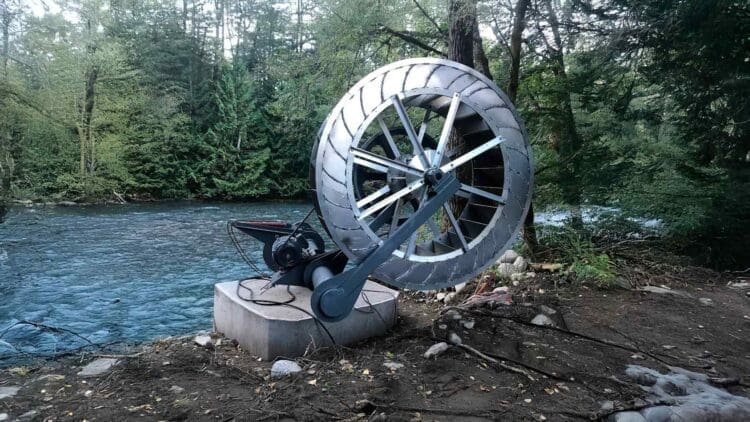

Taking a page out of the old millwright’s guide to power up a household with clean energy.
The vast amount of power locked within water must never be underestimated and must be harnessed with care.
For centuries, humanity has been tapping this source, but as electricity demands grew, so did the risks.



Will a Canadian man’s advanced approach to an old harnessing method become the new norm for unlocking hydropower?
How an engineering marvel now comes with heavy baggage
Taming the turbulent flow of water has been a practice used by humans for millennia.
In modern-day Jordan, the oldest known dam worldwide, the Jawa Dam, dates back between 5,000 and 6,000 years.
This was an era before dam construction was a monument to human engineering. For early civilizations, it helped navigate the unpredictability of nature.
Eventually, this survival tactic evolved into the global industrial marvel known to modern society.
Today, dams provide great amounts of renewable electricity and are key to the green energy transition.
However, these titans also carry significant ecological and structural baggage.
As the 21st century evolves, it is becoming more difficult each day to carry the weight of these installations. Add the looming global climate crisis to the mix, and it is no wonder the world is struggling.
For many nations, their environment and economies may no longer be able to bear these burdens.
A drying world and its debt on the “ecological tax”
It seems the climate crisis has shifted to fifth gear and is accelerating to a point of no return.
The world is “left in the dust” as a result. With unpredictable weather patterns and a cracking atmosphere, experts argue that traditional dams are now becoming massive liabilities.
For many years, the construction of these reservoirs relied on stable, historical weather conditions to maintain water levels.
Now that this is changing, many regions are left to face the music.
Extreme droughts and melting glaciers are drying up reservoirs, preventing turbine and financial flow. The stagnant water experiences vegetation overgrowth, which begins to rot in the oxygen-poor depths and inevitably releases methane.
Others are burdened by the hydro “pressure trap.” Dams require water to drop from great heights, creating lethal pressure changes for migrating fish.
Fortunately, a Canadian man went with a different hydro direction that could inspire others to follow suit.
The 19th-century page’s solution to fix a 21st-century energy problem
Many people dream about living on free energy at home, but very few achieve this dream. However, a retired plant manager from British Columbia found the answer to the future by looking to the past.
This man is Marc Nering, and he wanted to benefit from the river’s power without the “baggage” of a dam.
While working out of his garage, he decided to take a page out of an 1800s millwright’s guide.
This led him to power his home with the simple laws of friction and gravity.
The water wheel with the old-school touch to provide electricity 24/7
Nering’s water wheel rests on pontoons and harnesses energy from the surface. Gravity keeps the wheel submerged, and the current’s friction against the aluminum blades generates 3 kW of power.
He replaced modern-day steel bearings with Lignum Vitae, which is a rare, self-lubricating wood. This made the system virtually indestructible in wet conditions.
This design may have started in a garage, but its popularity spilled over globally.
Its “plug-and-play” hydropower capabilities are now being explored from Chile to Italy, breaking the “billion-dollar cage.”
The old 19th-century blueprint thus helped to create a 21st-century lifeline, transforming how the modern world meets its energy needs. So, instead of quietly creating risks for millions with dams, the best way forward is letting the river run free.