
With turbines nearly three times their size, Britain’s biggest wind farm is preparing to reinvent itself from the ground up
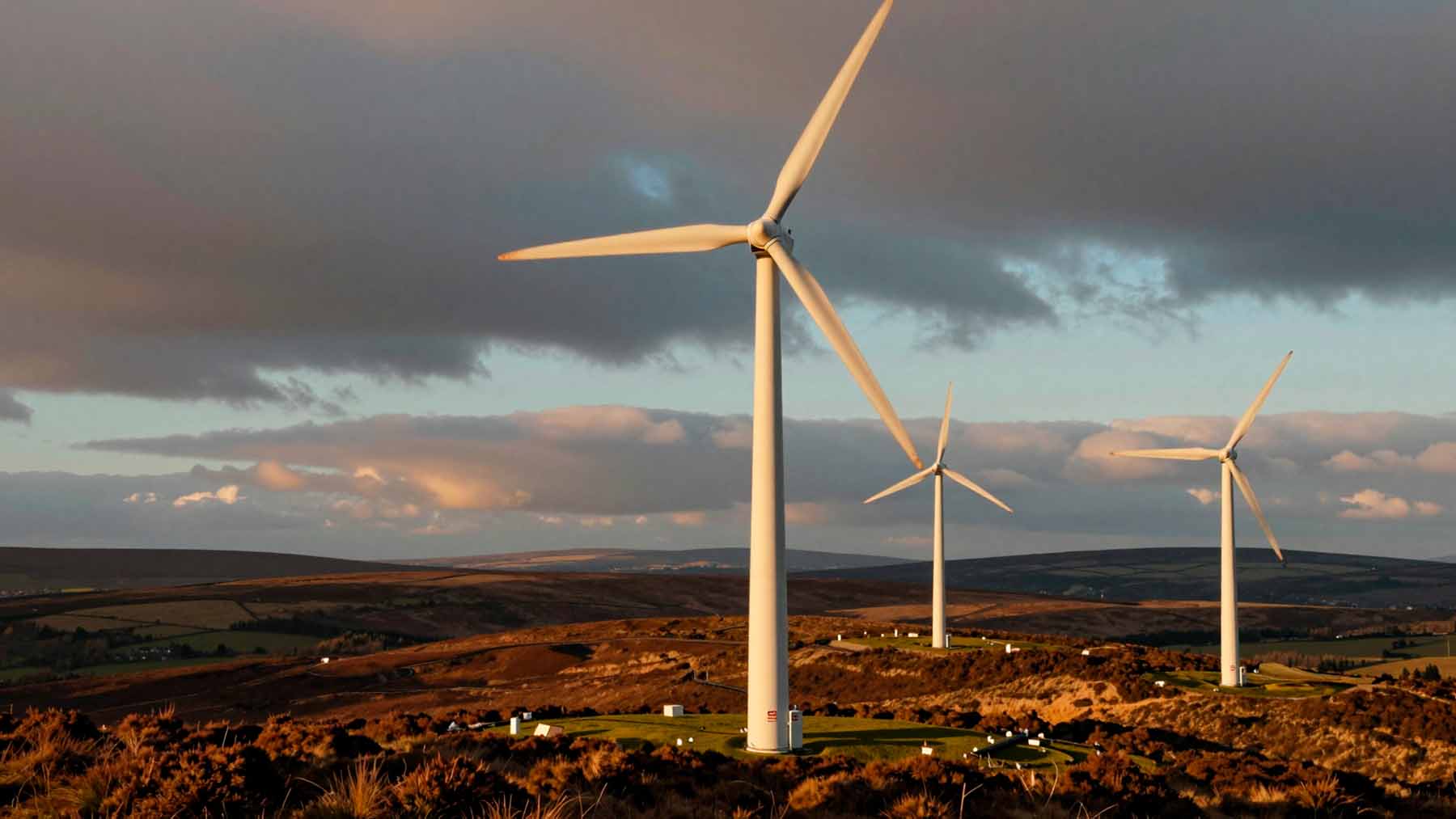 Image generated with artificial intelligence
With turbines nearly three times their size, Britain’s biggest wind farm is preparing to reinvent itself from the ground up. High on a wind-swept plateau south of Glasgow, the iconic Whitelee wind farm has defined the regional landscape since 2008.
Its 215 towering turbines once represented the pinnacle of renewable engineering, generating clean energy for hundreds of thousands of homes. Today, the United Kingdom’s largest onshore facility stands at a critical crossroads.
Across the global energy landscape, clean power operators are confronting an inevitable challenge: what happens when first-generation clean energy assets reach the end of their operational lifespan?
Unlike legacy units that execute full emergency shutdowns during minor glitches, modern systems modulate blade speed to maintain continuous, safe power generation.
The emerging strategy is repowering—dismantling legacy infrastructure to deploy modern, high-efficiency technology.
A wind farm built for another era
Whitelee evolved in stages rather than appearing overnight. The initial development phase in 2008 introduced 140 turbines measuring 360 feet tall, rated at 2.3 megawatts each. A subsequent expansion in 2013 added taller 3-megawatt models.
Currently, the 215-turbine complex delivers 539 megawatts of total generating capacity, supported by a 50-megawatt battery storage unit. However, rapid technological acceleration has left these early models behind. Machines considered revolutionary in 2008 are now functionally outdated.
Developer ScottishPower Renewables has initiated formal regulatory filings to overhaul the entire installation, setting off comprehensive governmental reviews.
Same land, double the power
The proposed overhaul highlights extraordinary gains in efficiency.
Plans call for removing all 215 legacy turbines and installing just 124 modern units. Standardized at 787 feet tall, these colossal generators will each produce roughly 7 megawatts. This upgrade will elevate total output past 1 gigawatt—nearly doubling power generation while using 42 percent fewer structures.
Reducing turbine count streamlines long-term maintenance. Wind industry expert Kaj Skov Nielsen notes that maintaining a doubled turbine size does not double required labor hours, and each tower requires only one foundation.
Furthermore, existing site assets—access roads, electrical grid connections, and land rights—remain fully utilized. Reusing established infrastructure significantly lowers capital costs and environmental impact compared to greenfield developments.
Smarter machines, not just bigger ones
Physical scale represents only part of the technological leap. Contemporary turbines integrate sophisticated sensor suites unavailable during Whitelee’s original construction.
Advanced optical and acoustic detection systems identify approaching birds or bats, automatically dialing back rotor speeds to safeguard wildlife. Predictive analytics further elevate operational reliability. Real-time sensors detect subtle mechanical friction or gearbox debris, alerting technicians before critical component failure occurs.
Smart control systems also manage minor electrical anomalies dynamically. Unlike legacy units that execute full emergency shutdowns during minor glitches, modern systems modulate blade speed to maintain continuous, safe power generation. As Nielsen observes, the operational difference is night and day.
Repowering is not without its challenges
Executing an overhaul of this magnitude presents complex logistical hurdles.
Transporting massive 787-foot components over narrow rural bridges demands substantial road upgrades or complex modular transport. Project developers must balance infrastructure modification costs against on-site assembly logistics.
Structural foundation engineering adds another layer of complexity. Supporting heavier modern nacelles requires reinforced or completely rebuilt concrete bases.
Although ScottishPower must clear rigorous environmental and community impact reviews, the project holds distinct advantages: pre-approved land rights and zero expansion into untouched wilderness.
A global shift gathering momentum
Whitelee’s transformation reflects a broader transition across global energy markets.
Leading manufacturers like Siemens Gamesa, Vestas, and Nordex now offer commercial 7-megawatt land turbines, while GE produces 6-megawatt models. BloombergNEF analyst Harrison Sholler emphasizes that these heavy-duty machines are fully proven at commercial scale.
In the United States, average onshore turbine capacity grew from 0.8 megawatts in 2000 to 3.5 megawatts in 2024, according to the Lawrence Berkeley National Laboratory. Oklahoma deployed the nation’s first 6-megawatt onshore project that same year.
Over the next decade, BloombergNEF projects repowering will supply 10 gigawatts of the 86 gigawatts in new U.S. wind capacity, with activity surging into the 2030s.
In mature markets like California, repowering will drive virtually all new onshore capacity because prime wind corridors were developed decades ago.
Yet the largest U.S. repowering endeavor currently planned reaches just over 200 megawatts—a fraction of Whitelee’s upcoming 1-gigawatt project.
As Sholler notes, American markets have not yet matured to gigawatt-scale repowerings, but that tipping point is fast approaching. Ultimately, Whitelee serves as the primary blueprint for the future of global renewable energy.
Kelly is an experienced writer with 15 years of experience exploring the big stories that shape our world, from tech breakthroughs and space exploration to climate, energy, and the fascinating quirks of science. She has a talent for turning complex ideas into sharp, memorable insights that stay with readers long after they’ve finished reading.
