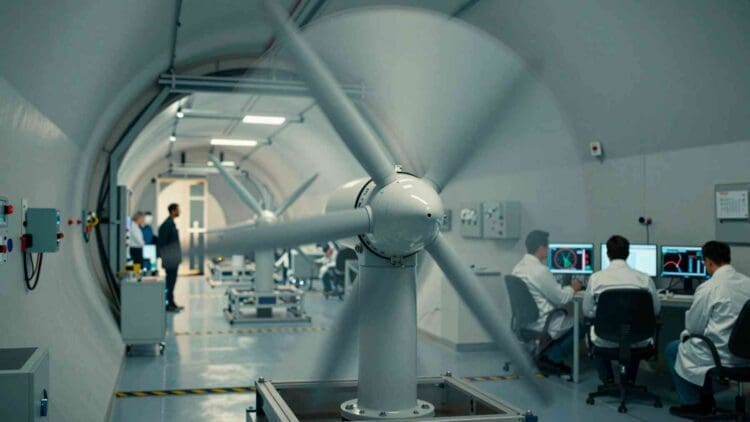

A small wind turbine with two counter-rotating rotors on a single gearbox-free generator has successfully transitioned from wind tunnel testing at a professional aeronautical facility in France to a fully validated aerodynamic benchmark, offering a rare experimental dataset for a design that has mostly lived in simulations.
Researchers from Hanze University of Applied Sciences measured the electrical output of their 5.2-foot diameter counter-rotating dual-rotor turbine across wind speeds from 4 to 15 m/s at the CSTB facility in Nantes, recording a peak power coefficient of 0.33. A validated aerodynamic model then suggested that number could potentially reach 0.51 with optimized settings.
Wind tunnel tests at CSTB measures turbine performance
The turbine tested at CSTB was a 5.2-foot diameter counter-rotating dual-rotor wind turbine (CR-DRWT) built by researchers from Hanze University of Applied Sciences. Testing took place within the framework of the 2025 International Small Wind Turbine Competition, with wind speeds stepped from 4 to 15 m/s in 1 m/s increments across the facility’s aerodynamic test section.



CSTB’s Nantes facility provided a controlled environment with turbulence intensity below 1.5% and a maximum free-stream speed of 70 m/s. The turbine’s 21.5-square-foot swept area produced a blockage ratio of 6.7%, comfortably below the threshold requiring correction.
Performance results were straightforward: the turbine reached a maximum electrical output of 1,013.79 ± 8.58 W at 15 m/s, with a peak measured power coefficient (CP) of 0.33. It also demonstrated reliable self-starting at wind speeds as low as 3.5 m/s — a practical requirement for urban deployment where wind conditions are intermittent and rarely predictable.
Why a double rotational armature design was chosen
Small wind turbines have long struggled commercially. Compared to utility-scale systems, they typically deliver lower efficiency, lower capacity factors, and higher energy costs per kilowatt-hour — a gap that has motivated interest in configurations capable of extracting more energy from a given rotor diameter.
Counter-rotating dual-rotor designs are one such approach. Classical single-rotor theory sets the Betz limit at a CP of 0.59, while extended actuator disc theory for dual-rotor systems suggests a theoretical maximum of 0.64. Some computational studies place it higher still under specific spacing conditions.
What distinguishes this turbine mechanically is its double rotational armature generator. One rotor connects to the generator stator and the other to the generator rotor, and the two counter-rotating shafts drive the generator directly — no gearbox is required, eliminating a common source of mechanical complexity and failure. The resulting design offers doubled direct-drive power, compact dimensions, and reduced noise and vibration, making it well suited to urban settings where space and noise tolerance are both limited. An earlier iteration used bevel gears and showed no power increase over a single rotor; switching to the double rotational armature design produced a 10% CP improvement.
The extended BEM model validated and optimization performed
To interpret the wind tunnel results and explore performance potential, the researchers extended an existing blade element momentum (BEM) model. The original model, developed for dual-rotor systems with separate generators, was adapted to represent the torque balance and shared power production of the double-rotational armature configuration.
The extension works by enforcing a torque balance condition between the two rotors. For a range of upstream rotor tip speed ratios, the model identifies valid downstream operating points where torques are matched, and the net generator RPM becomes the sum of both rotor speeds — reflecting the counter-rotating setup directly.
Validation results were encouraging. The extended model showed good agreement with measured power output, efficiency, and generator RPM across the tested wind speed range. Some deviation appeared in upstream rotor RPM readings above 11 m/s, which the researchers attribute to a likely pulse-counting limitation in the sensor acquisition code rather than any physical discrepancy.
With validation established, the team ran a sweep optimization across 121 pitch angle combinations, varying upstream and downstream rotor pitch independently from 0° to 10° in 1° steps. The optimal configuration placed the upstream rotor at approximately 9.8° pitch and the downstream rotor at 0.6°. Under the competition’s Weibull wind distribution, this configuration predicts an annual energy production of 2,150 kWh and a theoretical maximum $C_P$ of 0.51.
Context: prior CR-DRWT research and remaining performance gap
The measured CP of 0.33 falls within the range reported by earlier small-scale wind tunnel studies on comparable CR-DRWT systems, which found CP values of 0.34 to 0.41 — suggesting the result is physically reasonable rather than an outlier.
A meaningful gap remains between small-scale experimental results and what larger or computationally modeled systems have achieved. Field tests on a 30-kilowatt CR-DRWT with asymmetric rotors found a CP near 0.5, and CFD simulations of equal-diameter rotor configurations have reported peak values approaching 0.53. Small turbines operating at lower Reynolds numbers face aerodynamic conditions that are harder to replicate and harder to model accurately.
The researchers identify several specific paths forward: CFD analysis of the current configuration could capture three-dimensional flow effects that BEM methods cannot represent, testing at higher Reynolds numbers would bring experimental conditions closer to real-world operation, and the downstream rotor — currently a mirror of the upstream rotor — could be redesigned with blade geometry specifically suited to the modified inflow it actually receives.
A concrete target to work from
This study provides one of the more complete experimental datasets available for a small-scale CR-DRWT with a double rotational armature design. The turbine achieved a peak CP of 0.33 in controlled wind tunnel conditions, consistent with comparable published experiments, and demonstrated reliable self-starting at 3.5 m/s.
The extended BEM model validated against those measurements predicts a theoretical $C_P$ of 0.51 under optimized pitch settings… An optimal pitch combination of 9.8° upstream and 0.6° downstream, paired with a projected annual energy production of 2,150 kWh, gives future design iterations a concrete target to work from.
Eliminating gearboxes reduces mechanical complexity and suits the double rotational armature configuration to urban applications. Further gains will likely require CFD modeling, higher Reynolds number testing, and a purpose-designed downstream rotor blade — steps the authors identify as the logical next phase of development.
Kelly is an experienced writer with 15 years of experience exploring the big stories that shape our world, from tech breakthroughs and space exploration to climate, energy, and the fascinating quirks of science. She has a talent for turning complex ideas into sharp, memorable insights that stay with readers long after they’ve finished reading.