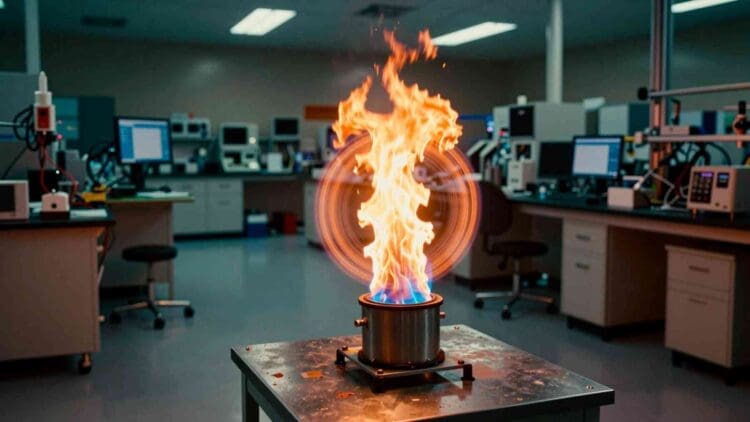

Facing a fire, a firefighter’s instinct is to reach for a hose, a chemical extinguisher, or a foam system — tools built around flooding a blaze into submission. But researchers at Ohio State University have been testing something that looks nothing like any of them: a bucket-shaped device strapped to the arm, firing invisible rings of air toward the flames.
No water. No toxic foam. Just wind — and something carried inside it.
The device, developed as a portable alternative to conventional firefighting equipment, hints at a fundamentally different way of thinking about how fires get put out.




A different kind of firefighting tool
The device looks more like a DIY science project than emergency equipment. A small, bucket-shaped launcher mounts to an arm brace and aims at a fire the way a firefighter might aim a hose — but without the hose, the water, or the chemical foam.
Traditional firefighting tools carry real costs. Chemical foams can be toxic, hydrant systems put significant strain on water resources, and both approaches require firefighters to get dangerously close to active flames. The Ohio State team set out to find something better. Their initial hypothesis focused on combining an electrical arc with conductive aerosols (tiny particles capable of directing electricity) delivered directly into a fire by vortex rings. The research was led by John LaRocco, a research scientist at the Ohio State University College of Medicine, alongside co-authors Qudsia Tahmina and John Simonis, with findings published in the journal Technologies.
How vortex rings carry the fight
Vortex rings are donut-shaped bands of air — the same phenomenon behind smoke rings. Stable, self-contained, and surprisingly effective at carrying material across a distance.
In this device, those rings act as the primary suppression mechanism. Launched in short, focused pulses, their accelerated airflow generates rapid turbulence when they reach the flames, physically separating the heat source from the fuel source to break the combustion cycle. Interestingly, while the team originally designed the system to carry a conductive aerosol payload meant to generate ozone and expand the reach of an electrical current, the actual trials yielded a surprise: the aerosol addition didn’t change the outcome. The mechanical disruption of the vortex rings alone was powerful enough to suppress the target flames.
One structural advantage worth noting: vortex rings maintain their shape even as they slow and dissipate. The aerosol payload keeps traveling, reaching fires at greater distances than many conventional methods allow.
Finding the right formula
Before building anything, the team had to identify the right aerosol chemistry. Seven different chemical mixtures were tested across two separate trials, with each combination measured for how effectively it conducted electricity.
The winner was a coarse copper solution — the most conductive of the group — which became the vortex ring material used in subsequent testing. With that settled, the researchers built and compared two prototype launchers. The first used compressed air released through a conical muzzle. The second relied on an elastic diaphragm with a square-edged muzzle, producing a vortex ring through a stretched membrane. In laboratory trials against controlled flame arrays, both prototypes achieved a maximum effective range of nearly 2 meters — roughly 6.5 feet. However, the compressed air version proved significantly more efficient and reliable than the manual diaphragm model.
Built for real-world conditions
Portability was a design priority from the start, resulting in a launcher that is compact and highly maneuverable. Simonis described the design’s simplicity as its greatest feature, noting that because the core mechanics are straightforward, the technology scales easily.
While currently a proof-of-concept tested on a small scale, the long-term vision is highly scalable. A single, refined unit could handle localized electrical or structural hot spots, while multiple firefighters carrying their own launchers could theoretically tag-team a larger hazard. Crucially, the 6.5-foot range allows operators to maintain a safer standoff distance, reducing the risk of burns and smoke inhalation. Vortex rings carry their payload over distance, so firefighters can maintain a safer standoff. Co-author Tahmina noted that low cost was a goal from the beginning, not an afterthought.
What comes next for the vortex launcher
The research team has already outlined a path forward. One proposed upgrade involves integrating multimodal sensors and computer vision, allowing the launcher to identify and target fires automatically regardless of ignition source.
Potential applications extend well beyond burning buildings. The researchers point to industrial automation, aerospace, military vehicles, and spacecraft interiors — environments where a compact, water-free suppression tool could prove critical. Fires in confined or remote spaces, where hauling water or foam is simply impractical, represent exactly the kind of problem this device was built to solve.
As the technology matures and its range expands, the vortex launcher may move from promising prototype to standard equipment in places conventional firefighting cannot reach.