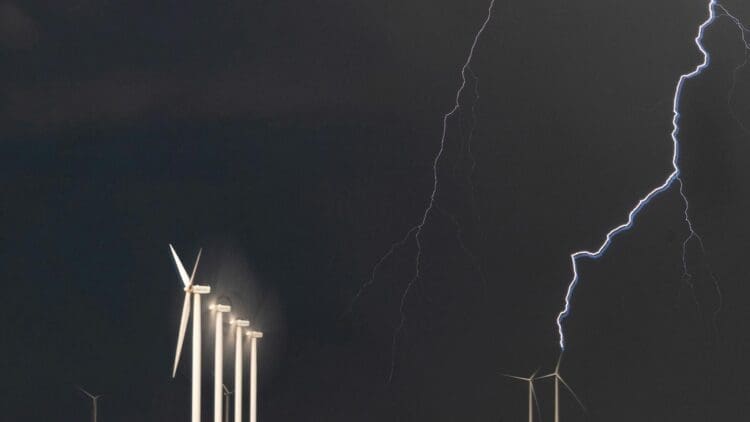

Wind turbines and storms may end up being best friends.
The towering giants of wind power may seem indestructible at first sight, but not much can stand in the way of Mother Nature.
Modern green solutions have become so technically advanced that they are starting to impede their own ability to thrive.

Will the latest adaptations help them stand the test of time, or are they doomed to become dormant white elephants?
How the “cure” for climate change is facing a catch-22
In the attempt to mitigate the devastating effects of climate change, the world unknowingly got caught in an ironic twist.
Greenhouse gas emissions have been causing Earth’s temperatures to rise, which triggered a domino effect of events.
Warmer temperatures cause the atmosphere to retain additional moisture and energy. This results in a cascade of frequent, extreme weather phenomena.
Some regions must learn to adapt to droughts, water scarcity, and extreme heat. Others face severe tropical storms, flooding, and dangerous lightning storms.
To lower emission levels, deploying large-scale renewable energy infrastructure to replace fossil fuels is key.
This is where the cruel fate of irony stepped in, as this infrastructure is highly sensitive to volatile weather. Wind turbines that are designed to touch the heavens become vulnerable in supercharged storms.
In those times of emergency, the sophisticated solutions meant to keep the lights on falter, keeping us caught in a catch-22.
Exploring different turbine designs to weather the storm
The world and its renewable energy innovators are not ready to give up on wind power just yet.
Globally, unique “storm-catching” renewable technology designs are being deployed to withstand extreme weather conditions.
However, the majority of these concepts are aimed at offshore or floating installations. For onshore wind turbines, lightning storms are still highly problematic.
Scaling down wind turbine designs or removing the blades from turbines will, unfortunately, not help them to improve lightning survival.
Structural hardening must go beyond basic exterior alterations. Solutions are needed to help protect the “brain” of a wind turbine from the shocking effects of lightning strikes.
Researchers have discovered that traditional lightning rods are not enough to shield these installations from destruction. This is because electromagnetic surges still induce harmful currents in their wiring.
Fortunately, not all hope is lost, as a study discusses a breakthrough that will increase turbine durability.
Wind turbines standing their ground in a perfect storm
NOAA has sounded the alarm about atmospheric patterns cracking. With potential intense rain and droughts lying ahead, the study’s solution could come in handy.
The study “Electromagnetic transients and failed upward leaders observed during lightning activity in an onshore wind farm” was published in arXiv.
In a nutshell, high-voltage testing on protective radomes has indicated that turbines ” actively respond” to storms. Turbine height and conductive materials create an electrical discharge (upward leader).
This “charged greeting” dictates where lightning must strike.
Taking control of the charged conversation with a Dissipation Array System (DAS)
A DAS uses “point discharge” that generates ion clouds (space charges) around the sensitive turbine components.
The ion clouds “hide” the turbine, preventing upward leader formation and thus, lightning from striking.
Small, segmented metal diverter strips are added to guide electricity currents across non-conductive sensors. This protects the “brain.”
These measures ensure that even in the most extreme electrical storms, wind turbines can “stand their ground.”
The silent dialogues not only boost infrastructure longevity but also ensure uninterrupted power at all times.
The “cure” for the climate crisis can be as resilient as the planet we want to protect. This innovation helps to bridge the gap between high-tech advancements and sustainability, bringing us another step closer to net-zero.