
Scientists sent drones into one of Earth’s most violent ocean currents and found something that could change how we power our homes
 AI-made
Imagine flying a drone directly into a violent ocean vortex.
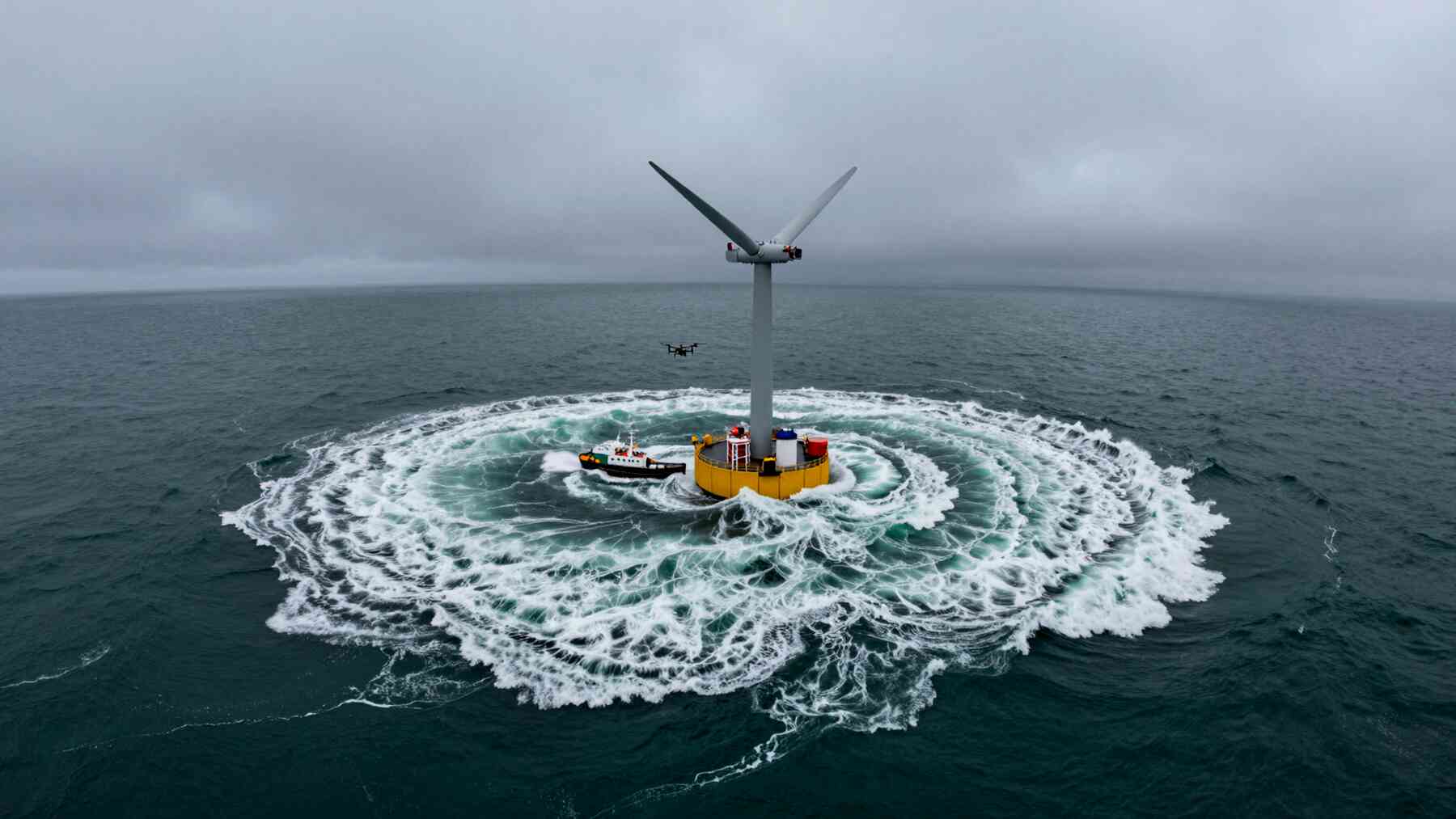
Off the coast of Scotland’s Orkney Islands, where tidal currents rip past at over 9 miles per hour, researchers did exactly that. They flew aerial drones straight into the churning waters surrounding the world’s most powerful tidal turbine.
The target of this daring mission was the Orbital O2. It is a massive, 243-foot-long floating platform anchored to the seabed.
This design makes it the most powerful tidal turbine in operation today, capable of generating enough clean energy to power about 550 American homes every year.
Getting accurate measurements around a structure this size in such violent water is incredibly difficult. Yet, solving this puzzle is the only way to safely bring tidal energy to our power grids.
A turbine unlike any other
Most tidal turbines are bolted heavily to the seafloor. They sit in the dark, waiting for the water to rush by. The O2 is completely different. It floats.
Its massive steel platform sits right on the ocean’s surface. Heavy mooring lines anchor it to the seabed.
The turbine feeds electricity directly into the local grid at the European Marine Energy Center.
Because it floats, the O2 can harness the fastest currents near the surface. This design makes it the most powerful tidal turbine in operation today, capable of generating enough clean energy to power about 550 American homes every year.
But floating also makes it a scientific mystery. It interacts with the ocean differently than fixed devices.
To understand these complex water flows, scientists needed a brand-new playbook.
Mapping chaos: Drones meet the tidal stream
How do you measure a torrent moving at 9 miles per hour? Standard research boats struggle. Traditional ocean sensors get tossed around and damaged in the swirling waters.
To solve this, a clever research team decided to look down from above.
Scientists from the Marine Biological Association, the University of Plymouth, and UHI Shetland combined forces. They paired high-tech aerial drones with specialized research vessels to map the rushing tidal streams in stunning detail.
Specifically, they wanted to study the turbine’s wake. This is the turbulent, messy water left downstream after the turbine spins.
-
Why it matters: If you want to build a whole farm of these turbines, the wake is everything.
-
The risk: Place them too close, and the front turbines steal all the energy from the back ones.
This study, published in Nature Communications, is the first to map these dynamics at such a massive scale.
What the data revealed about placement and performance
The drone data brought back some eye-opening insights. The water does not move at one predictable speed. Instead, it shears and twists, flowing in different directions at different depths.
These chaotic flows put intense physical stress on the turbine structure. It also hurts the turbine’s power output.
You cannot easily predict this kind of chaos from a comfortable office desk.
The data showed that the O2’s wake travels surprisingly far downstream. This means developers cannot pack turbines together like sardines.
Computer simulations are great, but they cannot capture the real-world complexity of narrow channels and shifting island currents. Real-world measurements are not a luxury. They are essential.
Wildlife in the current: Orcas, seabirds, and turbine wakes
The drones did not just capture water movement. They also captured marine life. During one flight, researchers spotted a pod of orcas swimming right past the spinning turbine. It was a stark reminder that we share these waters.
Actually, the turbine changes local animal behavior. A previous study by the same authors found that the chaotic wake actually concentrates small fish near the surface. This creates a perfect, easy-to-spot buffet for hungry seabirds.
But this ecological shift is a double-edged sword:
-
The benefit: Easier foraging grounds for local birds.
-
The danger: If we build massive walls of these turbines, we might block migration routes for marine mammals.
We cannot make engineering decisions in a vacuum. The O2’s location highlights this delicate balance.
Tidal energy’s bigger promise and remaining hurdles
Tidal energy has one massive advantage over solar and wind: predictability. The moon is reliable. We always know exactly when the tide will turn.
There is also a massive physics advantage. Water is about 800 times denser than air. That means a small water current carries a lot more punch than a fast wind.
Some experts estimate tidal stream energy could eventually supply up to 11% of the UK’s annual electricity grid.
Still, the industry faces big roadblocks:
-
High capital costs: Building ocean-grade steel to withstand extreme forces is expensive.
-
Grid connection limits: Remote islands often lack the heavy power lines needed to send energy back to big cities.
-
Brutal wear and tear: Saltwater and violent currents destroy moving parts quickly.
But this drone study gives us a map forward. Better data means smarter designs, cheaper maintenance, and safer operations. Yet, as the drones hovered over the churning white water, they noticed a strange anomaly in the data. What is that ‘something’ they found?
Kelly is an experienced writer with 15 years of experience exploring the big stories that shape our world, from tech breakthroughs and space exploration to climate, energy, and the fascinating quirks of science. She has a talent for turning complex ideas into sharp, memorable insights that stay with readers long after they’ve finished reading.
