
Wind turbine wakes create a hidden “safe corridor” for birds, but also a dangerous zone near the blade tips
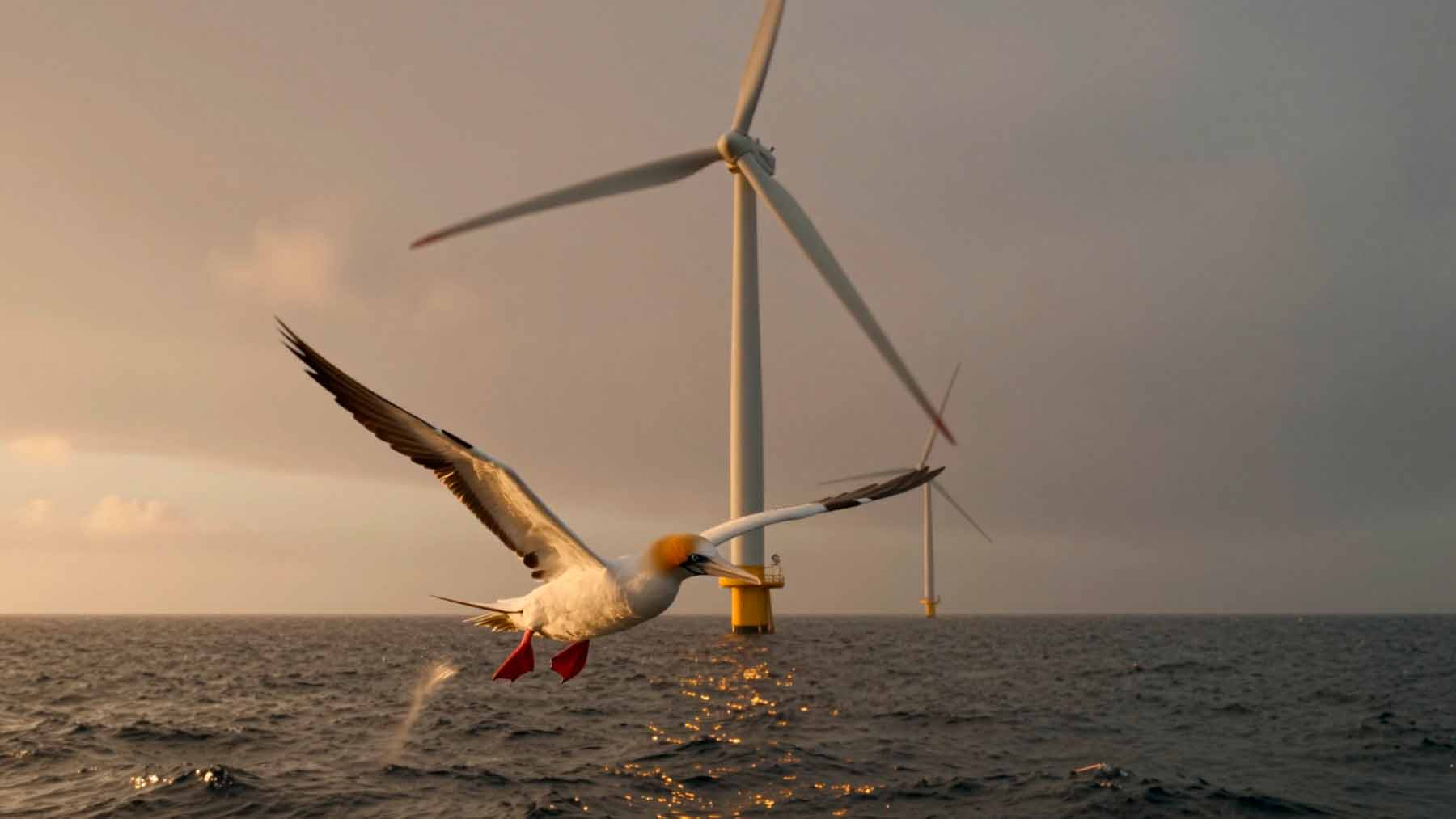 Image generated with artificial intelligence
Wind energy expansion has sparked ongoing debate over bird safety. Traditional research tracks mortality by counting carcasses near turbine bases. However, this leaves the underlying aerodynamic mechanisms unexamined. Fluid dynamicists mapped the invisible wake behind rotating blades to solve this. They aimed to see how churning air alters flight balance.
How the simulations worked
Modeling how turbulence disrupts flight requires bridging massive spatial scales. A utility-scale 2 MW turbine spans roughly 262 feet across its rotor diameter. A gliding seabird has a wingspan under 6.5 feet. Running a single simulation across both dimensions demands impractical computing power.
Researchers solved this scale discrepancy using a decoupled fluid mechanics approach. Large eddy simulation (LES) modeled the macro-scale wake field behind the spinning rotor.
This mapping allows operators to deploy targeted acoustic deterrents and detection sensors precisely where collision risks concentrate.
That flow data was then fed into a Reynolds-averaged Navier-Stokes (RANS) model. This secondary step tracked the forces acting on a gliding bird.
Across 62 flight path simulations, researchers calculated the lift-to-drag ratio. High values signify efficient, low-effort flight. Lower values force the bird to expend far more energy to stay aloft.
A 30% penalty at the blade tip — and an unexpected boost below
Simulations revealed that aerodynamic hazards concentrate heavily near the upper blade tip. This occurs roughly 360 feet above ground level. In this region, a bird’s lift-to-drag ratio drops by up to 30%.
This penalty peaks about four rotor diameters downstream. That is the point where wake turbulence reaches its most disruptive intensity.
Turbulence intensity acts as the primary driver behind this loss of lift. Raw wind speed reduction plays a secondary role.
Conversely, conditions flip entirely below the lower blade tip at altitudes of 100 feet and below.
In this lower band, the turbine wake actually enhances aerodynamic performance. It boosts the lift-to-drag ratio by 10% to 15%. This creates a low-altitude “safe corridor” matching real-world bird flight patterns.
When turbines line up, risks compound
A single turbine creates localized airflow changes. Utility-scale wind farms deploy dozens of rotors whose overlapping wakes compound atmospheric disruption.
When modeled within dense multi-turbine arrays, the high-hazard zone expands significantly. This is the area where lift efficiency drops by over 20%.
Simultaneously, the low-altitude safe corridor shrinks as cumulative turbulence cascades through the array.
Staggering turbine placement offers an effective engineering solution.
Offsetting turbine rows laterally by 1 to 1.5 rotor diameters shrinks dangerous turbulence zones dramatically. It also improves overall power generation efficiency.
A risk map that could reshape wind farm design
These aerodynamic insights led researchers to establish a four-zone risk framework. It features a high-risk Hazard Zone, a moderate Surveillance Zone, a neutral Baseline Zone, and a supportive Flight Path corridor.
This mapping allows operators to deploy targeted acoustic deterrents and detection sensors precisely where collision risks concentrate. This avoids attempting blanket coverage across an entire facility.
Future modeling will incorporate dynamic wing-flapping kinetics and complex atmospheric conditions.
Ultimately, these computational breakthroughs demonstrate that wind turbine wakes create a hidden “safe corridor” for birds, but also a dangerous zone near the blade tips.
All the information in the full study is available here: Yang, X., Zhou, L., Sui, Y. et al. Effects of wind turbine wakes on bird gliding aerodynamic performance. Sci Rep 16, 3106 (2026). https://doi.org/10.1038/s41598-025-33055-x
Kelly is an experienced writer with 15 years of experience exploring the big stories that shape our world, from tech breakthroughs and space exploration to climate, energy, and the fascinating quirks of science. She has a talent for turning complex ideas into sharp, memorable insights that stay with readers long after they’ve finished reading.
