
Washington congressman urges U.S. Coast Guard to review oil spill plans ahead of new Alberta-to-B.C. pipeline
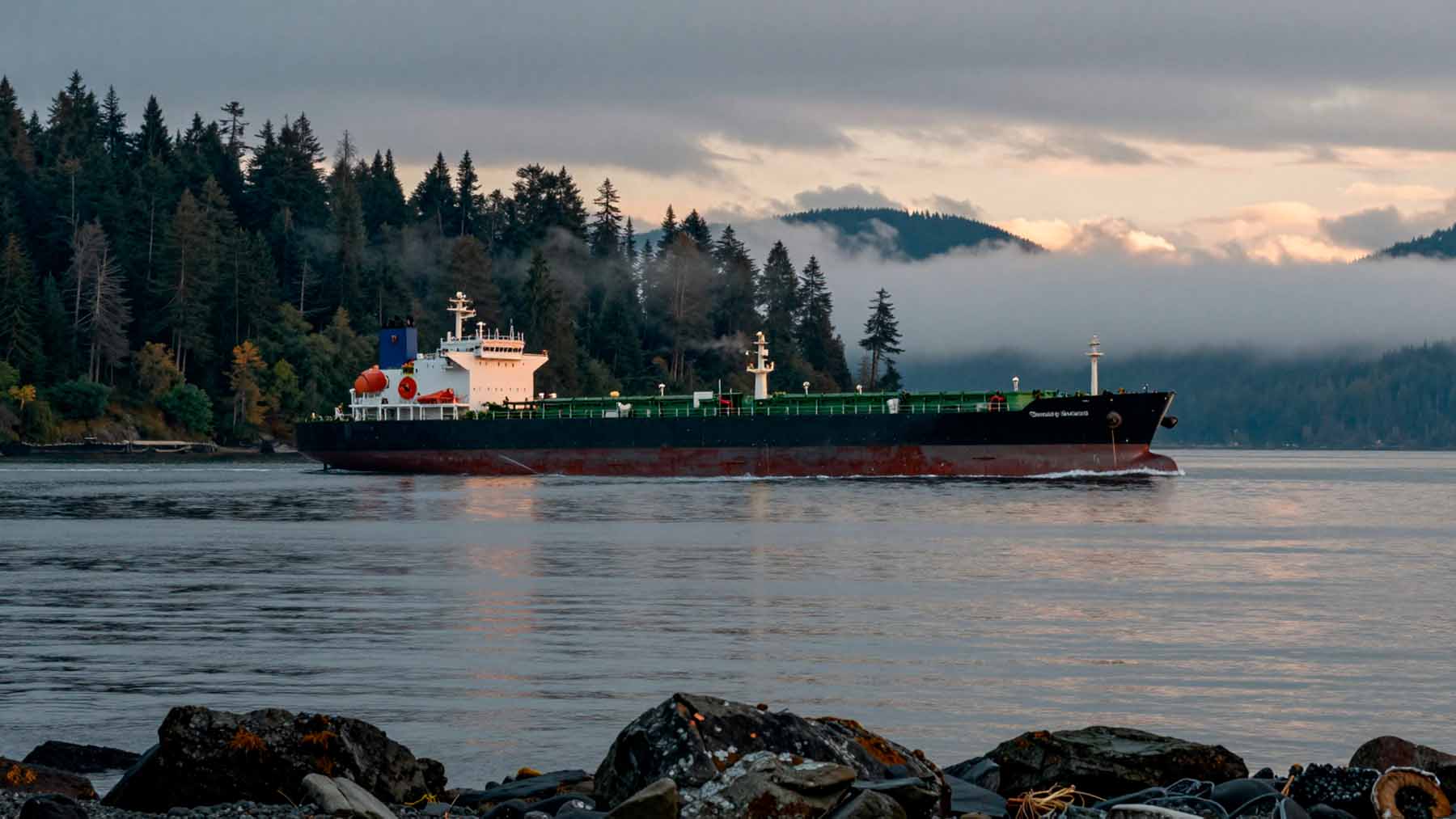 Image generated with artificial intelligence
A U.S. congressman is calling on the Coast Guard to take a fresh look at oil spill preparedness—and a planned pipeline is the reason why. Rep. Rick Larsen (D-WA) sent a formal letter this week to a senior Coast Guard official requesting a review of existing response plans. The trigger: the announced construction of a new oil pipeline running from Alberta to B.C.’s Roberts Bank terminal, located just a few miles by water from the Washington State border.
Larsen sends letter to U.S. Coast Guard over spill preparedness
Rep. Rick Larsen didn’t just raise concerns publicly—he put them in writing. The Washington State Democrat sent a formal letter this week to a senior U.S. Coast Guard official, asking how the agency is coordinating with Canadian authorities under an existing joint pollution contingency plan.
Larsen sits at the top of the Democratic side of the House Transportation and Infrastructure Committee. That position gives his requests real institutional weight. This isn’t a constituent complaint—it’s a signal that U.S. lawmakers are watching Canadian infrastructure decisions that touch shared waters.
Those tankers would travel through the Salish Sea, the interconnected network of waterways straddling the border between Washington State and British Columbia.
He also plans to reach out to Canadian counterparts directly. His message will be straightforward: the people he represents oppose the pipeline.
A new Alberta-to-B.C. pipeline would bring more tanker traffic to the Salish Sea
The pipeline at the center of all this would run from Alberta and terminate at B.C.’s Roberts Bank terminal—a marine facility sitting just a few miles by water from the Canada-U.S. border. That proximity is exactly what has Larsen and his constituents on edge.
More pipeline capacity means more oil moving through the system, which means more tankers. Those tankers would travel through the Salish Sea, the interconnected network of waterways straddling the border between Washington State and British Columbia.
Larsen has been direct about what he sees as the consequence. In his own words, increased traffic brings “the risk of catastrophic oil spills.” That’s not speculative language—it reflects a well-established relationship between tanker volume and spill risk that marine safety experts have long recognized. For his constituents, the Salish Sea isn’t abstract. It’s the water off their coastline, the habitat supporting local fisheries, and the ecosystem tied to the region’s economy and culture.
Canada-U.S. pollution contingency plan at the center of the concern
The specific mechanism Larsen is asking the Coast Guard to examine is the joint Canada-U.S. pollution contingency plan—a framework outlining how both countries coordinate preparation and response when oil spills threaten marine environments on either side of the border.
His concern is whether that plan is still adequate given what’s now on the table. The pipeline announcement represents a meaningful shift in the region’s risk profile, and he wants to know if existing coordination has kept pace.
U.S. Representative Rick Larsen‘s letter asks the Coast Guard to clarify how current efforts align with the updated infrastructure reality—essentially asking whether the playbook was written for a different game. If tanker traffic in the Salish Sea is set to increase substantially, response capacity and coordination protocols may need to catch up. The contingency plan isn’t a static document. It’s supposed to reflect actual conditions, and Larsen’s argument is simple: conditions are changing.
Cross-border implications and political context
Oil spills don’t respect international boundaries. That’s the practical reality underlying Larsen’s concern, and it’s why this can’t be treated as a purely Canadian domestic matter.
The Salish Sea spans both U.S. and Canadian waters. A spill near Roberts Bank terminal—just miles from Washington State—could move into U.S. waters quickly, depending on currents, wind, and response time. Geography makes spill preparedness a binational issue by definition, not just by treaty.
Larsen’s move also reflects something broader happening in U.S. congressional circles. American lawmakers are paying closer attention to Canadian energy infrastructure decisions that affect shared environments, and when a new pipeline or terminal gets announced north of the border, representatives in adjacent states don’t take long to start asking questions. His planned outreach to Canadian counterparts adds a diplomatic dimension to what started as a domestic request. This conversation isn’t staying in the Coast Guard’s inbox.
What this means going forward
Here’s where things stand: A new oil pipeline from Alberta to B.C.’s Roberts Bank terminal has been announced. The terminal sits close to the Washington State border. Increased pipeline capacity will bring more oil tankers into the Salish Sea. Rep. Rick Larsen has formally asked the U.S. Coast Guard to review and update oil spill response plans under the existing Canada-U.S. pollution contingency framework, and he plans to communicate his constituents’ opposition directly to Canadian officials.
No Coast Guard response has been reported yet, and the pipeline itself remains in the planning phase. But Larsen’s letter puts the preparedness question on the record—and on the agenda—before construction begins rather than after.
Disclaimer: Our coverage of events affecting companies is purely informative and descriptive. Under no circumstances does it seek to promote an opinion or create a trend, nor can it be taken as investment advice or a recommendation of any kind.
Kelly is an experienced writer with 15 years of experience exploring the big stories that shape our world, from tech breakthroughs and space exploration to climate, energy, and the fascinating quirks of science. She has a talent for turning complex ideas into sharp, memorable insights that stay with readers long after they’ve finished reading.
