
Called the “first bird-inclusive turbine ever,” its blades can detect an impact as light as 0.2 ounces and automatically save images of the collision
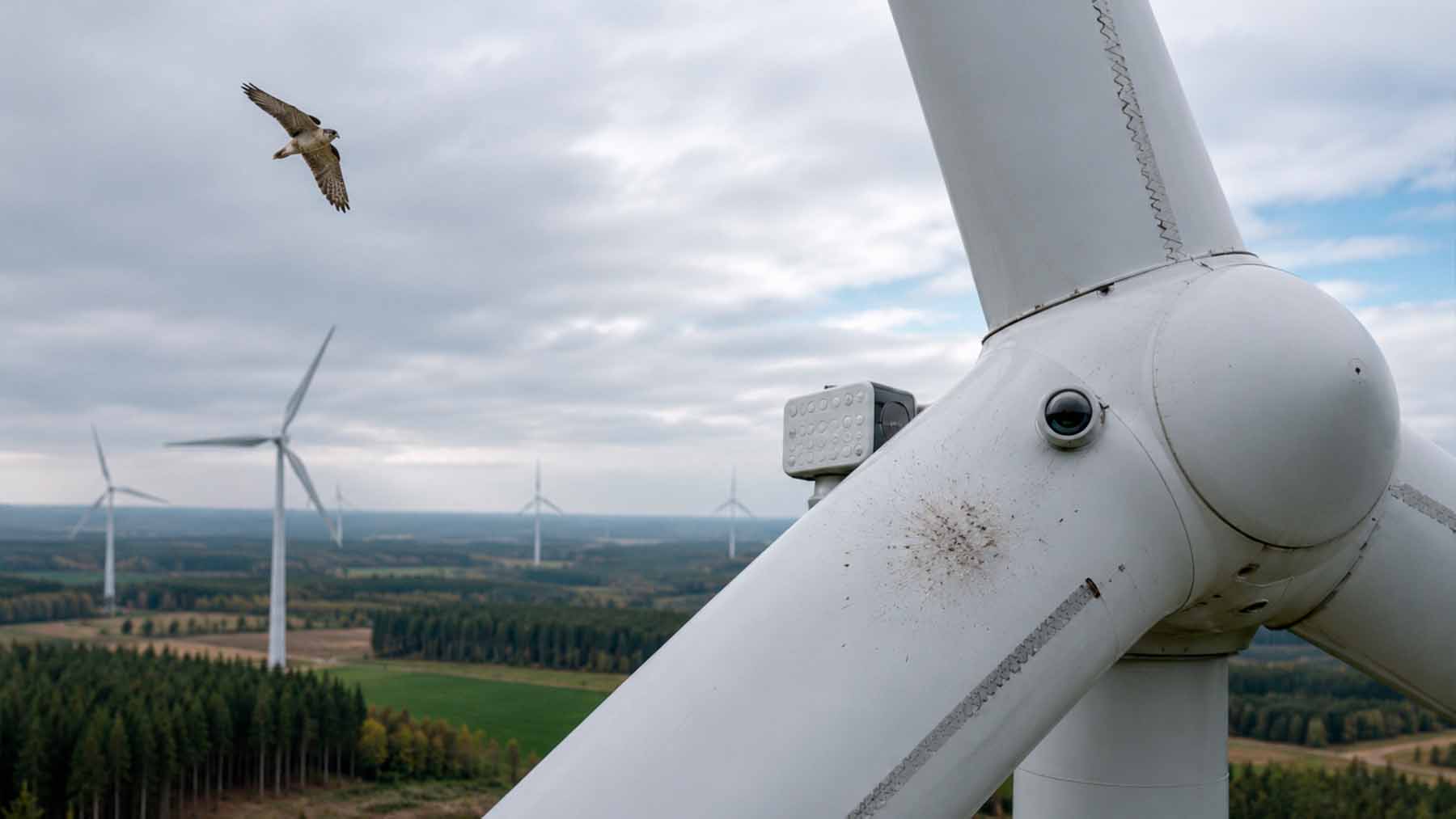 Image generated with artificial intelligence
Researchers created the best turbine collision monitoring technology for use in remote offshore environments.
Worldwide, wind power capacity is rapidly increasing to address growing electricity demands while meeting climate targets.
However, this fast expansion is raising global concerns about airborne wildlife.
Ultimately, it will enable meeting strict environmental laws, optimize adaptive wind turbine curtailments, and accelerate wind capacity growth.
Standard monitoring shows alarming fatalities, but does not account for nighttime and sea collisions.
Will the latest technologies improve the world’s understanding of the impact of wind power on flying species?
How modernized demands are conflicting with green goals
Not too long ago, humanity had to navigate life without the advanced technologies and infrastructure of today.
In this pre-digital era, grids managed one-way power flows.
Centralized fossil-fuel plants primarily supplied the electricity required for cyclical, heavy machinery.
Now, high-density, uninterrupted loads are increasing.
Modern electricity consumption is growing almost 2.5 times the rate of overall energy demand.
This unforeseen growth is centered around AI, data centers, widespread cooling, and transport electrification.
In the United States, roughly half of its electricity demand growth will be accounted for by data centers by 2030.
Today, power grids integrate complex, multi-directional renewable inputs to manage this high consumption.
However, as consumption outpaces green generation, fossil fuels still generate over half of global electricity.
To decarbonize grids once and for all, nations must increase the rate at which scaled wind power is deployed.
Unfortunately, this inevitably introduces a secondary environmental challenge.
The complexities of scaling wind turbines
In a single year, global wind capacity has increased by 40%.
This growth rate is set to continue as turbine deployment accelerates to meet surging electricity demands.
Both onshore and offshore infrastructure have seen an increase in installations.
In the U.S., large-scale wind capacity is predominantly made up of land-based turbines, standing at 158.6 GW.
Meanwhile, the capacity for operational offshore projects is a much smaller capacity of 171 MW.
With more developments in the pipeline, concerns about ecological impacts are rising.
As turbine blades rotate, they sweep large airspace areas and directly overlap with active flight paths.
Experts estimate global annual collisions reach hundreds of thousands for birds and up to a million for bats.
But these projections do not account for nighttime collisions or offshore impacts.
WEST collaborated with TNO to co-develop and test a new monitoring technology that will improve collision estimations.
A multi-sensor monitoring approach to solve the collision gap
Standard monitoring entails manually searching for and counting carcasses near wind turbines.
The newly developed and upgraded WT-Bird system replaces this approach with continuous, real-time data collection.
It provides an automated, multi-sensor solution to track collisions with operational turbines.
The technical papers can be reviewed on the Department of Energy’s platform Tethys, operated by Pacific Northwest National Laboratory.
Using a 1.5 MW research turbine for evaluation, the system detected impacts as light as 0.2 to 1.4 ounces.
A field demonstration took place on a 2.5 MW turbine at the University of Minnesota.
It tracked 15 collision events, mostly in darkness. The results matched the ground carcass surveys.
The mechanisms behind detecting light impacts and nocturnal collisions
Inside the blades are high-sensitivity fiber-optic sensors that detect structural acoustic impacts.
Vibrations are analyzed in real time with advanced classification algorithms. Normal wind noise, turbine vibrations, and weather are filtered out.
Vibration detection triggers camera capture of the rotor field.
The images are analyzed with embedded edge processing, which also lowers storage requirements by over 90%.
The multi-sensor system has reached commercial readiness.
It has proven its capability to deliver real-time data under extreme environmental conditions.
The Ecowende offshore wind farm will feature 12 of these systems to establish a new benchmark for nature-inclusive operations.
Ultimately, it will enable meeting strict environmental laws, optimize adaptive wind turbine curtailments, and accelerate wind capacity growth.
Anke Maree is a writer with a clear and engaging editorial style. Her work focuses on making complex topics accessible, informative, and relevant for readers across different areas of interest.
