
Near Joshua Tree, two abandoned iron-mine pits could become a 1,300-MW water battery with four underground turbines
 File image
Developers plan to create a massive water battery by adding turbines to old iron-mine pits in California.
Capturing and storing excess clean power is key to meeting rising national energy demands.
However, standard battery storage systems are facing major bottlenecks in the United States.
This strategy is highlighted in the project’s state environmental filing, the California State Water Board – Eagle Mountain review.
An innovative storage approach is crucial, as solar and wind generation rapidly expands countrywide.
Will transforming these abandoned sites help the nation achieve a more stable power grid?
How intermittency has made meeting clean energy goals more complex
The United States has set ambitious national climate targets.
Under its Nationally Determined Contributions, greenhouse gas emissions must be reduced 50% to 52% by 2030 compared to 2005 levels.
Furthermore, by 2035, the national power sector must be fully transitioned to carbon-free electricity.
These interim targets, among others, are stepping stones to the 2050 net-zero emissions economy.
The nation has achieved major milestones over the past decade, as green energy capacity has significantly increased.
Total solar capacity has surpassed 290 gigawatts, while large-scale wind has surged to 150 gigawatts.
These sources combined now account for more than 80% of total new power capacity added to the U.S. grid.
Despite these milestones, green power generation must expand even faster to meet rising electricity consumption.
This is especially vital as data center power usage is predicted to double within two years. It will then account for up to 8.5% of national peak demand.
The bottlenecks of continuous high-capacity renewable additions
Digitization and electrification will continue to expand, triggering ongoing consumption growth.
As a result, developers are accelerating solar and wind deployment nationwide to keep decarbonization on track.
Unfortunately, these leading renewable sources are presenting severe operational barriers.
Solar and wind generation are inherently intermittent and are entirely dependent on daily weather patterns.
Since global warming has worsened, atmospheric shifts and weather patterns have become more volatile.
This creates dangerous supply gaps on the regional grid.
That is why massive storage solutions have become more popular as complements to these green energy projects.
However, standard chemical batteries require critical minerals for manufacturing.
In the U.S., domestic reserves are very low, leading to high vulnerability to supply chain risks.
Additionally, chemical batteries have limited power duration.
That is why long-duration storage solutions are being explored, especially in California.
This strategy is highlighted in the project’s state environmental filing, the California State Water Board – Eagle Mountain review.
Creating a water battery by adding turbines to abandoned pit mines
There are several abandoned mines across the U.S., all with the potential to become more sustainable assets.
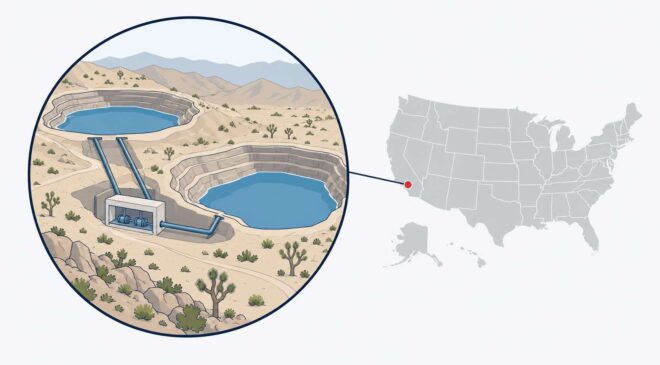
In the latest strategy, developer Eagle Crest Energy Company plans to transform two old iron-mine pits into a closed-loop battery.
The proposed pumped storage project will be located near Desert Center, close to Joshua Tree National Park.
Creating a closed-loop pumped storage facility
The existing Central Pit will serve as the upper reservoir. The East Pit will function as the lower reservoir.
During low-demand periods, water will be pumped to the upper pit.
When demand peaks, water is released back down through an underground system with four Francis turbines.
Once the facility reaches full commercial operation, it will deliver an installed generating capacity of 1,300 megawatts.
It will also provide up to 20,000 acre-feet of excess clean energy storage, overcoming intermittency issues.
The project also offers other distinct advantages.
It provides long-duration, carbon-free storage for the grid without flooding natural habitats or damming natural rivers.
Beyond improving grid reliability, it will significantly advance California’s shift toward 100% renewable electricity.
State and federal regulators also continue to monitor environmental compliance. Special attention is given to groundwater protection measures and local ecosystem conservation.
Ultimately, as variable green power generation rapidly expands, more innovative long-term energy storage solutions will be needed.
Anke Maree is a writer with a clear and engaging editorial style. Her work focuses on making complex topics accessible, informative, and relevant for readers across different areas of interest.
