
Tennessee engineers are studying whether abandoned coal mines across the U.S. could be filled with water and pumped back into the water supply when needed
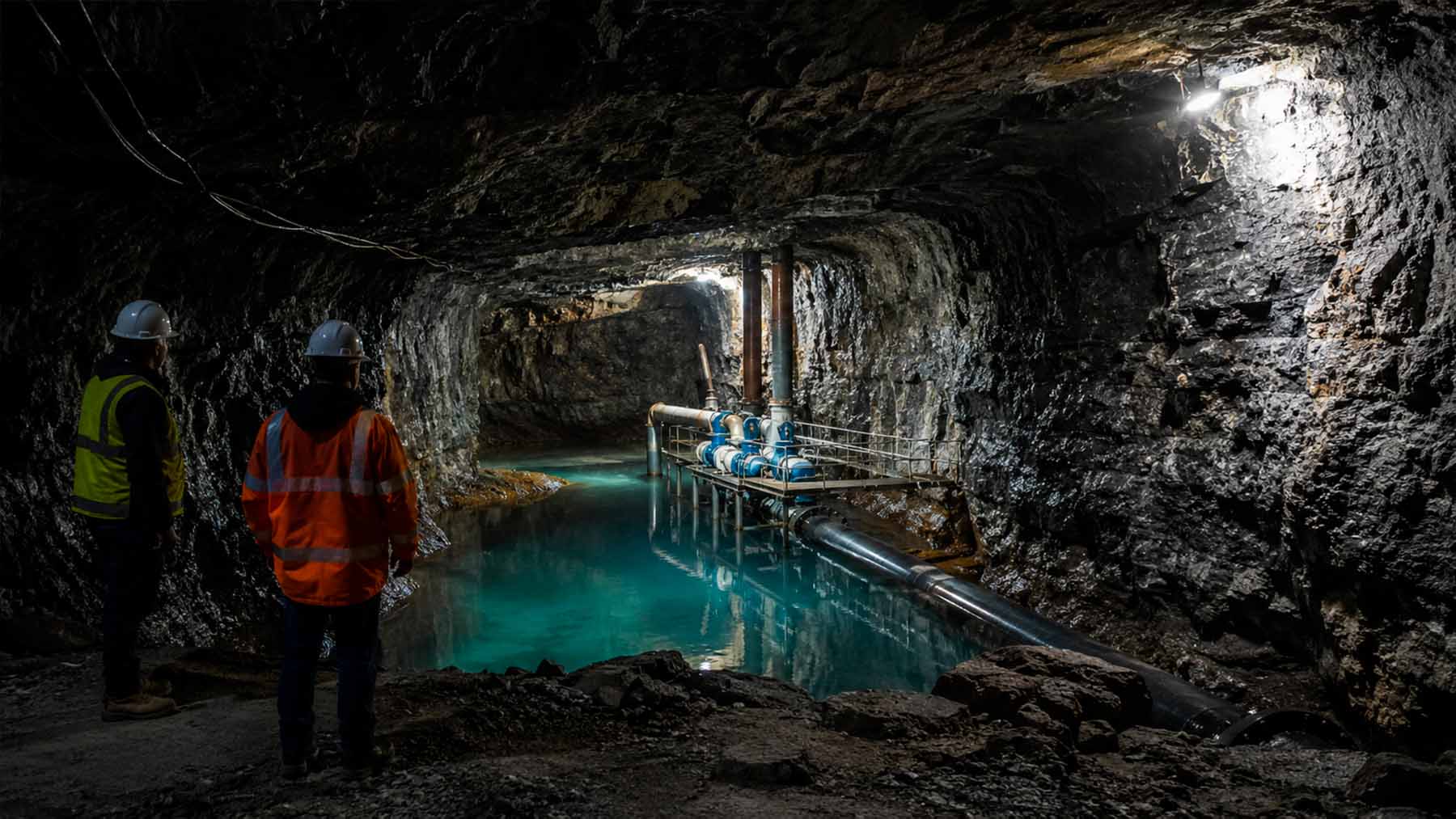 Image generated with artificial intelligence
Old coal mines have the potential to be repurposed as energy storage systems by using water.
Worldwide, researchers are exploring alternative methods for storing and transmitting electricity for varying demand periods.
While conventional Pumped Storage Hydropower systems work well, they present complex physical barriers.
Today, worldwide electrification, a growing population, and rapid industrialization have raised this demand to over 600 exajoules.
Now, Tennessee is hosting research focusing on using outdated mines across the United States instead.
Will this innovative approach help strengthen grid resilience and secure vital supplies nationwide?
How global power demand varies daily
Modern daily life has significantly changed compared to a century ago.
In 1916, many cities across the world had access to electricity for lighting, trams, and industrial use.
In general, power was generated primarily by coal-fired and hydroelectric facilities.
Limited accessibility meant that global energy consumption was roughly 15 exajoules.
Today, worldwide electrification, a growing population, and rapid industrialization have raised this demand to over 600 exajoules.
Grids are presently under immense pressure to maintain physical stability.
This results from the need to constantly balance power generation with consumption.
Total electricity demand is set to exceed 30,000 terawatt-hours globally per year.
Existing infrastructure is not designed to handle these modern daily shifts.
Morning routines and early evening hours are typically periods at which demand spikes.
When this demand outpaces supply, the risk of unsafe frequency fluctuations increases.
This makes adequate energy storage fundamental to prevent rolling blackouts.
The barriers of traditional energy storage systems
In the U.S., one of the largest utility-scale energy storage approaches is Pumped Storage Hydropower.
It accounts for more than 90% of the nation’s storage.
While it has proven to be highly effective over the years, the model now struggles to expand.
It faces steep geographic, environmental, and financial barriers.
Traditionally, two giant water reservoirs must be constructed at different elevations.
This requires suitable mountainous terrain near existing transmission lines, which limits expansion potential.
Additionally, the development of these reservoirs often displaces local ecosystems.
In arid western states, the risk of high evaporation rates also increases, adding more pressure to water-scarce regions.
Furthermore, these facilities demand exceptionally high upfront capital.
Another obstacle includes the requirement for large-scale undeveloped land.
This often triggers local opposition and prolonged legal disputes, significantly delaying project progress.
To overcome this, Oak Ridge National Laboratory is testing abandoned coal mines as alternative Pumped Storage Systems.
Storing energy with water in old coal mines
Across the U.S., thousands of decommissioned mines can be repurposed to create new energy storage.
For Pumped Storage Hydropower, this will immediately solve the geographic barriers.
Another report from the Oak Ridge National Laboratory indicates that the upper reservoir surface will be above the mine.
The lower reservoir will rely on the underground coal mine’s deep, excavated tunnels.
Storing and transmitting excess electricity
Affordable excess power moves water via pumps from the coal mine to the surface reservoir.
As electricity demand increases, release valves open.
The water moves down through vertical channels into the lower coal mine voids using gravity.
This spins hydro turbines to produce clean electricity for national grid stabilization.
Advanced hydrodynamics and chemical computational models are used to ensure safety.
They determine whether the coal mine walls can handle high fluid pressure without collapsing.
Additionally, they simulate the way water interacts with native minerals to prevent corrosion and chemical erosion.
The Tennessee researchers’ initial models were successfully developed.
The next step is to evaluate site-specific financial viability using techno-economic analyses.
Oak Ridge National Laboratory’s future work will focus on improving its predictive tools with industry partners.
Should they succeed, repurposing abandoned coal mines will significantly lower construction expenses. Project deployment will also accelerate.
Ultimately, this innovation can unlock long-term energy storage to strengthen nationwide grid resilience.
Anke Maree is a writer with a clear and engaging editorial style. Her work focuses on making complex topics accessible, informative, and relevant for readers across different areas of interest.
