
Millions are counting on El Niño to save the Colorado River, but scientists say that bet may not pay off since a warmer world turns even record snowfall into little more than a “drop in the bucket”
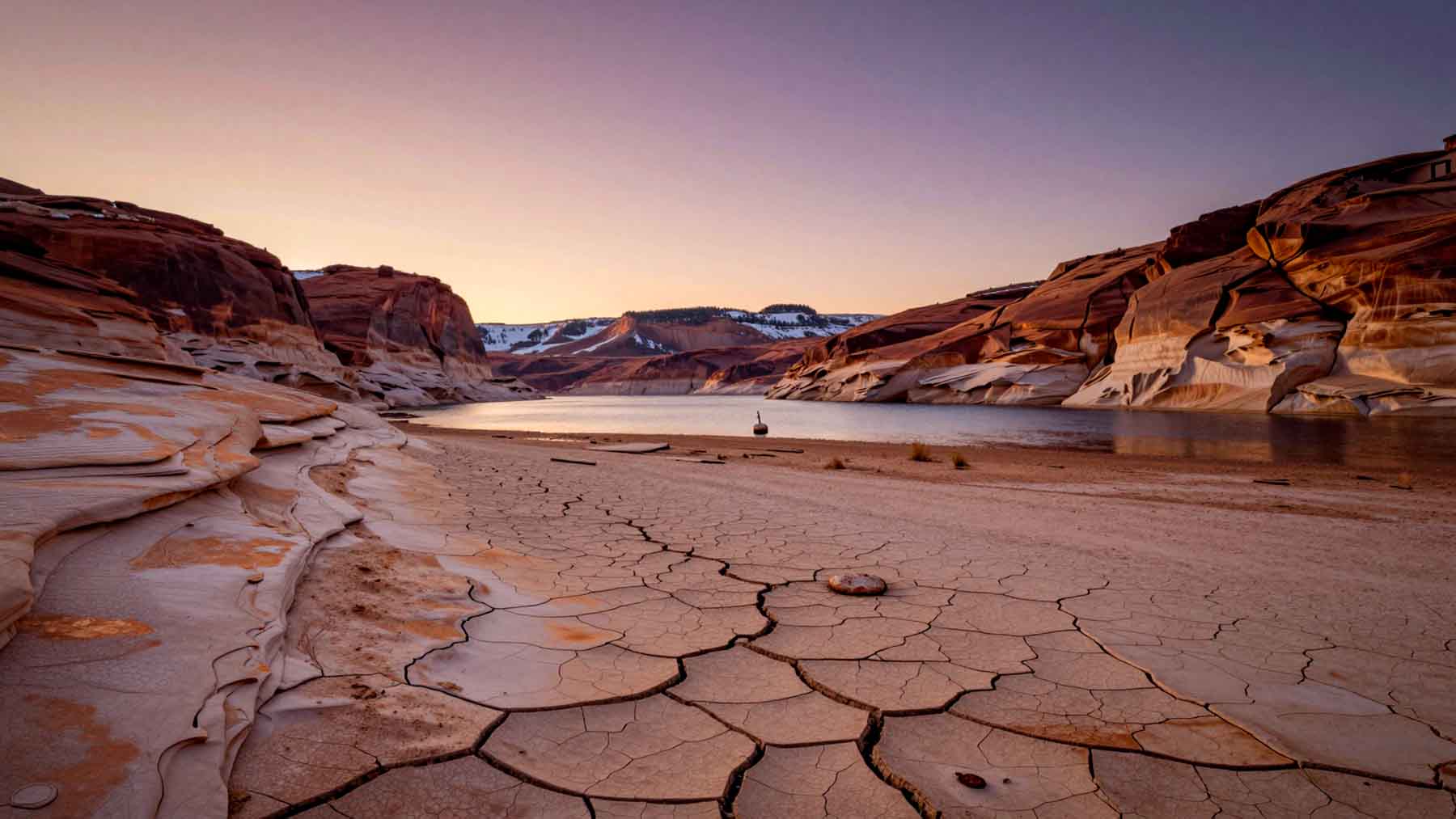 Image generated by artificial intelligence
The strongest El Niño pattern in recorded history is bearing down on the American West. Yet the Colorado River—the primary water supply for 40 million people across seven states—remains near its historic low.
For communities across the Southwest, a relentless storm season feels like an urgent lifeline. But climate scientists who have tracked this ongoing basin crisis warn that winter precipitation alone cannot resolve a structural deficit built over decades.
A river at its lowest—and a deadline no one can ignore
Lake Powell currently rests at 3,519.4 feet above sea level, while Lake Mead sits at 1,039.6 feet. Both reservoirs are hovering dangerously close to “deadpool”—the critical elevation where water can no longer pass downstream through dam infrastructure.
The river has been severely over-allocated for decades, with agricultural and municipal users drawing significantly more water than the natural system supplies.
The deadpool threshold for Lake Powell is 3,370 feet, while Lake Mead reaches deadpool at 895 feet. However, hydroelectric generation at both Glen Canyon Dam and Hoover Dam will stall long before water drops to those absolute limits.
Beyond physical water scarcity, political tensions are mounting.
The century-old compact governing Colorado River water allocations expires at the end of 2026. Basin states have repeatedly missed negotiating deadlines, triggering federal intervention.
The river has been severely over-allocated for decades, with agricultural and municipal users drawing significantly more water than the natural system supplies. As John Berggren, regional policy manager at Western Resource Advocates, noted, the long-discussed Colorado River crisis has fully arrived.
What El Niño actually does—and where it falls short
El Niño patterns do bring measurable moisture to parts of the American West. Berkeley Earth climate scientist Zeke Hausfather highlights wet winters across the southern tier—including Southern California, Arizona, New Mexico, and the Gulf Coast—as one of the climate cycle’s most reliable features.
For those Lower Basin states, a powerful El Niño brings genuine hydrologic relief.
However, the Colorado River system is not primarily fed by Lower Basin storms.
The river relies heavily on seasonal snowmelt originating in four Upper Basin states: Colorado, Utah, Wyoming, and New Mexico. That high-elevation snowpack supplies the vast majority of inflow entering Lake Powell and Lake Mead.
The relationship between El Niño and Upper Basin snowpack remains unreliable. Hausfather points out that during the strong 2015–2016 El Niño event, the Upper Basin received only average snowfall, showing modest correlation between ocean warming and mountain streamflow.
Rain falling in Phoenix does not refill Lake Powell. Geography remains the defining factor.
Why ‘record-strong’ doesn’t mean ‘record snowpack’
Current ocean indicators suggest this El Niño event could rank among the strongest on record. Climate scientist Daniel Swain of UC Agriculture and Natural Resources notes that a standard El Niño and an extraordinarily powerful event function almost as distinct phenomena.
At this magnitude, there is a real possibility that Upper Basin watersheds might experience above-average precipitation.
However, elevated precipitation does not guarantee an equivalent mountain snowpack.
Rising baseline temperatures across the West are changing how winter storms translate into runoff. Swain explains that incoming moisture is frequently absorbed by parched soils, evaporated into a warmer atmosphere, or delivered as rain rather than snow.
Consequently, recent wet winters generate far less reservoir inflow than equivalent precipitation events produced decades ago.
Even the best-case scenario isn’t enough
The mathematical reality remains stark. Climate experts agree that even a record-setting snowpack year would fail to erase the Colorado River’s cumulative deficit.
The systemic gap between supply and demand has compounded over a century. One exceptional season cannot restore missing reservoir storage.
Furthermore, global thermal trends compound regional dry conditions. Projected temperature increases threaten to accelerate evaporation, with climate models indicating Colorado River flows could decline by up to 30 percent by 2050 due to warming alone.
A strong snowpack year offers temporary operational space rather than a permanent fix.
As Berggren emphasized, a single heavy winter provides brief relief, but the underlying structural crisis immediately resumes.
What to watch next
The coming months will demonstrate whether mountain snowpack translates into meaningful reservoir recovery, testing both atmospheric predictions and regional infrastructure limits.
Yet the river’s ultimate trajectory depends far more on legal negotiations than storm tracks. The expiration of current operating guidelines at the end of 2026, federal mandates, and agricultural conservation targets will dictate long-term stability.
These realities frame the core challenge facing the West: Millions are counting on El Niño to save the Colorado River—but scientists warn a warmer world turns even record snowfall into a drop in the bucket.
While storm systems buy critical time, state leaders and water managers must use that window to restructure river management for an increasingly arid future.
Kelly is an experienced writer with 15 years of experience exploring the big stories that shape our world, from tech breakthroughs and space exploration to climate, energy, and the fascinating quirks of science. She has a talent for turning complex ideas into sharp, memorable insights that stay with readers long after they’ve finished reading.
