
Underwater microphones near Norway’s Hywind Tampen wind farm record sperm whales and killer whales amid turbine and anchor noise

Floating offshore wind power in Norway’s deep waters uses innovative methods to monitor potential marine impacts.
The Norwegian maritime energy sector remains heavily carbon-intensive, conflicting with climate mandates.
The nation is now actively decarbonizing this sector with deep-water renewable energy generation.
Mooring lines and anchoring systems also transmit acoustic noise through deep-water columns, potentially affecting marine biodiversity.
But these large-scale platforms pose potential risks to marine mammals like sperm and killer whales, requiring advanced evaluation.
Will hydrophones’ empirical sound recordings off Norway help guide sustainable offshore development?
How Norway has historically struggled with a carbon-heavy offshore energy footprint
The Norwegian maritime energy sector has remained highly carbon-intensive due to significant offshore oil and gas production.
Offshore drilling and extraction operations’ electricity generation relies almost exclusively on high-capacity gas turbines.
That is why these offshore platforms have exceptionally carbon-heavy footprints.
Their annual power generation produces approximately 11 million metric tons of greenhouse gas emissions.
This accounts for roughly 25% of Norway’s total national emissions.
Unfortunately, this massive offshore emission footprint directly conflicts with strict climate mandates.
Norway is legally committed to the Paris Agreement and its own Climate Change Act.
Under these acts, the nation aims to reduce emissions by 55% by 2030.
However, decarbonizing these deep-sea platforms has proven historically challenging.
Long-distance underwater cabling for mainland power transportation is financially limiting and technically difficult.
As a result, developers are turning to deep-water floating offshore wind generation to overcome these constraints.
But even the most innovative green energy solutions can still present ecological trade-offs.
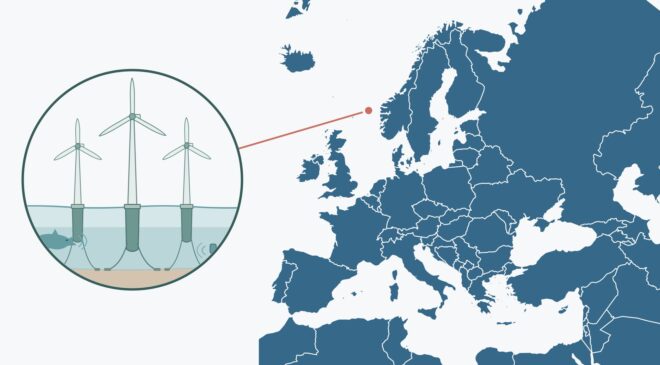
Making offshore fossil fuel extraction greener
The most practical approach to decarbonizing Norway’s maritime sector is deploying floating offshore turbines directly at sea.
These turbines can capture the deep sea’s stronger, more consistent winds, ensuring high-capacity output.
This, in turn, will provide massive volumes of carbon-free electricity directly near remote oil and gas platforms.
Consequently, this direct connection to the offshore platforms will eliminate the reliance on carbon-heavy gas turbines.
It will help offset up to 200,000 metric tons of carbon dioxide emissions each year, significantly boosting the green footprint.
However, despite these environmental advantages, utility-scale expansion could introduce new underwater concerns.
Active floating turbines generate ongoing mechanical vibrations, low-frequency subsea noise, and generator hums.
Mooring lines and anchoring systems also transmit acoustic noise through deep-water columns, potentially affecting marine biodiversity.
To determine these acoustic footprints, developers teamed up with experts at JASCO Applied Sciences.
The researchers deployed unique underwater microphones across the seafloor around Norway’s Hywind Tampen wind farm.
Monitoring acoustics underwater off the coast of Norway
The Hywind Tampen wind farm is a key site for ecological testing.
It is located about 87 miles off the Norwegian coast in the North Sea.
The facility consists of 11 floating turbines operating at depths ranging from 850 to 980 feet.
Specialized hydrophones were deployed to monitor their impacts on the deep waters.
Recording ambient marine and structural noise
Passive acoustic sensors convert subsea sound waves into electrical signals.
The devices use both multidirectional hydrophone arrays and single omnidirectional sensors.
They are anchored near turbine bases and mooring lines to continuously record ambient marine acoustics and structural vibrations.
The monitoring campaign was designed to capture seasonal changes in sound patterns over 13 months.
Periodic findings identified narrowband operational noise below 200 Hz. Mechanical rotation generated tones near 25 Hz and 75 Hz.
Vocalizations from sperm and killer whales navigating the wind farm zone were also detected.
Acoustic analyses indicated that turbine noise levels remained relatively low compared to the ocean’s ambient sound.
The operational acoustic noise did not exceed safety thresholds or trigger behavioral avoidance.
These findings demonstrate that floating wind can power offshore fossil fuel platforms without significant ecological trade-offs. Ultimately, the results provide a scientifically supported framework for Norway to accelerate its deep-sea floating wind expansion.

Anke Maree is a writer with a clear and engaging editorial style. Her work focuses on making complex topics accessible, informative, and relevant for readers across different areas of interest.
