
Floating wind turbines are moving into deep water, unlocking vast wind resources off the US West Coast, Japan, and Norway that fixed-bottom turbines can never reach
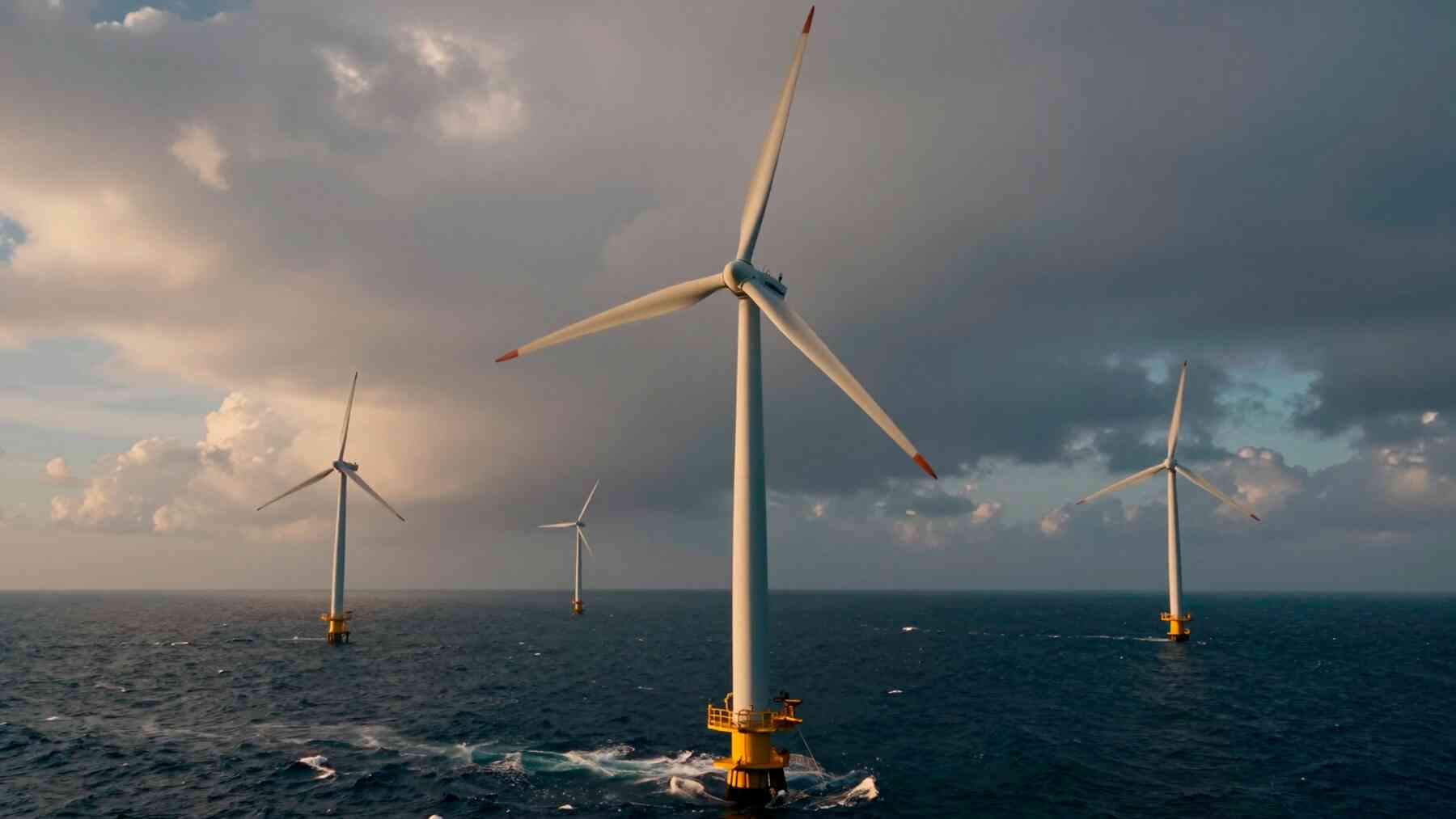
Most of the world’s best offshore wind resources sit beyond the reach of conventional turbines. Waters deeper than about 200 feet — along the US West Coast, much of Japan, and large stretches of Norway — rule out the fixed-bottom foundations that anchor today’s commercial wind farms to the seabed. Floating offshore wind was designed to change that. The technology has been demonstrated at small scale, and researchers say it could more than double the global offshore wind energy potential. But proven prototypes and commercial deployment are very different challenges — and the gap between them involves far more than engineering a bigger turbine.
Why depth changes everything for offshore wind
The 60-meter threshold is the dividing line in offshore wind. Below that depth, conventional fixed-bottom foundations — monopiles, jackets, gravity-based structures — become technically impractical and prohibitively expensive. That rules out enormous stretches of ocean sitting above some of the planet’s strongest wind resources. For countries like Japan and Norway, and for the entire US West Coast, the continental shelf drops steeply. Fixed-bottom wind isn’t a future option there — it’s a geographic non-starter.
Floating offshore wind (FOW) changes the equation by anchoring turbines to floating platforms rather than the seabed, opening access to deep-water resources that could more than double global offshore wind energy potential. FOW turbines have already demonstrated energy output comparable to fixed-bottom units. The remaining challenge isn’t whether floating wind works — it’s whether the industry can build it fast enough, and cheaply enough, to matter.
Spars, semi-submersibles, tension-leg platforms: supply chains can’t invest in tooling and capacity when every project might use a different configuration.
The engineering complexity behind a floating turbine
A floating offshore wind turbine isn’t simply a conventional turbine placed on a boat. It’s an integration of two deeply complex systems: a large wind turbine with more than 8,000 electrical and mechanical parts, and a marine floating structure designed to survive decades of open-ocean conditions. When the platform moves with waves and currents, the blade-pitch system must compensate continuously. Without sophisticated damping controls, platform motion can interact with the rotor in ways that amplify oscillations — a potentially dangerous feedback loop.
Below the waterline, mooring systems hold the platform in place while allowing enough movement to avoid structural stress. Dynamic power cables must flex with every wave without fatigue failure. Units of 15 MW and beyond are now in design, but scaling a floating system is far more complex than scaling a fixed one — every size increase ripples through platform geometry, mooring loads, and control architecture simultaneously.
From prototype to production: the industrialization gap
The floating wind industry today builds platforms essentially one at a time. That’s appropriate for prototypes but incompatible with the gigawatt-scale deployment needed to make FOW a meaningful part of the energy mix. The transition to serial production requires standardization — something the current diversity of platform designs makes nearly impossible. Spars, semi-submersibles, tension-leg platforms: supply chains can’t invest in tooling and capacity when every project might use a different configuration.
Port infrastructure is an equally pressing bottleneck. Floating turbines require specialized staging and integration ports with the space, crane capacity, and deep-water access to assemble massive components before tow-out. Those ports largely don’t exist yet. Experts project that FOW could reach cost parity with fixed-bottom offshore wind by the mid-2030s — but only if industrialization accelerates significantly, and soon.
Advantages that fixed-bottom wind can’t offer
Distance from shore is usually framed as a logistical problem for floating wind. It’s also a genuine advantage. Farms sited far offshore face fewer conflicts with coastal communities, fishing industries, and near-shore marine ecosystems. Deep-water wind resources also tend to be stronger and more consistent than those closer to shore — and that consistency matters for grid operators. More predictable generation improves reliability and can better match periods of peak electricity demand, increasing floating wind’s market value relative to more intermittent renewables.
What needs to align for floating wind to scale globally
Technology, infrastructure, and policy all need to move together, and right now they’re moving at different speeds. Stable turbine designs are essential — frequent changes undermine manufacturer confidence and delay the cost reductions that come with volume production. Grid infrastructure can’t be an afterthought either; offshore transmission networks and floating substations must be developed in parallel with wind farms, not retrofitted afterward.
Policy frameworks vary widely across the countries best positioned to benefit from floating wind. Auction design, permitting timelines, and port investment incentives all shape whether projects actually get built. Better coordination across jurisdictions — and more consistent long-term signals from governments — would help the private sector commit to the large upfront investments the industry requires. The technology has proven it can work. Whether the industrial and policy ecosystems will mature quickly enough to let it scale is a harder question entirely.
The complete article is available at: Robertson, A., Musial, W., Shields, M. et al. Considerations for the global commercialization of floating offshore wind energy. Nat. Rev. Clean Technol. 1, 734–749 (2025). https://doi.org/10.1038/s44359-025-00093-7

Carlos is an engineer with strong expertise in technical and industrial topics. He previously worked at international companies such as Siemens and is multilingual.
