
A California vineyard installs 43 vertical solar panels between grape rows without blocking harvesting equipment

A Californian hillside vineyard embraced an innovative solar panel design to address farming pressures.
The state’s agricultural sector is struggling to balance environmental challenges, rising energy costs, and crop yields.
The sector must also decarbonize under strict national climate regulations.
Can this strategy help California’s farms produce clean power while protecting valuable crops amid intensifying climate extremes?
To overcome these barriers, dual-use photovoltaic projects are being tested directly on working farmland.
Can this strategy help California’s farms produce clean power while protecting valuable crops amid intensifying climate extremes?
How a vital sector continues to face a long line of challenges
California’s economy is primarily sustained by farming.
The state generates more than $50 billion in annual agricultural output.
It also produces over a third of the nation’s vegetables and almost 75% of its fruits and nuts.
Unfortunately, this crucial sector faces immense, escalating pressures.
Accelerated global warming has triggered significant environmental challenges.
Prolonged droughts and extreme heatwaves are straining water supplies and surging groundwater pumping costs.
Electricity rates have also increased by over 80% in parts of the Central Valley over the past decade.
Together, these challenges threaten overall farm viability and crop yields.
In addition to these hurdles, the agricultural sector is also under pressure to decarbonize.
Farming operations, equipment, and irrigation pumps account for roughly 8% of California’s greenhouse gas emissions.
To achieve carbon neutrality by 2045, the sector must rapidly reduce emissions while maintaining high food production.
This can be done by accelerating the deployment of large-scale solar power.
Yet the solar energy and farming sectors have faced long-standing tensions.
The division between California farmland and solar power
The tensions between the two sectors trace back to a historic competition for flat, sunny, open land.
This is because standard utility-scale solar plants require vast, contiguous acreage.
As a result, fertile soil and productive farmland are often permanently displaced, causing land-use conflicts.
The loss of prime farmland reduces farm jobs, sparks fierce zoning disputes, and threatens critical food supply chains.
Furthermore, traditional solar setups shade out crops and block tractors.
This is why many growers view renewable energy growth as a direct threat to their livelihoods.
Hence, agricultural decarbonization has become deeply challenging.
Affordable, on-site green power generation is needed to cut emissions, but farmers cannot afford to lose valuable crop acreage.
Fortunately, innovative dual-use designs that let crops and solar panels thrive side by side can overcome this.
Groundbreaking vertical photovoltaic trials in California vineyards exemplify this innovation.
The national information hub, NCAT AgriSolar Clearinghouse, shares this practical case study.
Vertical photovoltaics in action at Livingvine Vineyard
Adopting solar power directly on vineyard sites has been challenging, but pilot projects are offering unique solutions.
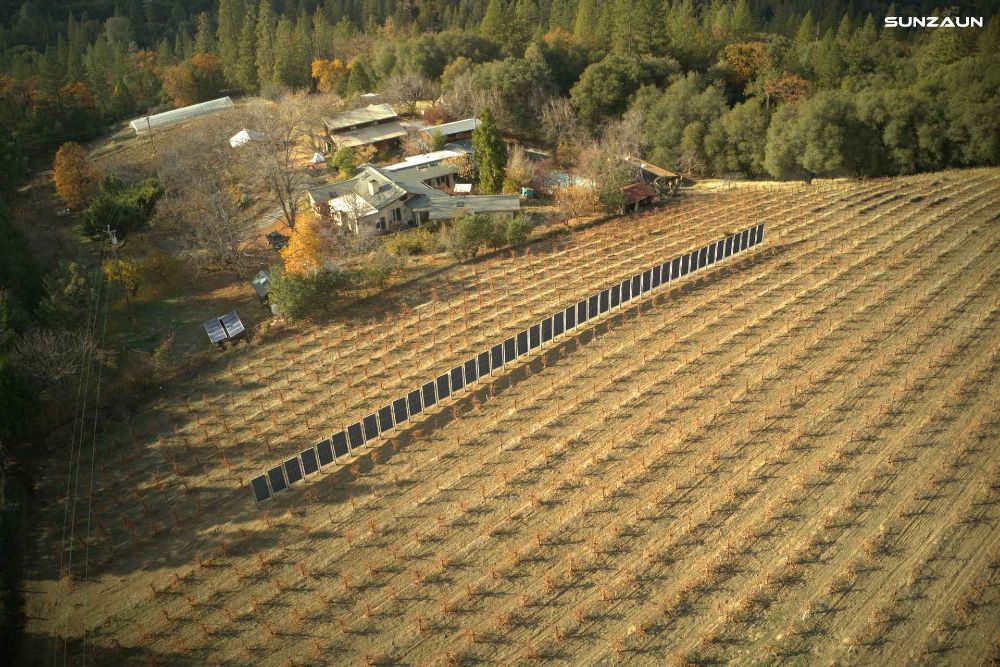
Livingvine Vineyard in Somerset, California, currently serves as a live research and demonstration site.
Sunstall installed the innovative Sunzaun vertical racking system directly between existing grapevine rows.
This dual-use system features 43 frameless bifacial modules mounted upright on single-post steel racks.
They form a narrow, 23-kW power-generating hedge, using minimal ground space while replacing standard end-posts.
Major operational benefits for the vineyard
Wide alleys remain clear, enabling tractors and harvesting equipment to move freely.
Zero acreage is lost to deploy clean energy infrastructure.
The bifacial panels face east and west, capturing sunlight on both sides, which maximizes power output during peak demand hours.
The panels also serve as windbreaks, protecting the vines from harsh heatwaves and reducing soil moisture evaporation.
The Livingvine dual-use system is currently operational, producing on-site power for irrigation pumps and farm operations.
This pilot project offers a scalable blueprint for other California growers.
It proves that solar arrays can integrate seamlessly into active crop rows without sacrificing yield.
Ultimately, by adopting unique solar-and-agriculture dual-use methods, both farmers and the energy sector can benefit.

Anke Maree is a writer with a clear and engaging editorial style. Her work focuses on making complex topics accessible, informative, and relevant for readers across different areas of interest.
