
Solar energy is expanding fast—but not always without a fight. As panels spread beyond rooftops onto open fields and meadows, public pushback has become a real friction point, slowing projects and complicating clean energy targets.
Now a different approach is quietly shifting that dynamic. Agrivoltaics—the practice of installing solar panels on land that continues to be farmed—appears to sit much more comfortably with the public than conventional solar parks. A new survey-based study from the University of Bonn suggests the gap in acceptance may be wider than expected.
The land-use dilemma slowing solar’s expansion
Renewable energy needs space—a lot of it. As solar capacity grows, developers have increasingly turned to open fields and meadows for large-scale installations. That shift has collided with something unexpected: public resistance rooted in a simple concern. People don’t want to see farmland swapped for rows of panels.

Citizens frequently cite visual impact and the loss of productive agricultural land as reasons to oppose open-land solar parks. That opposition isn’t just aesthetic—it creates real delays and political friction that can stall projects entirely, and for countries trying to hit clean energy targets, that’s a meaningful obstacle.
It’s precisely this tension that prompted researchers at the University of Bonn to ask a more nuanced question: does it matter how solar is installed on agricultural land, not just whether it is?
What agrivoltaics actually looks like on the ground
Agrivoltaics doesn’t replace farming—it layers on top of it. Panels are installed on land that continues to produce food, whether that’s a wheat field, a cow pasture, an apple orchard, or a vineyard. The setups can be surprisingly practical.
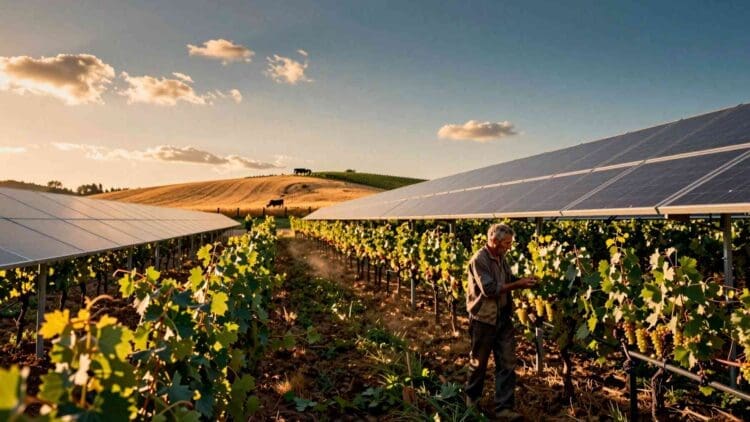
Solar panels mounted as canopies over grapevines or fruit trees do double duty: they generate electricity while shielding crops from hailstones and harsh sunlight. On wheat fields, panel rows can act as windbreaks, functioning similarly to a hedge or a wall. Cows graze in the gaps between panels. Crops still grow beneath them.
There are trade-offs. Yield reductions are a known and documented downside—less sunlight reaching the ground generally means less crop output. But in certain contexts, the dual-use arrangement creates genuine synergies rather than just compromises.
How the study was designed and who was asked
The University of Bonn team recruited nearly 2,000 adults across Germany for an online survey. Participants were selected to reflect the national population across age, sex, education, income, and region. Before answering any questions, they received balanced information about both agrivoltaics and conventional open-land solar parks, including advantages and disadvantages. This was intentional: the researchers wanted informed opinions, not gut reactions.
Participants were then split into three randomized groups. Each group viewed photo pairs showing a specific farming landscape—pasture, wheat field, or vineyard—with and without solar panels, alongside images of conventional solar parks in the same setting. They rated landscape attractiveness, recreational value, and whether they’d pay a price premium for electricity from each type of installation—or pay to prevent it.
A clear gap in public approval
The numbers tell a consistent story. Nearly 44% of respondents said they’d be willing to pay more for electricity generated by agrivoltaic systems. For conventional open-land solar parks, that figure dropped to just 29%.
The gap runs in the other direction too. Only 2.9% of participants said they’d pay to prevent agrivoltaic installations, compared to 4.8% for standard solar parks. That may sound like a small difference, but in policy terms it represents a meaningfully lower base of active opposition.
Respondents still viewed both types of installation as impairing the landscape. The perceived damage, though, was judged less severe when farming continued alongside energy production. As the researchers suggest, it may come down to a fundamental distinction: solar energy pushing agriculture aside feels different from solar energy coexisting with it.
Promise and limitations: What still stands in the way
The study’s lead researcher, Prof. Matin Qaim, is careful about what the findings can and can’t claim. Survey participants didn’t spend real money—the willingness-to-pay figures are hypothetical. Still, Qaim argues the attitudinal signal is meaningful and points toward a genuine difference in public perception.
The economics remain a harder problem. Agrivoltaic systems cost more to install than conventional open-land solar, and lower electricity yields mean investments take longer to pay off. Researcher Hendrik Zeddies, who grew up on a farm himself, is direct about it: without subsidies, widespread deployment is unlikely.
That’s the next frontier to watch. If policymakers treat agrivoltaics as a legitimate tool—supporting it through targeted incentives—it could offer a path to scaling up renewables without igniting the land-use battles that have slowed conventional solar. The technology already exists. The public, it turns out, may already be on board. What needs to catch up is the policy framework.

Kelly is an experienced writer with 15 years of experience exploring the big stories that shape our world, from tech breakthroughs and space exploration to climate, energy, and the fascinating quirks of science. She has a talent for turning complex ideas into sharp, memorable insights that stay with readers long after they’ve finished reading.