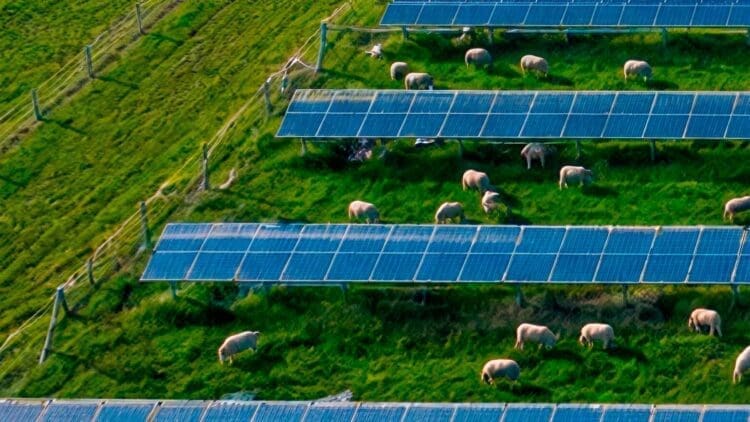

Texas has become the new face of agriculture and solar plants working together symbiotically to achieve true sustainability.
Global energy demand is surging. Digitalization requires constant, high-volume baseload power.
Rapid solar expansion is essential, yet it faces stiff public and industrial resistance.



But not everyone agrees.
Will establishing this new beneficial relationship between the two sectors help overcome this general resistance?
The digital thirst: Why our cities are starving for power
Texas’s “Texas Triangle” (Houston, Dallas, Austin) population is exploding, straining the ERCOT grid.
However, modern metropolises are all evolving into high-density digital worlds. This is raising energy needs to new peaks.
Globally, this surge is influenced by three main factors that make conventional grid management more complex.
For tech giants, data centers have become ubiquitous in urban centers. This is especially as the “cloud” continues to expand.
To ensure that these hubs remain operational, uninterrupted baseload power is needed for operations and server cooling.
One ChatGPT query consumes 2.9 watt-hours—nearly 10 times the 0.3 watt-hours of a standard Google search. This explains the consumption boom.
Grid infrastructure is aging. 70% of transmission lines in the United States are over 25 years old.
This is why the expansion of utility-scale renewable projects is fundamental.
Unfortunately, major cities have limited installation space.
But rural landscapes do not. This often leads to friction with agricultural communities.
The solar land war: Why rural communities are fighting back
Achieving sustainability in an AI-driven world is no easy feat. Especially with the skepticism surrounding solar expansion.
Farmers fear losing “Prime Farmland” status, a USDA designation for the most productive soil.
These lands have defined the economic and cultural identity of rural counties for many generations.
With the industrialization of the countryside, it feels like local wildlife is being displaced. Historical landscapes are being altered.
Concerns are also increasing about the loss of agricultural activity at solar sites.
Over 13% of solar projects displace active cropland, fueling the “food vs. fuel” debate.
Surrounding vegetation must be carefully managed to prevent “shading” and production losses.
Fuel-based mowing costs roughly $200–$500 per acre annually and emits heavy carbon.
And machinery has limitations. Fortunately, Enel North America has an affordable, greener approach.
The new woolly workforce of solar plants
Agrivoltaics development programs to promote solar growth are a growing innovation.
Enel North America deployed a biological “mowing” fleet across 6,000 acres of Texas solar sites.
This strategic shift toward a biological solution has significantly optimized the maintenance of over 700,000 solar panels.
Power pastures: Why 13,000 sheep are beating diesel machines
Mechanical mowers create “soiling,” where dust reduces solar panel efficiency by up to 7% month-over-month.
Sheep “prescriptive grazing” reaches 100% of vegetation under low-clearance trackers where mowers cannot go.
Additionally, the 13,000 sheep initiate a restorative cycle with their hooves that is changing the soil’s chemistry.
Instead of harmful chemical fertilizers, natural fertilization returns nitrogen and organic matter to the soil. This creating a self-sustaining loop.
The flock’s movement breaks up the hard Texas soil, initiating natural aeration and improving ground hydration. Seeds are also transported, increasing local vegetation.
The Texan agrivoltaic model demonstrates that meeting the energy needs of the digital age does not require compromising agricultural heritage.
13,000 sheep were combined with utility-scale solar plants. O&M costs are significantly reduced while soil health is actively restored.
This symbiotic relationship between the two sectors has the potential to overcome rural resistance and promote capacity expansion.
This creates “pollinator-friendly” solar, boosting yields for neighboring farms via increased bee and butterfly activity.
If 13,000 sheep can turn a power plant back into a pasture, why choose between energy and the earth?
Anke Maree is a writer with a clear and engaging editorial style. Her work focuses on making complex topics accessible, informative, and relevant for readers across different areas of interest.