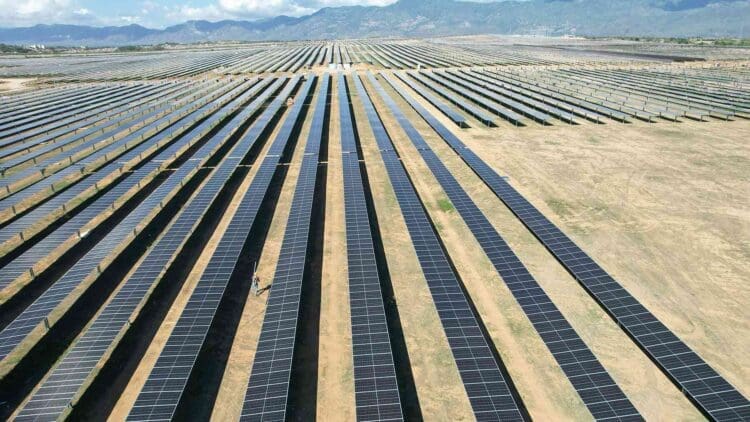

Hundreds of thousands of solar panels required moving the desert sand, which uncovered a 120-year-old mystery.
Worldwide, governments are rapidly building large-scale renewable infrastructure to meet urgent climate goals.
To complete the global transition from fossil fuels to clean energy, massive land developments are required.

However, transforming thousands of acres of untouched land can face hidden challenges.
What happens when a project in the desert collides with fragile ecosystems and buried history?
How the worldwide transition heavily relies on utility-scale solar
Global economies are being pressured to transition to low-carbon power.
This requires restructuring the energy sector.
The dominant drivers of global warming remain electricity and heat generation.
They account for over 30% of the world’s greenhouse gas emissions.
Consequently, strict international climate mandates demand rapid, permanent shifts away from fossil fuels.
Carbon neutrality can only be achieved by accelerating timelines to dismantle older infrastructure.
For example, Chile’s decarbonization plan entails retiring or converting coal-fired units.
To prevent major power grid deficits, immediate, large-scale clean energy replacements are needed.
This is where utility-scale solar infrastructure comes in. It provides the necessary capacity to bridge this growing energy gap.
It generates the massive, uninterrupted volumes of electricity needed by modern, digital economies.
Furthermore, hundreds of thousands of solar panels deliver clean power directly into grids at a competitive cost.
These are the reasons why Chile has deployed nearly 600,000 panels in the Atacama Desert.
Harnessing the solar panel potential of Sol del Desierto
Chile must evolve its energy sector as grid challenges persist.
The Atacama Desert is the ideal location for large-scale solar expansion.
The Sol del Desierto solar plant directly capitalizes on Earth’s highest solar radiation. It is located in the María Elena municipality of the Antofagasta Region.
The 244 MWp plant was built by Atlas Renewable Energy to accelerate the nation’s clean energy goals.
The plant consists exactly of 582,930 solar panels.
The panels use an advanced bifacial technology to capture direct sunlight while absorbing reflected light from the sand.
This technological optimization presents several benefits:
- Generates nearly 714 GWh of clean power annually
- Over 345,000 homes receive electricity from this output
- The project prevents 368,000 tons of carbon dioxide emissions annually
- Local employment was boosted, increasing female representation in the construction workforce to 15%
However, project development was not without obstacles.
At some point, a 120-year-old mystery was uncovered. Museo de Antofagasta became the official guardian of cultural heritage.
The forgotten footprints of Cantón El Toco
Moving the desert sand did not reveal lavish monuments or buried ancient tombs.
Instead, an intricate web of forgotten human movement was exposed.
The solar plant is directly above the historic Cantón El Toco region.
This desert zone hummed with immense industrial activity a century ago.
During the late 19th-century saltpeter mining boom, the area served as a crucial transit hub.
Mapping a dense network of historic paths and lines
Archaeologists outlined cart paths, old railway lines, and simple footpaths.
Remote mining offices were connected with work camps and crucial water sources, such as the Loa River.
The network eventually led straight to the shipping port of Tocopilla.
A total of 123 artifacts were uncovered, offering a look into the lives of desert workers.
The recovered items include historical pieces made of:
- Glass
- Metal
- Bone
- Stone
The Museo de Antofagasta officially assumed legal custody of all 123 artifacts.
The successful preservation of the artifacts proves that green progress does not require erasing the past.
Another key challenge was preserving the local wildlife, specifically, the lizards.
The desert ecosystem was prioritized by safely relocating and monitoring the populations before construction.
The Sol del Desierto project proves that true sustainability requires climate goals that respect local history and nature.
Anke Maree is a writer with a clear and engaging editorial style. Her work focuses on making complex topics accessible, informative, and relevant for readers across different areas of interest.