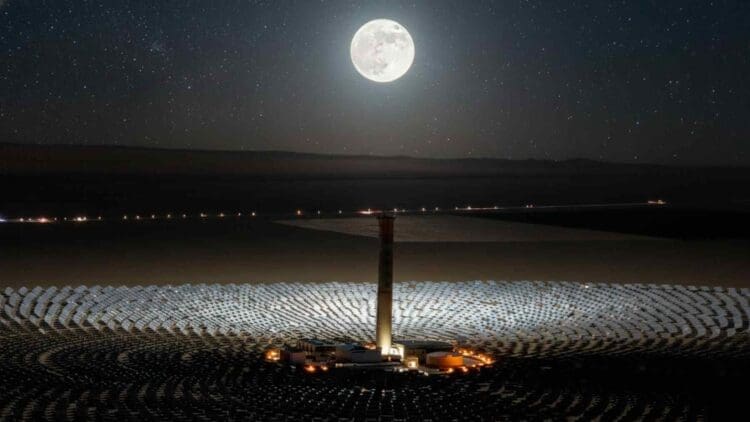
The United Arab Emirates is known for its wealth of crude deposits and the prosperity that oil has brought to the region. With the world now focused on reducing carbon emissions, the UAE has also committed to moving away from harmful forms of energy with a promise to install 10,000,000 solar panels, all concentrated in one region.
The oil-rich United Arab Emirates now has lofty clean power plans
The UAE government with its vast amount of financial resources is throwing its full backing behind a collaborative solar project involving state-owned utilities company EWEC (Emirates Water & Electricity Company) and Masdar, a relatively new player on the renewable energy scene.
Already, construction crews are breaking ground on a carbon-free project that ironically is being funded by the country’s fossil fuel profits. It’s a solar power endeavor, but the true innovative value will come from underground.

Aside from the ambitious target of installing millions of panels in one location, the project will also solve what has become the biggest obstacle in solar power – consistent output for all hours of the day and night. If it’s successful, this installation may well become the flagship for other countries to model.
A new center of clean energy driven by innovation and sustainability in the Arabian East: Masdar City
The UAE has ambitious climate goals, with the primary one being achieving net-zero carbon emissions in 25 years under its Energy Strategy 2050. An interim goal is increasing renewable energy capacity from the current 10% to 30% by 2030.
The United Arab Emirates still relies heavily on fossil fuels, but the government is fully committed to its sustainability ambitions. A “green” city of 15,000 people located southeast of the capital of Abu Dhabi called Masdar City is proving that even the most concentrated urban environments can become hubs for sustainability.
The region is a brilliant example of sustainability for these reasons:
- It was built using recycled items and materials, with a target to recycle 96% of waste.
- The city has zero traffic congestion due to the autonomous Personal Rapid Transit system.
- Masdar hosts the headquarters of the International Renewable Energy Agency (IRENA).
- All power consumed is generated by renewable means.
Power all day and night with 10,000,000 panels and a storage system to set a new benchmark in solar
Eventually, Masdar City became an esteemed organizational partner of the Arab Green Summit, setting a good example for other nations to follow. However, there’s another major feature of this fresh installation that makes it special: the capacity to release electricity 24 hours a day.
During Abu Dhabi Sustainability Week a year ago, it was announced that newcomer on the energy scene, Masdar, planned to construct a 5.2 GW solar panel facility integrated with a battery energy storage system capable of powering 800,00 homes. This storage feature is what will enable electricity to be supplied during nighttime hours, which has historically been the greatest shortcoming of solar systems to date.
Construction of the mega-facility officially commenced in October last year, and predictions indicate that it will be fully completed by next year. According to the official Masdar website, once the facility goes live, it will produce 1 GW of uninterrupted clean power day and night.
This isn’t an outlandish figure, as nearly 35 square miles of the desert will be covered by between 8 and 10 million solar panels. To increase efficiency, each panel will be controlled by tracking systems. A facility of this scale requires substantial funding, which has been estimated at $6 billion.
This titan undertaking, if successful, will prove that lithium-ion batteries can perform on a large scale, potentially inspiring other regions with year-round sunlight to follow suit. Of course, as the demand for lithium increases across various sectors, supply chain issues could become the new hurdle to overcome after solving the 24-hour output problem.
Disclaimer: Our coverage of events affecting companies is purely informative and descriptive. Under no circumstances does it seek to promote an opinion or create a trend, nor can it be taken as investment advice or a recommendation of any kind.